

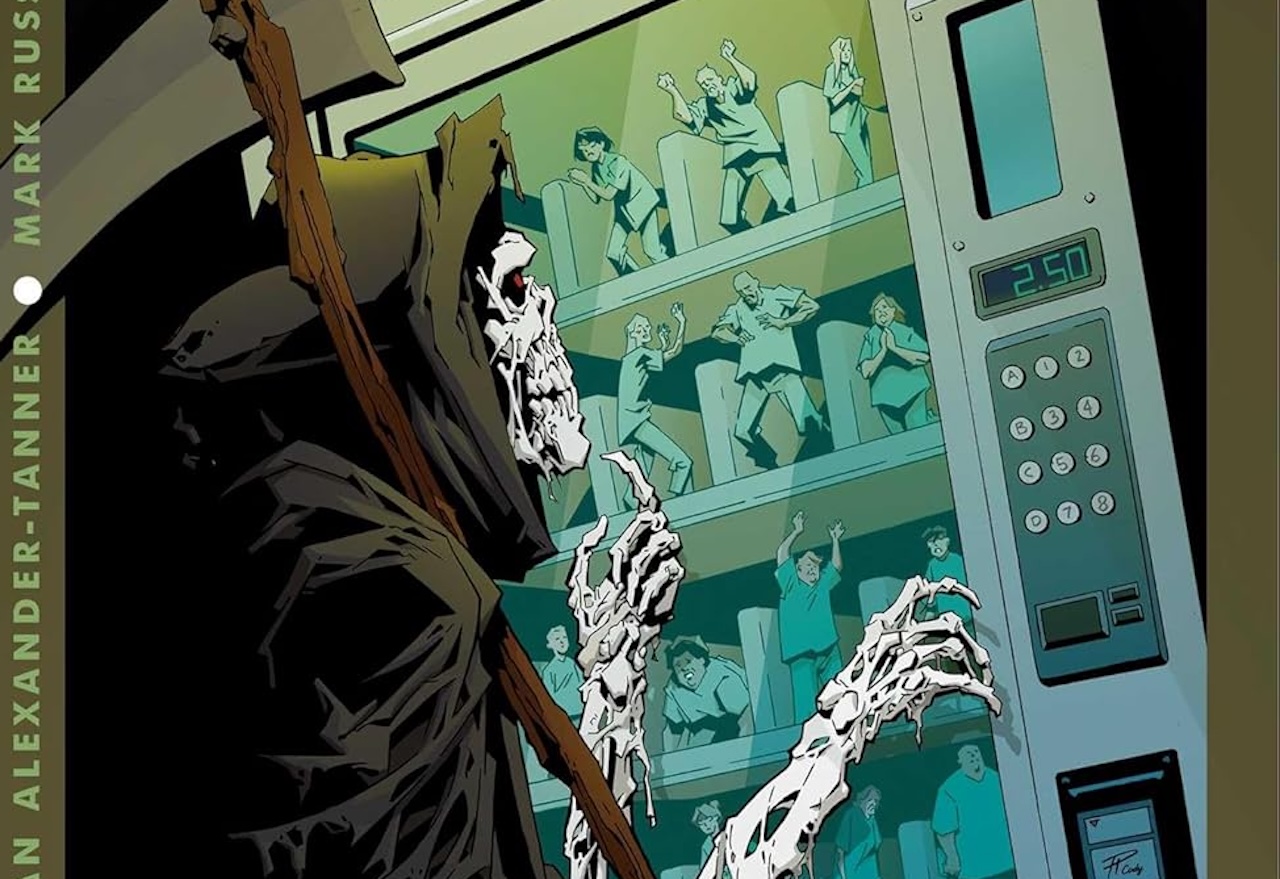

Popular writer Mark Russell has been putting out an interesting mini-series called Vanishing Point with publisher Mad Cave Studios. A six-issue anthology, each issue contains its own short story billed as part science fiction and part existential horror – with a twist that isn’t the point of the story, but the starting point to ask what it means to be alive. So, in a sense, it’s kind of like The Twilight Zone, but anchored more firmly within the science fiction genre. Since I’m always interested in comics that make me think deeply about life, I wanted to give it a shot.
I’m just a little late to the series – issue #5 comes out on the first of October. Let me start with short, spoiler-free, break-downs of the first four installments, before I give a brief review of #5.

Courtesy of Mad Cave Studios
Issue #1 – with art by Juan Doe – tells the story of a man on a ten-year mission in space, harvesting rare earth elements from asteroids. Doe’s art makes it all look like a Star Trek: Lower Decks cartoon in a parallel universe. From the get-go, you’d assume Russell explores themes of isolation – separation from family and loved ones. But he actually asks how far you’d be willing to go in order to ensure financial security for yourself and your family. And he wonders what consequences those decisions could have on your life – especially your mental health.
Issue #2 – drawn by series co-creator, Ryan Alexander-Tanner, with colors by Sydney Davidson – is a spooky slow-burn driven by the art. Russell and Alexander-Tanner seemingly want to explore the possibilities of life in a perfect future world – cleverly presented as a parody of The Jetsons cartoon. While everything seems perfect, something is always just a little off. Unfortunately, in the end, the creators never make any defining statement on their themes.
Issue #3 – with Alberto Ponticelli on art and Ellie Wright on colors – turns to the topic of evolution. The creative team imagines the far, far future in the year 6219 CE, exploring how things have evolved, what has changed – and more importantly what hasn’t. It seems to contemplate to what extent survival could be the guiding principle of life. But, like issue #2, although Russell introduces plenty of ideas, they never coalesce into anything final.

Courtesy of Mad Cave Studios
Issue #4 – with art by Jok – is by far the best of the series so far. In this story, a robot is suspected of having gained sentience – gained Life with a capital L. If the robot is proved to be sentient, it will be incinerated. However, in a cruel sense of irony, the test to prove it isn’t sentient entails mindlessly following orders to kill itself. Chris Weston’s incredible cover art summarizes the whole setup so wonderfully.
In this issue, Russell finally delves more thoroughly into what it means to be truly alive – what separates the sentient mind of a living being from the programmed mind of a non-sentient robot. Maybe I’m just a sucker for the sentimental, hopeful themes underscored by the more positive twist. Maybe I shouldn’t expect optimism and hope in a mini-series promising existential horror. But there is something beautiful and meaningful in the way Russell defines Life in this issue.

Courtesy of Mad Cave Studios
Which brings me to the newest issue – with art once again by Ryan Alexander-Tanner and colorist Sydney Davidson. Unfortunately, Alexander-Tanner’s interiors don’t match the quality of the cover art by Phil Hestor and Ryan Cody. Instead of the spot-on Jetsons parody of issue #2, the art here is simply generic, indie-comic cartooning style; not bad, but nothing above average. I suppose the cartooning-style stands in juxtaposition to the very dark themes, but I’m not sure it works completely on that level.
Be warned, the topic of this issue is quite dark: suicide. And Russell does ask intriguing existential questions that had me thinking. Why attempt to keep people alive who don’t want to be? Why should we go on living, if we’ve lost everything of worth in life? Is there something fundamentally worthwhile about being alive?
The protagonist and his contemporaries at first seem to be patients in a heavily and cruelly guarded mental hospital of the future. But the creative team places deliberate reveals throughout the story, slowly disclosing the truth of the protagonist’s situation. The final twist, made a little too obvious by the preceding foreshadowing, makes this issue the most Twilight Zone-like of the series.
Although this issue did make me think seriously about why it’s worthwhile to keep suicidal people alive, like the first three issues, I don’t think Russell and Alexander-Tanner go deep enough into these existential themes.
If only a promising solicit and great cover art were enough to make a great miniseries. But so far, only the excellent fourth issue has really inspired me to think more deeply about what it means to be alive. The other issues just don’t dive deep enough into their themes and end up not really saying anything aspirational. It’s best to think of Vanishing Point as a sci-fi Twilight Zone anthology, with very clever twists that may or may not be thought-provoking. And while the interior art has generally been above average – with the exception of issue #5 – the covers have really been the best images of the series. Hopefully the sixth and final issue will follow in the footsteps of issue #4 and bring Vanishing Point to an inspiring conclusion.




You must be logged in to post a comment.