

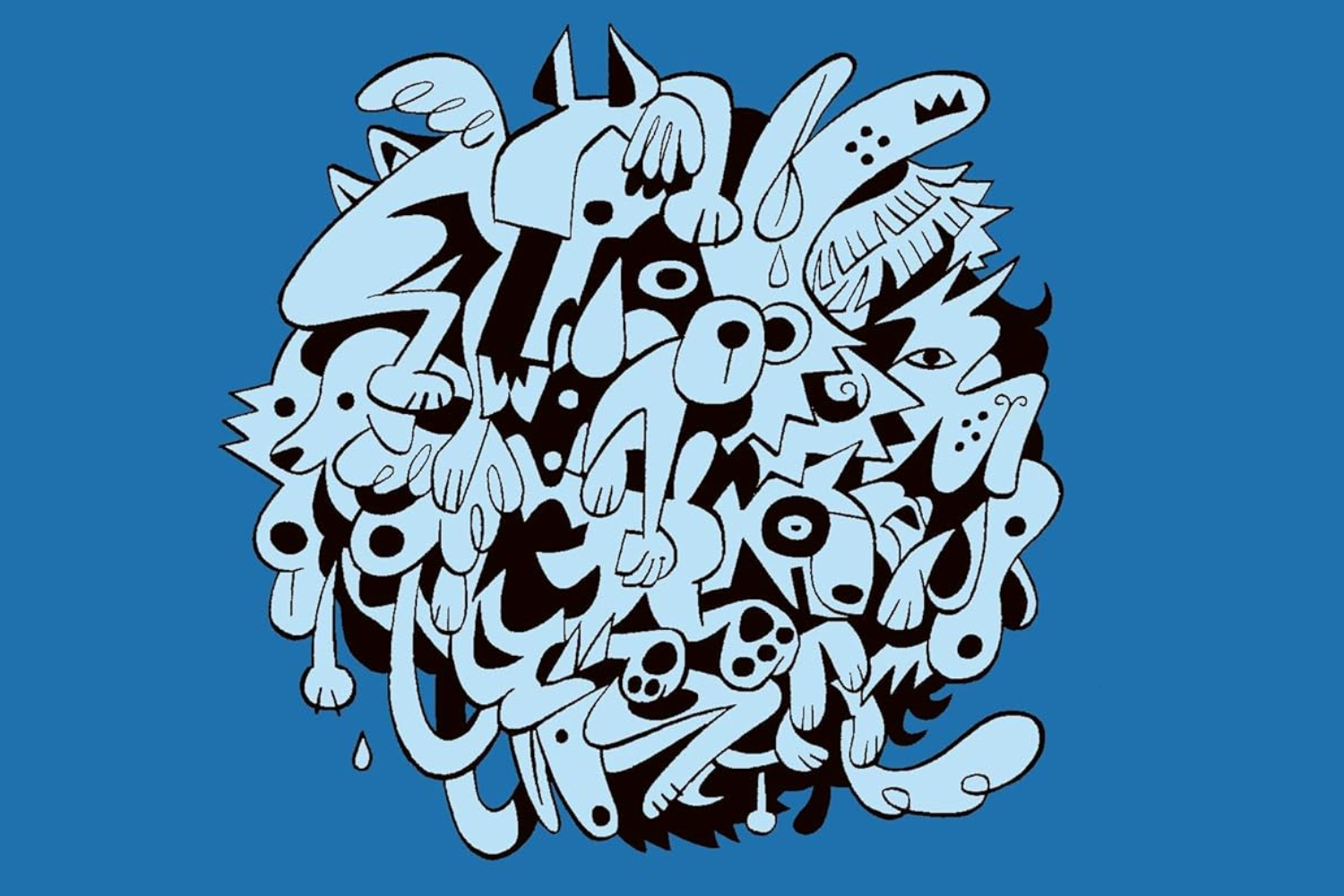

Everything about Dogtangle is ultra, mega weird.
On paper, it’s as if writer/artist Max Huffman tried to make the most specific and peculiar book imaginable. If the title itself didn’t already befuddle/confuse you into a stupor, there’s the book’s premise:
“Dogtangle opens with a town hall meeting in a Taco Bell nestled in the bland corporate environment of Business Park. A man [Vernon Smilth], bleating to anyone who will listen about the evils of current zoning laws, meets a woman [Caressa Vignette] who works in pharmaceutical marketing. They begin a relationship. They get married. From their union springs the idea of the Hypermutt: a many-headed mass of dogs that absorbs each new dog it encounters.”
If you’re still with us, then there’s the matter of Huffman’s art style. Here, the Chicago-based creator leans into some heady influences to craft a world that’s equally manic, bizarre, and unruly. It’s abstract art if it also had the gumption to huff industrial paint and start fist fights, but I’ll let Huffman share some actual insight.
“I’m always looking at a lot of mid-century and early 20th century magazine illustrations and cartoons, like New Yorker-style cartoons,” Huffman said during a recent Zoom call. “I’m also always looking at a lot of fine art and modern art and German expressionist stuff. Like, Der Blaue Reiter is really big for me.”
So, yeah, totes involved and weird and demanding all the live long day. But at one point in our hour-long chat, Huffman said something that resonated fully and completely. A quick like idea that, while seemingly innocuous, cuts to the heart of what makes Dogtangle generally special and undeniably essential for comics in 2025.
“I’ve heard a lot of people say that my art is difficult or it can be hard to parse or is abstract or hard to follow,” Huffman said. “It’s pretty manic. I think the pacing can throw people off — it’s very ‘go, go, go.’ It’s going to be hard to find a foothold or the rhythm of it.” He added, “I like the way I write and draw and make things, but I definitely want everything to be legible.”
There is: Through the sheer madness, the intellectual heft, and the art that demands your enthusiastic participation, Dogtangle is one man’s deeply human expression of living your life through art and trying to make a connection (any damn connection) in this day and age. Dogtangle is a plea to not get bogged down in the details and instead embrace the frenetic, sometimes ugly truth of life.
Kooky and intense are never “bad” qualities; they’re indicative of a lovelier humanity.
Love and Synergy

Courtesy of Fantagraphics/Max Huffman.
Fittingly enough, this whole thing started because of one especially human expression.
“It was actually one crystalline moment or encounter [of inspiration] for me…in 2021, when I went to Palo Alto for a wedding,” Huffman said. “The whole Silicon Valley is beautiful, lush landscapes, and then just extreme spiritual hollowness.”
While having to live that tech bro life for a weekend, Huffman took an Uber – from an older man named Vernon. And during their brief time together, ol’ Vernon shared a rather intimate story that later informed the core of Dogtangle. (Oddly, that core is not, like, a Pug or Labradoodle.)
“He told me about how he and his wife, over a span of 20 years, adopted, like, 30 dogs,” Huffman said. “And I was like, ‘These numbers are crazy.’ Then he told me that when all these dogs died, he kept their cremains in these ornate wooden chests in a walk-in closet. Every day he would go in and commune with the dog boxes. From there, it was like a hop, skip, and a jump to, ‘Let’s take that just one step further and have them all be one crazy dog and have this be a love story.'”
In turn, Huffman uses Dogtangle in his own heartfelt expression. Not one of loving too many people perhaps too deeply, but one about trying to let go and do something equally as bold and life-affirming (in his own way).
“The human element, or trying to have an emotional dimension to it, was a conscious decision from the jump,” Huffman said. “This is my first long-form book – I’ve done a lot of comics, but they’re all silly and short and mean. Like, I wanted to make a comic that has a love story or a romance element that’s about two people and not ciphers or a single protagonist. I wanted to do a comic that has children in it because I’ve never done that before. I want to actually try and be a writer for once – I’m still working on it.”
As an extension of that work, Dogtangle is also indebted to other, more “accessible” influences and references. These are creators that Huffman believes did something utterly personal and also quite revolutionary, and that’s ultimately how you fully embrace life.
“One thing for Dogtangle, I was looking at Lynd Ward’s Wild Pilgrimage. That, and Frans Masereel, who similarly was doing more geometric stuff,” Huffman said. “These guys made these wordless picture novels out of woodcuts that I found relatively recently in the grand scheme of things. It blew my mind that there’s such clear, beautiful examples of graphic novel tradition, or the comics tradition, and they’re not discussed at all as part of the canon. And I think that a lot of my profound artistic experiences in my life have been finding things like that – like, ‘Oh, shit, there’s this missing puzzle piece of human communication.'”
An Unruly Strike of Brilliance

Courtesy of Fantagraphics/Max Huffman.
When he first started creating Dogtangle – which was originally “going to be a corporate kidnapping mystery — and then that pretty quickly went off the rails” – Huffman followed the story out of this surge of passion and yearning for communication. This drive was so intense, in fact, that he didn’t even bother with “traditional” publishing approaches.
“I was self-publishing these little 12-page zines and keeping myself interested and excited and just trying to keep it going,” Huffman said. “When I did the first issue or first chapter, which is the baby blue portion, it was a moment I had just moved into a new apartment; it was my first time living alone. I had gotten this black and white laser printer. I did the first two back-to-back really fast. By the end of the second one, I was like this could actually be my first long-form narrative.”
But for Huffman, the 136-page final story isn’t just about trying to be a more inventive, daring creator. It’s also a way to work out certain anxieties and other trauma from the last few years. Creating something compelling only goes so far, and the real challenge is breaking through your own humanity to find the nugget of truth in the “Dogtangle” of daily life.
“It was lot of COVID anxiety at the beginning of the book,” Huffman said. “And it was a lot of watching where I was living – in North Carolina and the Research Triangle area – changing. Google was moving in and Apple was moving in. All these tech folks were coming to town and driving up rent. During the making of the book, I moved because Chicago became cheaper than Carrboro, North Carolina. It was a lot of looking at my own anxieties and discomfort with things in the landscape.”
In some ways, this discomfort came at a time when it was nearly impossible to meaningfully express it with other folks. And so Huffman found the “narrative” in his head growing all the more layered and complicated.
“The other thing that definitely contributed was…2021 was when the crypto and NFT stuff really started,” Huffman said. “Both were these environmentally destructive things. And then we were all inside these digital rooms about it – all this directionless, righteous anger. Then that crypto and NFT stuff was supplanted by AI/AI art, which is even more environmentally destructive. That ended up getting reflected in the book where it’s this ballooning capital pursuit that actually does ruin the world.”
So you’ve got the deeply personal – that’s Vernon and Caressa coming together to make their horrific “Hypermutt ” – which quickly spirals out of control (that’s the absurdity). Two sides that coalesce into one great story, a melding of the intimate and existential into something that’s bigger and more engaging than any of its themes, influences, etc.
So, how does Huffman actually do it?
A Future of Fools

Courtesy of Fantagraphics/Max Huffman.
Well, Dogtangle is a compromise of sorts. It’s about what happens when the technocratic elite get their chance to doom the world, but it’s also very much about something more within these people. Who are they really, and why do they do the things they do?
“I was also exploring the levels of irredeemability or villainy,” Huffman said. “Vernon’s just obnoxious, but he’s righteous and he has this civic sense of duty. Then Caressa is totally just this disruptor technocrat oligarch. She was inspired by the Elizabeth Holmes model. And then [also] Elon Musk, and presenting as a creative person but really just being of the executive class. This ideas that she’s like a genius wunderkind, but she’s really just a girl-boss monster.”
When the pair eventually come together, they end up “birthing” this horrific thing, and that’s certainly got something to say about not only NFTs but the rising scourge of AI. But Huffman also humanizes the pair, adding layers to what they’ve done and how they move through the world. This move doesn’t necessarily vindicate either, but instead it speaks to the idea that these are still people, and reconciling that is an important function of telling stories and living life.
“A point of fascination is…loathsome and irksome people do find love,” Huffman said. “You’ll meet the most annoying couple you’ve ever met and you’re like, ‘Holy shit, these people found each other, and that’s beautiful.’ And especially as someone who’s spent long stretches feeling on the outside of that, it’s simultaneously encouraging and also infuriating. The first parts of the book rushes through that relationship, and then they’re separated for the rest of it. It doesn’t matter how craven or pretentious these people are – it’s what makes the world go round.”
Or, to extend this notion a bit further, even the worst of us must sometimes struggle between perception and reality. (Still, only some of us mash dogs together to address these feelings.) We are all locked in this rat’s maze, the lovely and the techno-elite alike.
“I don’t know that the book really successfully explores this, but this idea you have of yourself and how you present it,” Huffman said. “Like, Vernon has that crazy barrister wig, and then what you actually are and what you are doing and how those contrast.”
Even calling this satire doesn’t necessarily work in a few key ways.
“I wasn’t like, ‘I’m going to make my grand satire,” Huffman said. “And I don’t think that I did make a grand satire.” He said that he’s “definitely resistant to a lot of the more heavy-handed approaches to that kind of larger commentary.” At the same time, he was afraid of “going too far in the other direction, and being too vague or too ambiguous. I definitely wanted it to be interpretive.”
So, to do just that, Huffman relied on the most interpretive source of ideas/inspiration imaginable.
“I process everything in my life usually through comedy or dreams or whatever,” Huffman said. “So a lot of the book came from images or bits or dreams.”
Then it became a “simple” question of translating that approach into something more tangible.
Gambling on Mutts

Courtesy of Fantagraphics/Max Huffman.
The solution? Chipotle signs. More specifically, Dogtangle puts on a masterclass in using plot and visual elements or ideas to foster satire (or something thereabout). The aforementioned signs are often barely visible, or their larger significance is obfuscated. But then maybe that’s the point all along – it’s about balancing the absurdity as a tool for poking at the weird/dumb/needless things we do as a collective, and then making us consider the whole darn system.
“With the Chipotle logos and stuff, there’s this thread through the book of gentrification cities [now] changing,” Huffman said. “It was like a kind of visual gentrification. You see a Chipotle later on, and then the Chipotle building is knocked down and there’s a nicer Chipotle inside it. I’m always airing on the side of not holding the reader’s hand. I think it can be alienating, but ultimately it’s a product I can respect more.”
But just as quickly as he explores gentrification in Dogtangle, Huffman will then swerve and deliver a bizarre medieval section that interrupts the story flow and makes you reconsider what’s really going on.
“I wanted to do something different now,” Huffman said of this dalliance. “The medieval chapter was a personal favorite for me, at least while I was making it. I was doing a lot of reference and studying that I didn’t do up to that point.”
The same goes for a bizarre moment in a hallway between Vernon and a wacky neighbor in search of the recycling bin.
“There definitely were parts, like that hallway sequence, that I wanted to slow it down,” Huffman said. “All of the movies I like are that kind of manic energy, so I just wanted to keep momentum over almost everything, especially [since] that’s how I was drawing it.”
Then, there’s one of my favorite sections: a chapter from within the hypermutt itself. On the surface, it’s odd and funny, emphasizing the great wit and humor in this book. (There’s a separate gag about Black Forest ham that’ll leave you in stitches.) It’s also how Huffman doesn’t just satire the elite, but further pokes and prods his reader, and gets us all thinking about the sheer absurdity of these concepts and what we’re meant to actually do about it.
“The chapter inside the dogtangle was definitely also just a week-long experience of pure drawing,” Huffman said. “The big gag in that joke is that it’s referencing the dogs playing poker painting. When they’re playing cards, it’s all amorphous Rorschach blobs – dogs are colorblind. There’s also no numbers, ’cause dogs can’t read or interpret symbols.”
Even the fact that this book is broken up into singular-but-connected chapters – as if everything could be its own solo story – is important. It’s about accessibility and momentum, yes, but also about speaking to something deeper. Some place beyond “traditional” satire and similar approaches, where emotions and ideas feel more vital.
“I was fascinated by comics that were serialized and that became graphic novels – like a Velvet Glove Cast in Iron,” Huffman said. “Each chapter stands on its, but they’re also laying scaffolding that, when it’s collected, you can’t imagine having one part without the other.”
Added Huffman, “Or, there’s the experience of being a kid and picking up some random new issue of a superhero comic, and from that comic, it gives you exposition that forms an idea of the entire run that ends up being true or false. I think there are definitely parts of [Dogtangle] that are more successful at being standalone stories and parts that serve to actually develop the plot.”
Here we arrive ever close to the book’s core: Being young and building your own stories to sort out the darn world.
Throughout the course of Dogtangle, we’ll encounter (with some frequency) a young boy named Simon who exists on the Vernon-Caressa periphery. He’s odd (that’s on brand, yeah?), but also quite charming/endearing, and he’s the heaviest poke or prod of humanity in this book. It’s his presence that really cuts through the noise of Dogtangle in a vital way.
Raising The World

Courtesy of Fantagraphics/Max Huffman.
Getting to write Simon didn’t just check off an aforementioned creative box for Huffman. It let him get to the heart of even deeper emotions and anxieties (even beyond recent COVID “worries.”) It’s a strange route, indeed, but it certainly works for Dogtangle.
“One of my goals in writing the book was to have a child character and then examine where I was at that time in my life at 10 when my parents were getting divorced and I was this odd, precocious, unkempt child mostly along for the ride,” Huffman said. “You never think that what’s happening around you is strange when you’re a kid or when you’re growing up like that.”
If you’re thinking that’s just clearly sweet and/or wonderful, just wait a little longer.
“And then I wanted to, without getting into too much spoiler territory, just do a time jump and have this character be an adult,” Huffman said. “And they’re processing their own childhood and looking back and doing the same thing that I was doing and see what their reality was really like. At the end of the book, Simon encounters a child clone and [acts as his] own adult figure.”
Sure, lots of folks have written about their messed up childhood. But in Dogtangle, it’s not just about trauma – it’s the through-line for this whole dang experiment.
“I definitely wanted to have those emotional themes to center everything around,” Huffman said. “And one of those was parenthood. In the way of non-traditional parenthood – Caressa and Vernon are parents to the Hypermutt. Simon’s parents are out of the picture, and they have this surrogate parent figure in Ermine. And then, obviously, you have Vernon’s mom throughout the story, and he’s a mama’s boy and that’s a very traditional parental role. I just wanted to have those relationships really running throughout and anchoring down all the personal character arcs.”
Because Dogtangle is, ultimately, a book that’s not only relatable under its uber weird core, but it’s hauntingly affective. You can explore all sorts of political themes and critiques on modern capitalism/consumerism. You can also see how pushing the confines of art makes for utterly engaging stories that force us to connect at this book’s given pace and inclination. And you can even wonder at the absurdity of being alive with a hearty chuckle and a shiver of fear.
Mostly, though, you have to make one important realization: This is life, and it’s just going to keep right on happening.
“I had this coda in mind where we’d see all the characters and where they’re – some of them are content with their station and some of them are prisoners and facing the consequences of the plot,” Huffman said. “And poor little clone Simon is just moving through this ruined world. It’s definitely not a happy ending, but it’s just like, ‘Time marches on.'”
All Ego, Big Love

Courtesy of Fantagraphics/Max Huffman.
Whether you can appreciate that or not, Huffman’s just happy he came up with any thing at all.
“I was thrilled just to have an ending,” Huffman said. “I’ve made a lot of comics that just stop or hit a wall.”
Based on that rather important change, the march of time has clearly been good for this artist. Sure, he still has his doubts and worries, like if people can appreciate his art. Or, if he can continue to find the tone and approach that satisfies his personal vision. In some important ways, Dogtangle is not only Huffman’s debut but a coming out party of sorts.
“I feel like I’m just cooking from a 30-year education in different traditions and the histories of art and illustration,” Huffman said. “It’s all been thoroughly absorbed and processed, and there’s been long periods where I was overly beholden to one influence or another. My hope is that I’m out of that tunnel now and synthesizing everything in a unique way.”
And self-confidence isn’t just something to feel all warm and fuzzy over. No, it’s how this weird but wonderful, wacky but accessible book is going to have even a fighting chance in the comics marketplace. Huffman certainly believes in it – he knows it’s a bonkers-ass product of his singular imagination, but there’s far too much heart, intent, and humanity for it to be ignored. And even if you personally can’t find the conceptual value in this story, be sure to let Dogtangle absorb you regardless.
“Maybe it’s egotistical, but I am suffering under the delusion that this is a book that could speak to a wider swath of folks than just diehard alternative comic fans,” Huffman said. “It’s hard because it’s not a book with…an easy elevator pitch. But it’s a funny comedy; it’s a sci-fi story; and it’s about processing our current landscape. I think if people enjoy engaging with that in movies or TV or other comic books, they should give it a shot. And maybe they’ll enjoy just looking at the pictures and drawings, too.”
Dogtangle is due out November 4 from Fantagraphics.



You must be logged in to post a comment.