

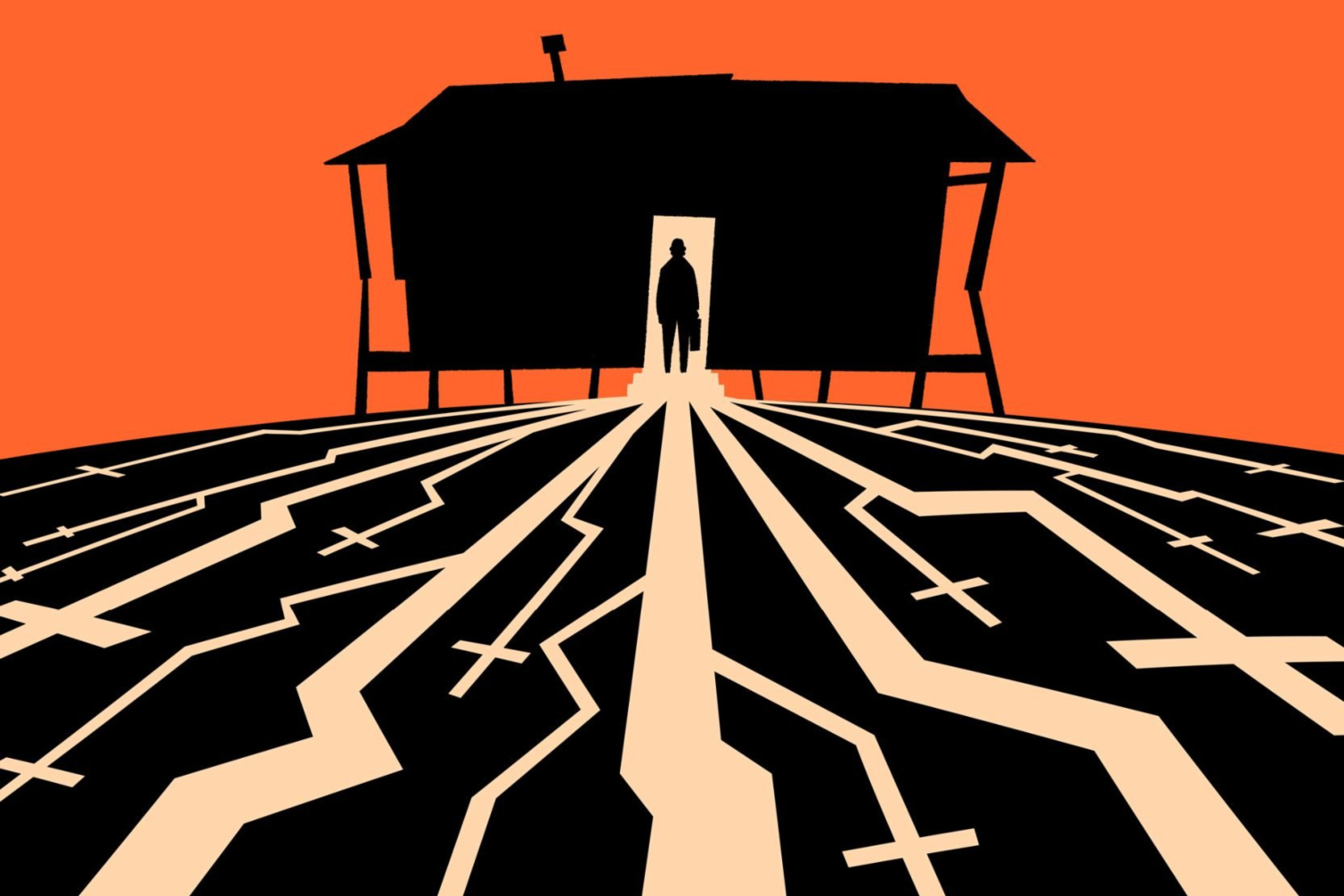

Stop me if you’ve heard this one before: A bunch of priests travel to a far-off island — where they face the devil’s demonic hordes.
That’s effectively the premise for Exorcism Island, a new Comixology Originals series from writer writer Jordan Thomas and artist Chris Matthews. After a “terrifying confrontation,” Father Gigi Amato joins a cadre of priests on a remote Caribbean island. Their work? To look after “the most long-term demonic possession cases” managed by the Vatican.
What’s effectively The Exorcism meets Awakenings, Exorcism Island is a terse but beguiling ride into the very core of human spirituality. Whether you come for the interesting layout, the entertaining dynamic between the priests, and/or the promise of white-hot supernatural action, Exorcism Island will possess you with its storytelling depth and commitment.
Exorcism Island #1 is out this week (October 21). In the lead up, both Thomas and Matthews were kind enough to answer some questions via email. That includes why the exorcism “model” proved so compelling, their influences and inspirations for the story, their ongoing collaborative process, the back-and-forth between the priests, and what’s still to come on Exorcism Island.

Courtesy of Comixology Originals.
AIPT: Why are exorcisms still so interesting/compelling? I read once it’s this metaphor for true spiritual devotion, and how terrifying that can be.
Jordan Thomas: It’s a concept that seems to have always been around and is still something people sling at people who have different beliefs to them. I even heard parts of a podcast recently with some far right supposedly religious types claiming that left-wing people are clearly possessed by demons and that the devil targeted Hollywood as a way to get their ideas out there. (Yes, really.) For me personally it’s just an interesting concept, the idea of something invading a person and poisoning their soul. It could stand in for any number of things, an illness, abuse…But looking back on what I wrote now, I think I was subconsciously dealing with how there’s these large groups of people out there currently who have been infected by lies and hate and social media and it has twisted them up to become something I find pretty terrible.
AIPT: You two previously worked together on the especially excellent Mugshots. How has that collaborative process developed, and is it through that camaraderie that you can tackle even more intense subject matter?
JT: Chris and I have been friends for something like 25 years now, so we have a deeper understanding of each other than most collaborators. However, sometimes working with your friends can be a recipe for disaster. But what makes Chris and I work so well, I believe, is that we’re both incredibly determined to do the best work we can do. We have discussions, give feedback, etc. without it ever becoming an argument or any resentment building. (Chris may disagree!).
Also, to be honest, in a lot of ways this book is less intense than Mugshots. In Mugshots everything was a lot closer to home, dealing with some things from my childhood and happening in the real world, whereas this story is more fantastical even if its dealing with very pertinent themes. In general the way Chris and I work is we just throw ideas at each other until something gets us both excited and then we work on that. On top of Mugshots and Exorcism Island, we have something like four or five other projects at various stages that we pick up and put down depending on what options we have out there with publishers.

Courtesy of Comixology Originals.
Chris Matthews: Mugshots was actually my first time making a comic book, so Jordan helped me quite a lot through the process. He would have a lot more suggestions in his scripts whereas these days I feel like he lets me get on with it a bit more.
AIPT: Do you have a favorite “exorcism” film, novel, comic, etc.? Something that perhaps made its way into this story (and why that title specifically?)
JT: I mean it’s hard to look beyond The Exorcist film, but I do also love the [William Peter] Blatty novels The Exorcist and Legion. In terms of more modern possession films I’m a big, big fan of Hereditary by Ari Aster. The slow build terror of that film likely had an impact on my writing of this series.
The name kind of started as [a] “Just calling it what it is” joke, and then I think both Chris and my buddy artist Cian Tormey both said, “Why can’t that just be the name?” And so we stuck with it.
CM: The Exorcist. I watched it with my mum way too young and it proper messed me up.
AIPT: How much of your own religious experiences inevitably filters into a book like this? Or, do you actively try to deny that and tell the story another way?
JT: I don’t really have any religious background at all. I wasn’t baptized, I never got taken to church. I’ve always found the stories interesting, I’m a huge fan of Mike Carey’s Lucifer comic series for Vertigo and how that delves deep into the Bible to look at the stories there at a kind of face value, but I’m not trying to get over any religious trauma or anything.
AIPT: I absolutely adore the “color-coded” approach to laying out the story and moving through time/space. Why did you opt to tell the story this way, and what was the planning/organizational process like?
JT: For me, it’s just a very elegant way of establishing location shifts and also at times whether we’re in the present or the past without the need for lots of expository captions or dialogue. The planning process was fairly clear on the opening section that I had a very concrete idea of how I wanted it laid out with equal sized panels and there being a pattern to color-coding and then on later issues Chris drew everything and had it in the off-orange main color and then we just discussed what section needed their own color-codes and put it together that way, which is the benefit of it just being a single color.

Courtesy of Comixology Originals.
AIPT: Building off that last question: Is there almost a (small) hope that readers get, to a certain extent at least, lost or overwhelmed? I feel like that possibility really brings you into the story a little more effectively.
JT: I don’t ever want the reader to feel lost, in reality the colors are meant to do the opposite, you may not be sure exactly what’s happening yet but you have the colors guide you as to which panels are telling which story. Definitely the opening of the first issue is a bit of a fever dream that maybe requires a second look to fully grasp it all, but I think we created an approach that is there to be understood if you take the time to understand it.
AIPT: Do you have a favorite page/moment in issue #1? Something that really speaks to the heart of Exorcism Island?
JT: Probably the panel of Father Miller sat there covered in God knows what having a cigarette, exhausted and fed up. That’s very much the tone!
CM: For me, its the first time Gigi enters the cabin. He’s been thrust into an absolute mess and he doesn’t really understand what’s happening.
AIPT: Do you have more affinity or pity for Gigi and the other fathers? Does that distinction matter at all? And do you have a “fave” demon-slaying priest here?
JT: The gang of priests are all in it together. I wanted them all to be likeable in their own way even if they are quite a grumpy, often cynical bunch. I can’t lie, Father Miller is absolutely my favorite of the priests on the island to write. Although another priest pops up in later issues who gives him a good run for his money.
CM: Yeah, I like all the priests; they’ve each got their own little quirks. Miller’s probably my favorite though. I enjoy his snarky attitude.

Courtesy of Comixology Originals.
AIPT: You’re both unwavering in your language and depiction of certain events/moments. I get that this has to be the case, but is that hard to do? And how do you reconcile certain language choices or people’s sensitivities in a book like this one?
JT: I just have to write true to the story I’m telling or for me, there’s really no point in doing it. In Mugshots, the only edits I had to make based on feedback from the publisher were to remove a few uses of a word that is considered particularly unpleasantly, but in reality I grew up around those types of people and I’d already toned down the awfulness of the way they speak. Again here we have demons from hell attempting to rile, insult and anger people, if anything I imagine were they to exist they would say much worse than I have them coming out with.
AIPT: I love how you strategically use humor both here and in all your stories. (The 13 bad omens/14 bad omens gag is truly solid.) Is there a “formula” in your head about making jokes without impacting the tension/mood?
JT: I tend to write through feel. I’ll normally have a bit of plan for where I’m going, but especially for dialogue I just spend an awful lot of time getting to know these characters and then just let them talk in a quest for something that feels real and honest, and making jokes or trying to make light of the situation just feels right for someone with the personality and life experience of a Father Miller. I’m not sure I’ve ever consciously thought about adding or removing humor from a scene, it tends to just flow naturally from the characters and their relationships. I am glad you’ve noticed the humor though as I saw a review of Mugshots somewhere online saying it wasn’t funny, but I thought there were quite a lot of good jokes in there!

Courtesy of Comixology Originals.
AIPT: What teasers and tidbits can we expect from the rest of Exorcism Island?
JT: It definitely escalates. We visit a few other far-flung locations, add some characters and get to meet what I think is a really great villain. Chris has delivered some wicked and wild unsettling horror moments for people to look forward to as well.
AIPT: Is there anything else we should know about Exorcism Island, comics, religion and spirituality, demons, etc.?
JT: We worked on it for a long time. I really hammered the script into shape, tightening up the final couple of issues in a way you don’t always get a chance to do, so I think if you like the first issue you’ll end up really loving the series. It’s also a proper comic, in that we’re doing things, like with the colors and the way Chris uses silhouettes and page layouts that really only work in comics, so even if you’re not a huge horror fan I believe there’s still a lot to enjoy in the series.



You must be logged in to post a comment.