

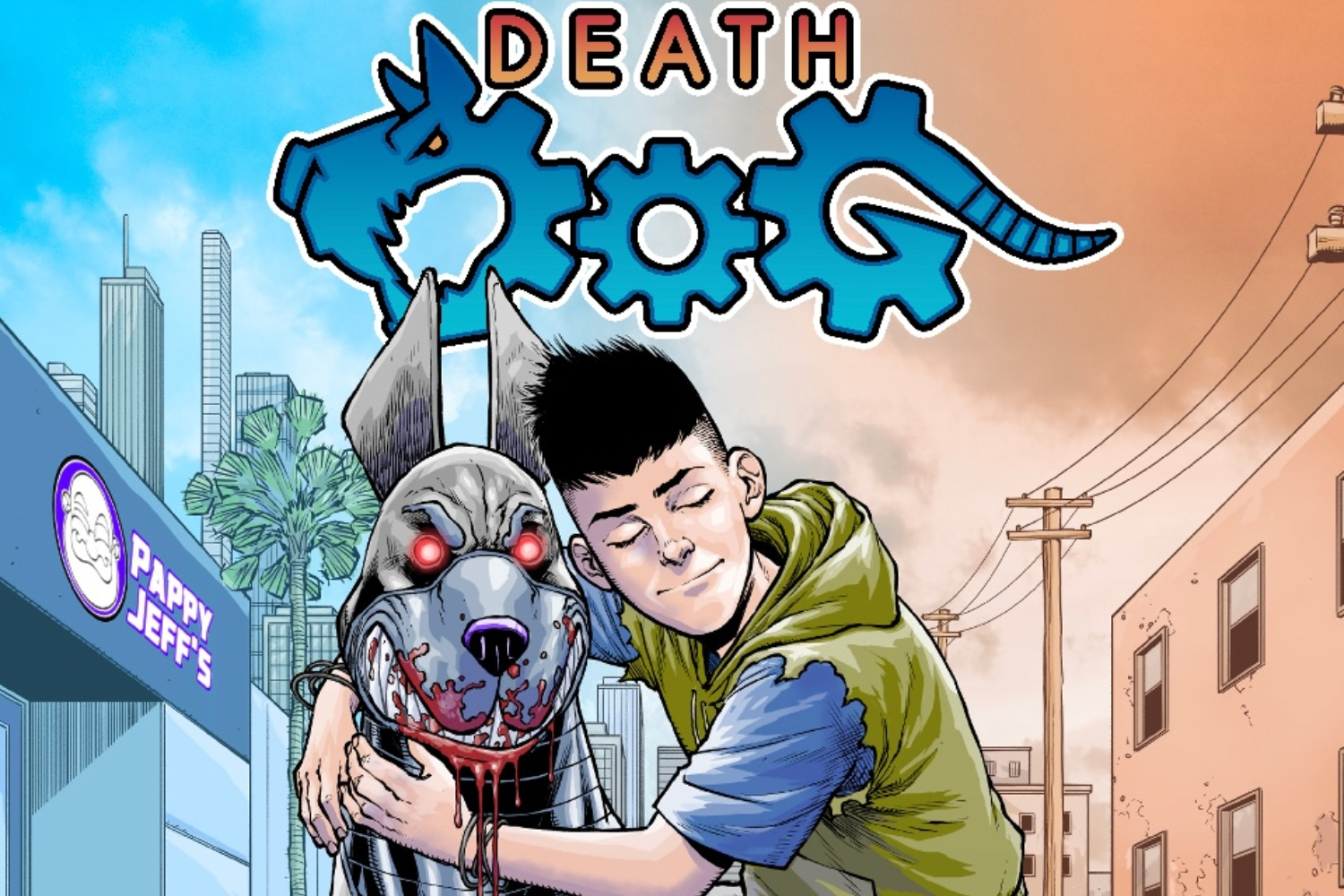

There’s lots of great dogs that have graced comics, films, TV, video games, etc. over the years. Such standout doggos include Scooby-Doo, Dogmeat, Lassie, Toto, Krypto, Jake the Dog, Pluto, and Courage the Cowardly Dog. Now, you may want to leave room on that list for another such faithful canine companion: Death Dog.
That’s actually the title of a brand-new AHOY Comics title from writer Bryce Ingman (My Bad) and artist Alan Robinson (New Fantastic Four). In Death Dog, we meet Wyatt, a “13-year old living in a country where no one protects kids.” One day, when he’s accused of shoplifting, Wyatt is nearly attacked by a vicious robot dog — until fate intervenes.
With the Death Dog now acting his most loyal companion, Wyatt will have to maneuver this nightmarish spin on America. (A place where “most children have jobs instead of attending school” — sound vaguely familiar?) But Wyatt will soon come to find then when you’re facing a harsh authoritarian society, it’s “it’s nice to have a deadly robot dog in your corner.”
Death Dog #1 is due out this week (November 5). Ahead of the debut, we caught up with Ingman recently via email. There, we talked about why dogs are the best heroes (and just the best in general), Death Dog‘s fictional influences, tackling ideas of police militarization via comedy, and the undisputed greatest fictional dog ever, among other topics and tidbits.

Courtesy of AHOY Comics.
AIPT: Why do dog-centric stories still stir our hearts and minds even to this day?
Bryce Ingman: Dogs, in general, are incredibly loving, kind, and loyal creatures. Plus, they’re really adorable. This makes them pretty irresistible to most of us humans, especially when we’re feeling like our world isn’t kind, loving, or loyal. Bottom line: dogs never go out of style!
AIPT: Did you lean into any “famous” dogs for inspiration? I’m getting some real Astro-meets-Dynomutt vibes for sure.
BI: I can see where you might get some Astro/Dynomutt vibes, but to be honest, I didn’t focus on any “famous” pooches when developing Death Dog; I drew upon the dozens of wonderful, real-life dogs who’ve brightened my life…and occasionally broken my heart.

Courtesy of AHOY Comics.
AIPT: I really enjoyed some of your other work, most notably My Bad. Did you take anything specific from that project into Death Dog?
BI: Thanks for the My Bad love. Mark Russell and I hope to do a fourth volume one of these days. I can’t say I took anything in particular from that book to develop Death Dog. That said, Acid Chimp was good practice at writing an animal character with a small English vocabulary — Dog and A.C. definitely have that trait in common.
AIPT: You’re talking about some rather heady issues here (like police militarization and child labor) in a really fun way. Does that undercutting diminish these ideas, or is through comedy the way we best understand these ideas/concepts?
BI: I’m absolutely serious in my intent when dealing with heavy issues like police militarization and child labor even if I present them through a veil of humor. Unlike My Bad, which has the raison d’etre of ‘jokes on every page,’ Death Dog leans into the jokes at times and backs off them at other times. I think that’s a fun, potent mix for fictional tales. I don’t really see it as undercutting the seriousness of the issues at all. The evil things humans do to one another are often also pretty ridiculous and humor is a powerful tool in combating those ridiculous evils.

Courtesy of AHOY Comics.
AIPT: Similar to the last question, does spoofing these ideas maybe make you feel more hopeful and not give into the endless despair?
BI: For sure. I think people are good at finding humor in dark places for just that reason — it’s a survival mechanism.
AIPT: Do you have a favorite story moment or page/panel – maybe something that speaks to the heart of this series?
BI: I love the bit in issue #2 where Wyatt is walking around with his deadly robot dog under a blanket to avoid attention. It’s stupid and wonderful and looks hilarious. But the heart of the book is expressed at the end of issue #2 when Wyatt is forced to make a momentous decision about his relationship with Dog. That’s truly my favorite moment.

Courtesy of AHOY Comics.
AIPT: What was it like working with Alan Robinson? I’d read he wasn’t a dog person before, and how did you convert him and how did that help with the actual book?
BI: Alan is a joy — enthusiastic, brilliant and easy to communicate with. But I had no idea he wasn’t a dog person! If so, he hid it well and treated our dog-star with great affection.
AIPT: Do you feel like Death Dog is ultimately some kind of warning (albeit a fun one) or a message of hope? Like, we can do better and not end up in a world with robo-dogs and neglected kids?
BI: I hadn’t really thought about it in exactly those terms before, but I suppose that this volume of Death Dog is more of a warning. If we’re lucky enough to do more volumes, I’ll eventually be steering things toward that horizon of hope.

Courtesy of AHOY Comics.
AIPT: Because I feel like it must be addressed: Who is the best fictional dog and why?
BI: This is by far the hardest question you’ve asked me, and I’ve spent days pondering it.
As a youngster, I loved the spunk and heroism of Toto in the 1939 film version of The Wizard of Oz. In literature, I’ve long been a fan of the loyal dogs in Jack London’s To Build a Fire and Stephen King’s The Stand. And both Dug, the talking dog in the film Up, and Krypto in James Gunn’s recent Superman movie deserve a mention for being utterly delightful, hilarious fictional dogs.
But I’m giving my ‘best fictional dog’ crown to Santa’s Little Helper from The Simpsons. The original Simpsons’ writers really nailed the personality of a loving, impulsive, somewhat pitiful, not particularly bright dog. Santa’s Little Helper is the kind of dog that will get up on the table and eat your dinner if you leave the room for more than 30 seconds, and I’ve known many wonderful, horrible dogs with that same nature. I’m also a big fan of his scrawny, gangly character design.
And “Dog of Death,” the episode where S.L.H. has a deadly “twisted stomach” requiring an expensive operation, is one of my favorite episodes of television ever. The vet bill is so huge that it forces the Simpsons to make financial sacrifices and, as the pain of these sacrifices settles in, they all begin resenting Santa’s Little Helper. Hilarious and heartrending stuff. Also, I’m just now realizing how that episode’s title is nearly the same as the title of the comic book we’re promoting here, which makes me smile.
AIPT: Is there anything else we should know about Death Dog, actual dogs, comics, comedy, sci-fi, the future, etc.?
BI: There’s a dog out there somewhere who would like you to scratch them behind their ears and/or rub their belly. Get to it!



You must be logged in to post a comment.