


Look around your favorite LCS — what do you see?
No, not the 2,138 Batman titles. Or the sixth print edition of Ultimate Spider-Man.
No, it’s licensed comics.
The last few years have seen a veritable explosion of these adaptations of your favorite films and cartoons. Be it TMNT, Terminator, Godzilla, Toxic Avenger, Dick Tracy, Roboforce, Sonic the Hedgehog, or even C.O.W.-Boys of Moo Mesa, among so many others, these books seize on a mountain of generational nostalgia with anthropomorphic animals and just a dash of irony.
You can, in part, blame and/or thank David Pepose for this “renaissance.”
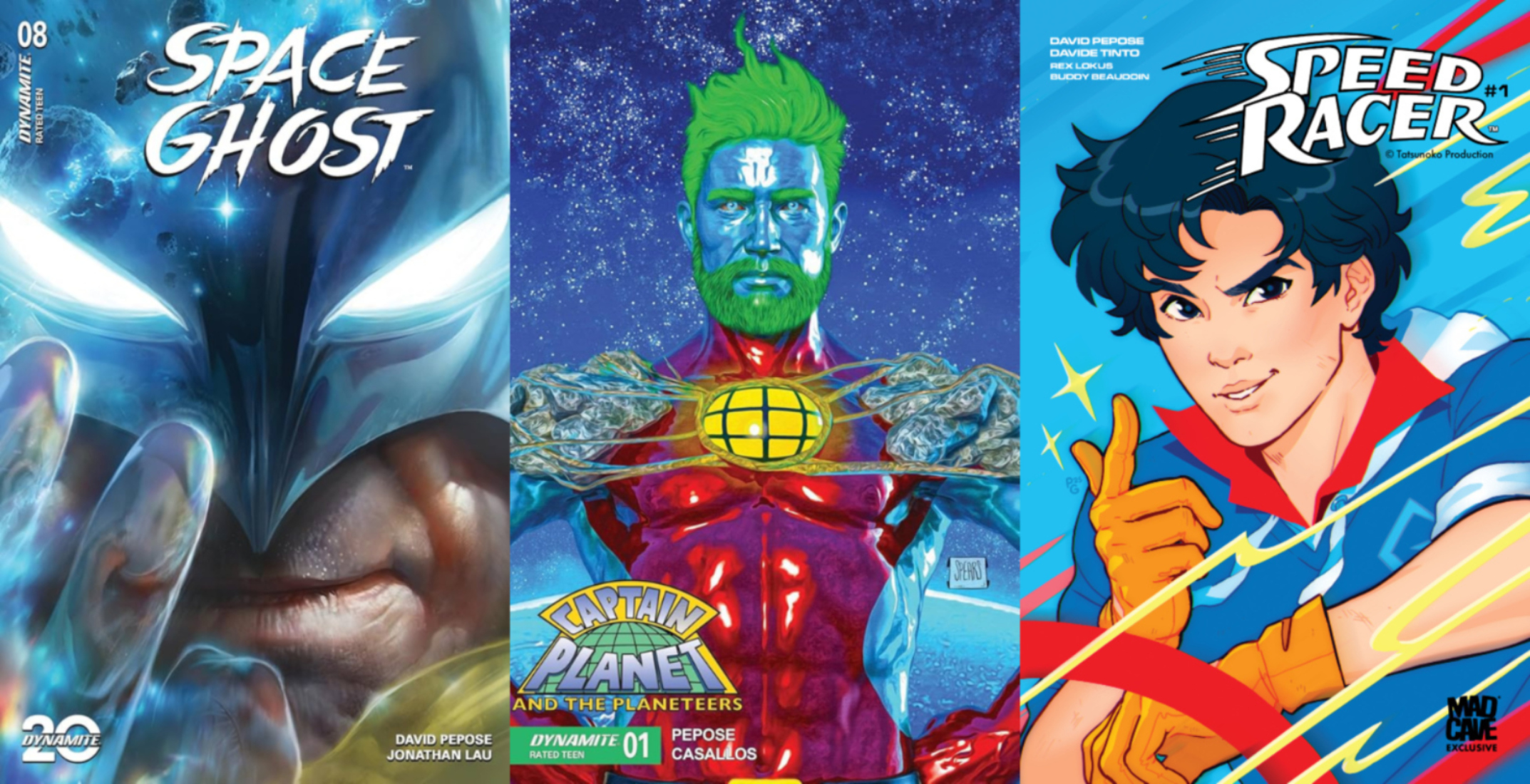
In the last year or so, Pepose has written three major such nostalgia titles: Space Ghost, Captain Planet, and Speed Racer. Despite a rather long and prosperous career elsewhere (everything from Spencer & Locke to Punisher), Pepose has a special affinity for these projects. Even more than that, he understands this singular phenomenon, its consumerist demands, the resulting ample creative opportunities, and all the nuance that makes these books so interesting. Talking to Pepose, it’s easy to see why this revolution of licensed work has taken hold in the industry, and what it ultimately means for all of us.
Mo Money No More?

From Space Ghost #8. Courtesy of Courtesy of Dynamite Entertainment.
Pepose wants to begin, however, with making it clear that the “revolution” didn’t just start with him. (Even if, again, he’s contributed lots to this phenomenon and its corresponding discourse.)
“I think we can all agree it was Daniel Warren Johnson restarting Transformers; that was the tip of the spear, the crest of the wave,” Pepose said in a recent Zoom call. “I have been really fortunate to follow in those footsteps. We also had Declan Shalvey and Drew Moss on ThunderCats. Now there’s Robert Kirkman and Dan Mora doing Transformers. I never expected to be the cartoon guy – this is a confluence of a lot of things that came together over the last year-and-a-half.”
We also quickly touched on another vital point in this larger conversation: This licensed work is often seen as mere cash grabs. You know, just a way for publishers to ring a little extra money out of hapless consumers. And, to a certain extent, Pepose totes agrees.
“What’s funny about the term cash grab…I feel like that might’ve been used to describe some of these nostalgia books five, 10 years ago,” Pepose said. “It felt like it was just coasting on the name of these properties. It was just appealing to the diehards, and it never really felt synonymous with a higher artistic calling.”
Added Pepose, “I think it used to be this forgotten corner of the comics industry where they’re like, ‘Well, we’ll ‘Moneyball‘ our way to making our quarterlies with these particular nostalgia licenses.'”
Alright, let’s take a brief interlude to talk numbers:
There’s little denying the role licensed titles play in the current marketplace. Per a 2024 white paper from ICv2, dollar sales of comics were up 11.7% from January to August (compared to the same period in 2022). And ICv2 CEO Milton Griepp named the “blowout successes” of licensed books (focusing on TMNT, the Energon Universe, and even Space Ghost) as a significant contributing factor.
And while comics sales were down considerably in 2023 (via Forbes), licensed titles helped some major publishers. As Comic Book Revolution pointed out, Image had just six issues in 2023’s Top 10 — four were Hasbro-licensed books. Meanwhile, speaking with SKTCHD’s David Harper, Aaron Trites of San Diego’s Now or Never Comics said licensed titles were “a constant hit,” adding that “smaller” titles (a la Flash Gordon) routinely “[outsold] Big Two flagship titles like Fantastic Four and Detective Comics.”
Of course, there’s a noteworthy downside surrounding this trend around licensed books. ICv2 more recently contributed IDW’s declining sales due in part to the “under-performance of licensed comic titles relative to expectations.”
Finally, for more on licensed books, be sure to read this excellent new piece from SKTCHD. Among many great insights, Harper gets at how the recent-ish turnaround for the comics market “hasn’t seemingly reached non-licensed comics yet.” The reality is far more complicated, but it’s interesting to see the role of these licensed books in the marketplace in terms of not only sales but creators’ perceptions/understandings and audience preferences.
Now back to your regularly scheduled programming:
So, what’s changed regarding the perception of these licensed titles? Well, according to Pepose, “the publishers are also throwing weight behind them in terms of the talent. He added, “And I think now in the wake of Transformers and in the wake of what Dynamite’s been doing with the Warner Brothers licenses, people are starting to realize like, ‘Oh, you can tell a real story with these books.'”
There’s another important piece of the puzzle — the comics’ tendency to over-mine its many IPs. After releasing something like 12,000 superhero stories/titles (and then giving each hero their own film franchise), Pepose thinks creators and fans are searching elsewhere for their next big hero to idolize.
“I don’t think the superhero universe is dead by any means,” Pepose said. “That’s why these nostalgia books have picked up in the way that they – superheroes, of course, are the bedrock of the direct market. But, with respect, I think maybe some readers have put so much pressure on everything that they are meant to do – perhaps beyond what the genre is designed to do and the format is able to do.”
This over-saturation, then, has bred a nasty habit among certain readers, and it impacts how they consume, digest, and celebrate their favorite comics.
“But my theory on all of this is that fans, particularly the Wednesday warrior crowds, the people who are sifting for information on social media, they’ve gotten to the point where they know the universes so well that they’re able to anticipate them,” Pepose said. “And that becomes a lose-lose situation because either they anticipate it correctly and then they’re mad and they say, ‘That the book was predictable.’ Or, they anticipate it wrongly, they say, ‘This doesn’t feel right because it’s ultimately not the thing I was anticipating.'”
A Touch of Drama

From Captain Planet #3. Courtesy of Dynamite Entertainment.
There’s one more important stereotype around these licensed titles that’s worth covering. Maybe even more than being deemed as soulless cash grabs, there’s this undeniable joke about the “gritty reboot.” It’s something Pepose is deeply familiar with, and something he fully wants to lay to rest.
“I totally understand the trepidation that some might have like, ‘Oh, is this going to be a dark, gritty reboot,'” Pepose said. “And as somebody who got his career started on the gritty, dark reboot of Calvin and Hobbes [Editor’s Note: That’d be the wonderful, aforementioned Spencer & Locke], I always say, ‘When I do a dark, gritty reboot, you’ll know it.’
So, then, how do you avoid the trappings of an overblown, over-indulgent reboot that completely misses the point of its source material? You get dark, but not too dark.
“It’s all about that redemptive climb,” Pepose said. “You can start in a bad place as long as you give the characters a way to like crawl their way out. Then I think it’s OK to have a little bit of drama, a little bit of stakes, a little bit of tension, a little bit of baggage.”
Case in point: Space Ghost.
“It starts off [with] this grim avenger of the cosmos,” Pepose said. “We wanted to show that he’s got a whole character arc in that he starts off as this guy who’s intentionally shoved his own humanity down. He literally wears a mask and calls himself Space Ghost.”
Even Speed Racer, that shimmery, extra hokey story about a boy and his car, has surprising layers.
‘His dad has a heart attack in the first issue,” Pepose said. “Ultimately, I’m writing for people in their 20s through 40s rather than kids. And so we’re able to push that envelope a little bit more and give it a little bit more heavier stakes. At the same time, I don’t want to write anything oppressive – or should I say, oppressiveness has its uses, but not in these books.”
But perhaps the most interesting example from Prepose’s “trinity” is Captain Planet. On the surface, it’s the one he most readily recognizes as being especially hokey.
“I get why people overlook the property,” Pepose said. “They say it’s dated and they say it’s a product of its time. It was meant to be. That’s why you had the crop tops and mullets.”
But if you hadn’t noticed, the whole story is more timely than ever before.
“The world outside the window today is a darker place. We’ve gone from the hole in the ozone layer and acid rain to a full-blown disaster movie that we’re all extras in,” Pepose said. “You see it in a world where you have Donald Trump and Elon Musk that are just calling all the shots and leading us into a worse tomorrow. So having a character who really represents that hope and optimism and humanity and who has been around long enough to say, ‘I know that things look bad, but there’s still goodness. There’s still hope.'”
Space Captains and Airbenders

From Speed Racer #1. Courtesy of Mad Cave Studios.
And that, friends, is exactly where this licensed work comes in to fill a much-needed hole in our shared reading habits.
“…This wave of nostalgia books, beyond just being able to raise the bar artistically, show that these old nostalgic cartoons still have something to say,” Pepose said. “But I think it’s also that nobody knows the mythology of Space Ghost or Speed Racer or Captain Planet. And so I think it makes readers a little more present in the reading that they’re not able necessarily to anticipate it. And they’re able to say, ‘Oh, I don’t know this universe. It feels fresh and new to me.'”
Pepose said that he feels like he’s a “pop culture archaeologist” trying to “figure out what makes these properties so enduring and then dusting them off to just make them feel as modern and accessible as possible.” It’s a process he’s more than familiar with, and he relates one important analogy that speaks volumes to his own work.
“I grew up on Star Trek: The Next Generation,” Pepose said. “It reminded me a lot of, even though I was too young to articulate it, was [Chris] Claremont’s ‘X-Men’ in space in a lot of ways.”
Pepose added, “But the original Star Trek, I had no frame of reference. And it wasn’t until the J.J. Abrams movie in 2009…I loved that movie so much. I had no relationship about Kirk or Spock other than, like, the cultural osmosis. But that movie just grabbed me. And I love that movie so much that when the credits rolled, I actually stayed in the movie theater and watched it a second time.”
It’s an experience that speaks to a single overarching question that informs Pepose’s own work: “How do we revisit this through the modern storytelling techniques of today?”
Well, turns out you do what all great artists do, and borrow a little from your heroes.
“With Space Ghost, it was, ‘What if we injected a little Batman: The Long Halloween into it since he’s got that Adam West Batman already in his DNA,'” Pepose said. Or, ‘Captain Planet, what if we injected a little Avatar: The Last Airbender.’ Or, ‘Speed Racer, what if we got a little Formula One but also Baby Driver and Fast & Furious in the mix.’ That’s what makes these things accessible and energizing. People want to get in on these things.”
But there’s a deeper reason for this approach, of course. It’s about a kind of cultural remix, and using storytelling and worldbuilding as these tools to engage and connect with readers.
“In many ways, I’m able to inject some of the tropes of some of the shared universes without necessarily having to do the horse trading of which characters are available and is this going to step on anybody else’s toes,” Pepose said, referencing how series operate at DC and Marvel. “One of the best parts of doing licensed work, but also the best parts of creator-owned work, is we’re able to put our stamp on it.”
A Better Breed of Fans

From Space Ghost #8. Courtesy of Dynamite Entertainment.
This approach, then, helps Pepose and his collaborators address a couple of important issues. The first? How to best court new readers.
“Maybe the hardest thing to crack in the whole comics industry is how do you build a good on-ramp for people,” Pepose said. “With these books, you don’t have to figure out what’s the volume of this thing. All you got to do is pick up issue #1. I write my books really for an audience of one, and that is my wife. She didn’t grow up with comics. I don’t write my books to preach to the choir; I want converts.”
Still, the other focus (if you hadn’t already guessed) is satisfying those aforementioned Wednesday warriors. Pepose recognizes that, given comics’ unique business model, these “faithful” often get lost in the mix (if you can somehow believe that notion).
“It’s a truth that we used to have…where readers would cycle out every five years, and then you’d get new readers,” Pepose said. “And I don’t think necessarily we have that much of an accelerated timeframe. But I do think we need to speak to the long running fans as well.”
At the same time, at least some of the “blame” does go to the long-time fans/readers given their own bad habits.
“Sometimes we Big Two fans can maybe build it a little narrow in terms of our tastes,” Pepose said. “Like, what we expect or what we will allow to fly, and how much we can color outside the lines. I do think if anything goes on long enough, the pendulum will always swing back to center. But why not take these cool, interesting swings? And that’s how you get something like Krakoa or that’s how you get something like a Spider-Man in space.”
To really secure this crowd of veterans, Pepose makes sure he does his homework, having watched every episode of Captain Planet and Space Ghost. That’s the only way he can foster the one thing all true comics fans can respect: nerd credibility.
“You’ll have the small handful of people who are purists, whether they want either a return to [Space Ghost] Coast to Coast, or they want this to feel like the ‘60s era,” Pepose said. “But that’s an infinitesimally small minority because the overwhelming number of people are either like, ‘I don’t know this character, so this is really cool.’ Or, it’s the people who grew up with it who are like, ‘Yeah, this rules.'”
Pepose added, “But I think having done the homework, that’s what lets fans give us a little more license – they know you might do a new take on Zorak, but we know you’re going to hit Zorak. You’re going to hit all the members of the Council of Doom. People are a lot more forgiving of the interesting kind of twists and wrinkles that we throw in along the way.”
They’re also forgiving, it seems, not only if you to the homework, but you can show yourself to be a proper nerd. Comics fans are only truly ravenous if they smell your feckless tendencies as some clunky outsider.
“People are justifiably protective and justifiably nervous of this idea of, ‘Oh, you’re going to publicly disrespect this thing I love and you’re going to make money off of it,” Pepose said. “I wouldn’t spend the time I do on these books if I didn’t love them.”
And if all of that fails, there’s one central element that’s vital to meaningful comics. It’s a trait and/or tendency that transcends all other context. Abandon it at your peril, but embrace it and watch the nice people flock to the shelves.
“There’s this formula of earnestness and kitsch that I think has propelled the comics industry for as long as it has been around,” Pepose said. “We elevate trash – in the most positive and polite way possible. We’re a lowbrow medium that has aspirations for high art. We strive for it even though we hold on to that genre trash foundation. I keep thinking like, ‘Oh, yeah, I think I’m in the right place.’ In terms of taking something that everybody’s going to underestimate, and nobody’s going to expect anything out of it, and let’s make something great with it.”
The Truest Deep Dives

From Captain Planet #4. Courtesy of Dynamite Entertainment.
Still, it’s not just that Pepose knows his audience (both current and potential). Or that he’s a “third generation comics reader,” someone with the insight to know a meaningful story and what’s otherwise avoidable garbage. It’s that more than even doing his homework, he cares deeply for these properties, and approaches each one with a certain depth and reverence.
“Every time that I’m on a book, it really is like you’re packing for a camping trip or maybe prepping for a marathon or somewhere in the middle,” Pepose said. “I need to make sure that I’ve got what I need in order to go the long haul and to go the distance. And so if I don’t have that emotional core to keep me going, it’s going to be a tough road.”
So, for example, watching every episode isn’t just to know what hand Zorak uses to shoot a gun. It’s very much about getting to the root of these characters, and being able to push them forward while respecting the core fanbase.
“I wanted to wrap my brain around, like, how does he work,” Pepose said of Space Ghost. “And then who are the villains? Who are the people that readers are going to expect? That really helped me crack the code of the book because then I realized Jan and Jace are so important to that mythology. That’s the secret of Space Ghost – it’s Jan and Jace’s story. Even in the pilot episode, you meet Jan and Jace before you Space Ghost.”
And when you know what a thing is really about, you can go nuts on emphasizing (or de-emphasizing) certain aspects and ideas to make a truly important story.
“For Speed Racer, I know that core family drama, that’s the engine that drives this beyond Speed chasing after his dreams and passions of racing,” Pepose said. “It’s about somebody who’s lost their brother and somebody whose father doesn’t want them to do this sport. And it’s a love story with him and Trixie and way that Spritle looks up to him. Once you get that, everything else just feels like a twist in execution. People will be surprisingly flexible about different twists you do on a pizza.”
Sometimes, as Pepose has found, you can know enough and still not have an idea for story directions. That’s where his collaborators come into make it all happen.
“Going in, I have some idea of what the tone is, but it’s only a guess because tone is ultimately established by the art,” Pepose said. “You often don’t know who the artist is going to be when you’re generating that initial pitch.”
Pepose added, “With Speed Racer, I think when I was originally coming up with that outline, it was probably going to be even a little bit more mature and a bit more grounded. But then we had Davide Tinto on art, that really set the tone in terms of the way the action looks and the expressiveness of the characters, and that affected the voice of them a bit. It’s figuring out what the landmarks are. It’s figuring out what are the important parts of this book that I need to visit at some point.”
(In addition to Tinto, Pepose readily praises his other collaborators across each book: artist Jonathan Lau and colorist Andrew Dalhouse on Space Ghost; artist Eman Casallos, colorist Jorge Sutil, and letterer Jeff Eckleberry on Captain Planet; and colorist Rex Lokus on Speed Racer.)
At the end of the day, though, it’s about regarding these characters as many of us did as wee youngsters: not just as heroes, but people we welcomed into our living room like atomic-powered family.
“It’s trying to treat the characters with respect to make them as three-dimensional and cohesive as you can,” Pepose said. “And just reminding the fans that I’m in love with this property. I love this thing just as much as you do. I’ve done the research, and I’ve found the reason I love it. And if I can share that feeling in my writing, if I can share that feeling in the way that I promote my books, then I think that’s the way that you make these things work.”
Storytelling For One

From Speed Racer #2. Courtesy of Mad Cave Studios.
It’s not just that Pepose sees the characters as being “real.” It’s also that he’s clearly thinking more about how to regard them and let their lives play out on the page. And that’s an important trend among these licensed books.
“Right now, there’s an ongoing conversation that a lot of creators are having, and maybe an ongoing conversation in fiction in general right now, is that you have to give your characters some challenges,” Pepose said. “You’ve got to put them through their paces. Just so you can watch them get up. And it doesn’t mean that you need to make the thing oppressive. It doesn’t mean that you need to make the thing depressing.”
It means, according to Pepose, that you go beyond your own feelings of despair not just cause it’s a better way to live. It’s also a better way to build a meaningful base of readers.
“That’s not how you build an audience. That’s not how you build emotional investment,” Pepose said. “You can do a gritty, shocking version of whatever childhood property you want and that’ll get somebody’s foot in the door once. You need something that’s going to go the distance. And that’s why I think all of my books have that optimistic core. They’re always striving to be better people. And more often than not, they succeed. If that’s not something that we could all use now, then I don’t know.”
Of course, there’s one more important wrinkle. Pepose isn’t changing these characters for the LOLz or even for the sake of fans; it’s for him first and foremost. When I asked him why, for instance, he made Space Ghost so dang intense when he didn’t have to, he said, “I know the books didn’t need it, but I needed it.” It speaks to his whole thought process across these titles: It’s just a way to polish something that’s already 24K gold.
“These characters, there’s nothing wrong with them,” Pepose said. “There’s nothing that needs fixing. I always push this idea of, ‘Did you know this could be really cool? Like, give it a look.’ This character’s really cool. And I think that’s all readers need. Like, they want books that are cool.”
At one point, I got to talking about how Space Ghost was, at least on a personal level, very much a COVID story. Which is to say, it proved to be a great lesson about rediscovering your own humanity, and realizing why you have to keep on fighting. It’s not something Pepose ever intended, but living for more than yourself is exactly what he had been going after.
“For Space Ghost, it’s hard to keep up marinating in your pain when you’ve got these two just effervescent kids,” Pepose said. “They’re going to bring out the best in you.”
It’s something that Pepose has drawn on from his own life, which is another reason these books seem to work so well. These stories aren’t just about pop culture icons, interesting heroes, analogies for our modern world, and/or great lessons in morality and decency. They’re an expression of Pepose’s very life trying to uplift these same ideals/values.
“Space Ghost is funny because it is, in a lot of ways, very autobiographical. My younger siblings are triplets, and we have about a nine-year age gap between us,” Pepose said. “And it wasn’t until issue #3 or #4 that I realized that’s why I’m writing it.”
Pepose added, “I had a good thing going as an only child, and 10 days before my ninth birthday, suddenly your world opens up in this huge way. The way that you used to do things is completely out the window. At the same time, you realize your life has been expanded in such a wonderfully positive way. You see the universe through somebody else’s eyes for the first time. It inspires you to be a better version of yourself because they need you.”
And while Captain Planet isn’t quite so personal — though Pepose did pitch it for a decade or so — at its core is something similarly near and dear.
“I grew up Jewish in the Midwest, so not part of the cultural dominant norm or anything,” Pepose said. “It has opened me up to be a better person, and certainly a more empathetic person and maybe even a more knowledgeable person. Captain Planet, that’s the ultimate friend-hang.”
The Stories Grow Wider Still

Variant cover by Jae Lee. Courtesy of Dynamite Entertainment.
If you think Pepose’s love is all pure and uncomplicated, it’s not all about telling feel-good stories. In some ways, he’s trying to influence or at least inform how readers connect with their favorite books.
For instance, Speed Racer and its “sibling” book, Racer X, don’t work in a way a lot of comics companions do. Rather than opting to connect entirely, they’re more complimentary. (Pepose credits Mark Russell with the idea have the books “run parallel.”) It’s a way to encourage, and never force, folks to read more books in a way that suits their needs.
“My first comics was Amazing Spider-Man #346, Spider-Man versus Venom,” Pepose said. “And then my very next issue was Infinity War #2, where it’s all the heroes assembling in the Baxter building. Like, ‘Oh, do they all know one another?’ The more books you read, the more you get to learn. I think in this internet Wikipedia age, it’s maybe become a lost art. But I think that’s part of the joy of it…the exploration.”
There’s also a point of addressing what Pepose calls a “marked shift,” adding that “We used to have this very decompressed story time, and then we’d have the books that were written really to be read as trade.” Pepose and other writers — he credits Ryan North on Fantastic Four and Jed McKay on Moon Knight — have hooked people by adjusting accordingly, with the success of his licensed titles stemming from “beyond the twists and tone and all that, it’s the structure. It’s the pacing. These books are all done-in-ones and done-in-twos.”
It’s a lesson he first learned while working on a Fantastic Four story during the Judgment Day crossover.
“Something clicked in me when I wrote that… like, ‘You have a two-parter, that’s the power of the cliffhanger.’ It forces you to get down very quickly,” Pepose said. “But it made me realize that readers get very invested when you have an ending. The readers have gone on a journey with these characters. They’ve watched them be in danger and then they’ve watched them succeed and they feel that sense of investment.”
That idea rests at the heart of Space Ghost, with Pepose saying that while Dynamite had “offered me a year,” his counteroffer was “12 [issues] plus an annual.” That way, he could tell the story “mostly done-in-ones. And then we punctuate it with these cool done-in-twos, and then a big done-in-three.” The more books, it seems, the more opportunities for true fandom to take hold.
“Every time we see our heroes prevail, the readers will fall in love with them that much more,” Pepose said. “And if we can do that 10 times in a year versus waiting six issues to do it once, people are going to get really invested. And if they don’t like a story, that’s OK, wait a month.”
A License For More

Courtesy of author.
Pepose is the first to admit that he never expected to land these titles. He recalls talking with Jody Houser at SDCC 2024 and that he “maybe missed [his] shot” for Captain Planet. However, that next day, Dynamite announced they’d secured the rights, and the rest, they say, is history. It’s all part of a much larger lesson for Pepose: Dream big, because you never know what might actually happen.
“I learned very quickly, probably around COVID and the Diamond shutdowns and everything happening, that you’ve got to be nimble,” Pepose said. “You’ve got got to be taking a million swings. You’ve got to be looking under every rock. You cannot predict where this industry is going to take you. That’s the cool thing about comics is that just as it is for a reader, it’s the same as a creator – it always finds a way to surprise you.”
So, even with so much accomplished already, does Pepose have any other dream gigs? Some forgotten Saturday morning heroes or obscure video game leads he’d like to revitalize? The big one, he admits, is James Bond, which he thinks is very much in the realm of possibility. (Dynamite, you know where to find your man.) But he also mentioned Fallout and Mortal Kombat (which would basically be a “grounded Bloodsport kind of tournament.”)
Yet there’s one idea that really stood out. It’s not only an interesting pick from the pop culture recycle bin, but it checks the boxes for what makes Pepose’s licensed work so compelling. It’s nostalgic and a little weird; it’s honest to the franchise even as it does something inventive and poignant; and it’s enthusiastic in its love of finding great stories almost anywhere.
With any luck, you’d see it on comics shelves sooner rather than later.
“Honestly, the one that I always think about, but I don’t think anybody will ever pick up the rights, is Streets of Rage,” Pepose said. “It’s The Departed meets The Warriors. Just this idea of undercover vice cops learning that there’s a conspiracy between the gangs and the cops and that everyone in the city is trying to hunt them down as they try to make their way out of the city. That’s very cool.”
Space Ghost (Vol. 2) #5 is due out November 19. Speed Racer #5 drops December 3.



You must be logged in to post a comment.