


I think Denise Mina might be wrong.
The Scottish writer once said that “people are interested in crime fiction when they’re quite distanced from crime.” I get what she’s saying (we can enjoy these stories safe in our lil’ social bubbles), but to me that speaks to ideas of intimacy and distance and enjoying things via filters and constructs.
My single, shimmery counterargument is, of course, The Voice Said Kill.
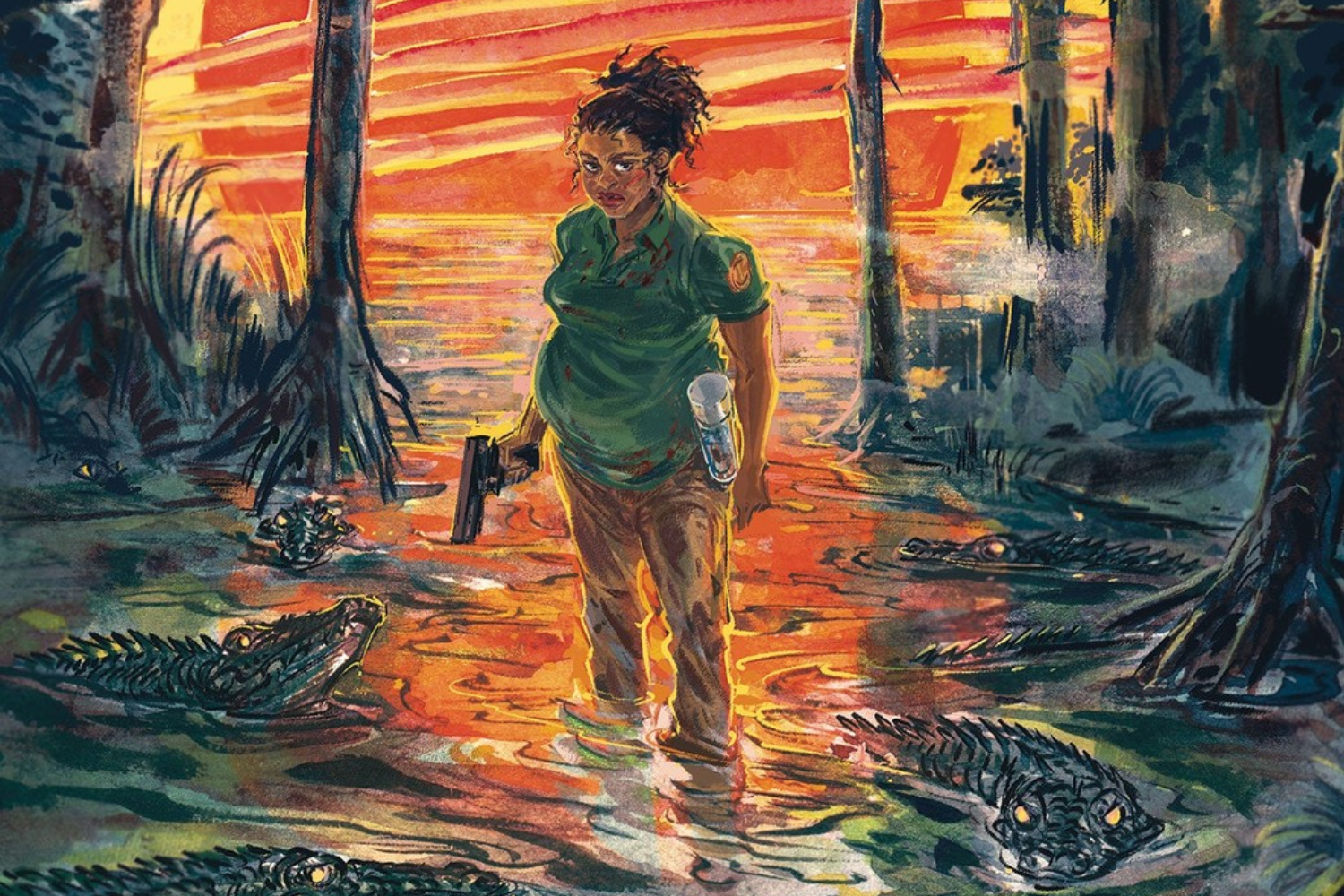
Over the first three issues, co-creators Si Spurrier and Vanesa R. Del Rey have crafted one hell of a crime story (that’s not really a crime story at all…) And, yes, the book does feature a rather specific story, as we follow park ranger Marie, ever pregnant and increasingly exhausted, simply trying to survive drug smugglers, the harrowing bayou, and gators galore.
Yet the magic of The Voice Said Kill is its unwavering intimacy; we’ve been right there with Marie the whole time, covered in sweat and swamp water, as she’s tried to stay alive for her unborn child (and maybe to see these dummies get their comeuppance). And through that proximity, The Voice Said Kill has deftly and expertly explored motherhood, the relationship between people and nature, notions of life and survival, and even the true scope of good and evil. We’re as close as close can get, folks, and it’s never been more exciting, terrifying, and psychically impactful.
And the fourth and final issue manages to bring us in even closer for a truly spellbinding conclusion.

Variant cover by Emma Price. Courtesy of Image Comics.
Here’s what you need to know going into The Voice Said Kill #4. With her team incapacitated due to “food poisoning,” Marie enters the bayou, where she meets and later shoots Buck Watters, the son of local crime queen-pin Mrs. Watters. From there, Marie gets caught up with the aforementioned smugglers, who are eventually led by the nasty Cindy. By the end of issue #3, Marie and her captors head back to the Watters’ compound to seek help for their Mexican connection. It’s hot, sweaty, and tempers are shorter and sharper than a gator’s tooth.
Oh, there was also a submarine, because of course.
I’ve worked hard not to overtly spoil too the bulk of The Voice Said Kill, as it’s the intricacies of this story that have 1) made it so darn compelling and 2) seen it play with noir-ian confines in some really interesting ways. But for the sake of clarity and whatnot, I can say that this issue boils down to an extended confrontation between Marie, Mrs. Watters, and Cindy, and it’s among the most emotionally and thematically potent scenes in a book packed with just such huge, combustive elements.

Courtesy of Image Comics.
From a thematic standpoint, it’s exactly where this book needed to wind up. The whole story so far has been an attempt to explore its big tent-poles through the filter of women, and each of the final “combatants” is in a unique position. Marie’s the pregnant cop, trying to keep the peace; Mrs. Watters is a matron, trying to maintain the tenuousness of her position and family; and Cindy is the upstart, trying to carve out her own place in this world. Each one has something novel to say about motherhood, society’s valuation and perception of women, people and places on the fringe of life, etc.
By pitting them against one another, we’re dissecting these big notions and huge life questions in a way that’s vital and exciting; it’s a tone and pace that makes very real the violence and feckless behavior lobbed at women all the time. It encapsulates the mounds of garbage we make them walk through even as we need them in a very real, very deliberate manner in order for the world to function. Their Mexican standoff, as it were, is an exciting sheen of glossy paint applied to very real social dynamics, interactions that are meant to throw up a mirror to our own absurdity, hypocrisy, and general shitheel behavior when it comes to how we treat women. (And even how we make them treat one another.) It’s not just emotionally resonant, but technically impressive as the creators have built to this moment with depth and precision to spare.

Courtesy of Image Comics.
At the same time as this is the moment where The Voice Said Kill has utterly, perfectly coalesced, the art does something novel and interesting: It pushes and pokes us even deeper, and in new, more dazzling ways. Del Rey (alongside colorist John Starr) spent the first three issues building this truly magical world, a swamp biome that is both unbelievably magical and also decidedly real and raw. And through that process, we’ve been made to see the world in this two-tone, oddly ambivalent way. A way, I’d add, that has been vital in breaking down our core assumptions and understandings.
But in issue #4, that ability is heightened. There’s a big gunfight (before the ladies have their standoff) that injects this sharp, violent charge of chaos and rage. It’s something dark and sinister, and while there’s been enough of that so far in The Voice Said Kill, this infusion is wholly unnatural. It’s a distinct breakdown of what we know, a dissolution of the understanding we’ve cultivated so far as to the scope and size of this world.

Courtesy of Image Comics.
From there, there’s also a scene with a drug trip (again, whose trip it is will require your reading). And that moment takes the torn strands of the world and breaks it down even further. It’s a deeply horrifying and unsettling scene, where we can no longer find the beauty in a dark moment (say, like a bayou packed with carnivorous predators) and instead are faced with pure ugliness and chaos. It’s not only a further breakdown of what we know, but a reminder that our grasp has always been mostly tenuous at best.
So, what are the point of these moments? Obviously, it’s to disarm us of any final mental weaponry we might have maintained, forcing us to surrender into the uneven, undeniable power of this world to affect us deeply. At the same time, though, it’s a statement of sorts. What comes after it (who ever walks away from the final confrontation) is someone who can thread the needle, as it were. Someone who knows the darkness in people’s minds, the undeniable carnage of the natural world, and that the only way for true survival is to embrace the darkness as much as the light. A person who is connected to this singular place, and who exudes a power that connects innately with the terror and potential imbued in the water and trees. In short, a person who hears the voices that most of us can’t, and who gave themselves to this place through love, devotion, and sacrifice.
It’s more than fitting, then, that the only ones with half a chance are the women willing to wade through the reeds and mud.

Courtesy of Image Comics.
I’m sure you’ve already assumed that Marie just might be that very person to emerge reborn from the swamp. But if you jump right to that conclusion, then you’ve clearly missed the lethal honesty and integrity that The Voice Said Kill has cultivated in just four short issues. Because the end doesn’t matter (as much as it very much does); what this book has really done is tell a massively important story with its own tone, pacing, emotionality, and level of intensity. A story that, if you boil it all down, is about love, life, and what we do to sustain it all when we know we’re never good or skilled enough. A story that challenges us by asking, “If you thought it was all about to end, what would you do?”
And in the case of Marie, what that final gesture looks like is something that cuts to the very heart of life. All we are is the hope we carry for what comes next, and if life is to mean a damn, we have to fight for it. The universality of this message doesn’t take away from the deeply feminist message of The Voice Said Kill. Rather, it’s always this layered, multifaceted experience to get us to look deep into the heart of life, a sense of robust confrontation that makes this a truly great crime story (when, again, it’s so much more still). So, get nice and close to this one, and I promise it’ll shuffle up your worldview, make you question your own assumptions, and stir up ugly, important truths. Mostly, though, it’ll move you deep and true.




You must be logged in to post a comment.