

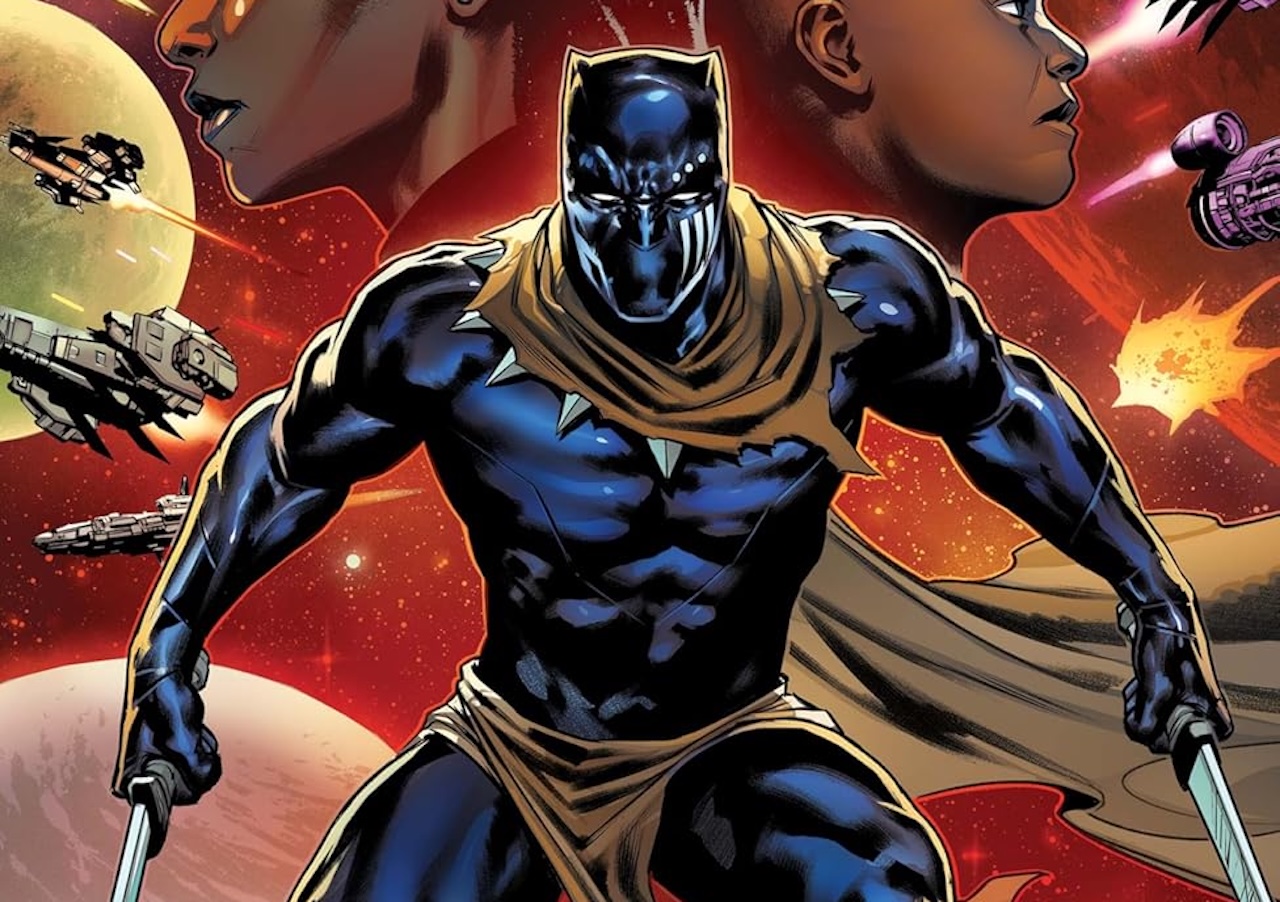

Of all the series spinning out of Imperial‘s aftermath, Black Panther: Intergalactic #1 was at the top of my list. Not only did it sound like it would bring T’Challa back to his roots of trying to balance life as a king and a hero, but it would also explore the intergalactic empire of Wakanda, a concept that I felt could carry its own book. Apparently, Victor LaValle and Stefano Nesi had the same thought, as Black Panther: Intergalactic #1 thrusts the Panther into the middle of a cosmic mystery.
Following his return to serving as Emperor of the Intergalactic Empire of Wakanda, Black Panther is carrying out one of his subjects’ dying wishes when he’s attacked by a piece of cutting edge technology that wants to cut his head off. Meanwhile, his sister Shuri goes off to find her brother, but learns from the former regent M’Baku that there may be traitors embedded deep in the Empire.
The elements that will draw readers to Black Panther: Intergalactic #1 is the cosmic background – think the sweeping scale of Star Wars or Dune but against the backdrop of the Marvel Universe – and the way the Panther is displayed. Not only does T’Challa showcase his incredible fighting prowess, but also his intellect as he attempts to figure out who sent these machines to kill him. LaValle definitely understands that the Panther is a multifaceted character, and that his life is changing; T’Challa even contemplates how he has to balance being a king with his membership in the Avengers, and if he’s stretching himself too thin. It’s that human element that makes Intergalactic an intriguing read.

Marvel
The other part of what makes Black Panther: Intergalactic #1 worth reading is that it’s a two-hander; while the Panther deals with weird robots, Shuri is tracking him down and dealing with the threat of a potential coup. I like the idea of shifting back and forth, as it gives LaValle time to develop both plotlines while also showcasing how different T’Challa and Shuri are. He is more reserved, while she’s more direct, and he seeks adventure, while she attends to matters of state. It’s a dynamic that I’m looking forward to seeing more of in future issues.
Nesi’s artwork is just as much of a draw as LaValle’s writing. A large part of that is because he knows how you should draw the Black Panther. Panther’s movements need to be graceful, deadly, and purposeful. All of that’s on display whether he’s fighting robots or a massive alien snake, and it looks cool as hell. So does his new costume, which keeps the armored look he’s been rocking, yet also drapes him in a regal purple cape.
The rest of the Intergalactic Empire of Wakanda looks just as impressive. M’Baku’s Ebony Guard is clad in jet black robes, adorned with an intricate red pattern. Shuri bears an outfit similar to her brother’s, cape and all, but her face is unmasked and her suit is less armored. These costumes stand out in the sci-fi landscape thanks to Bryan Valenza’s rich colors.
Black Panther: Intergalactic #1 finally returns to one of the most interesting parts of the Black Panther mythos, and expands Marvel’s cosmic landscape in the process. Whether or not you read Imperial, this is a perfect jumping-on point and a return to form for T’Challa.




You must be logged in to post a comment.