

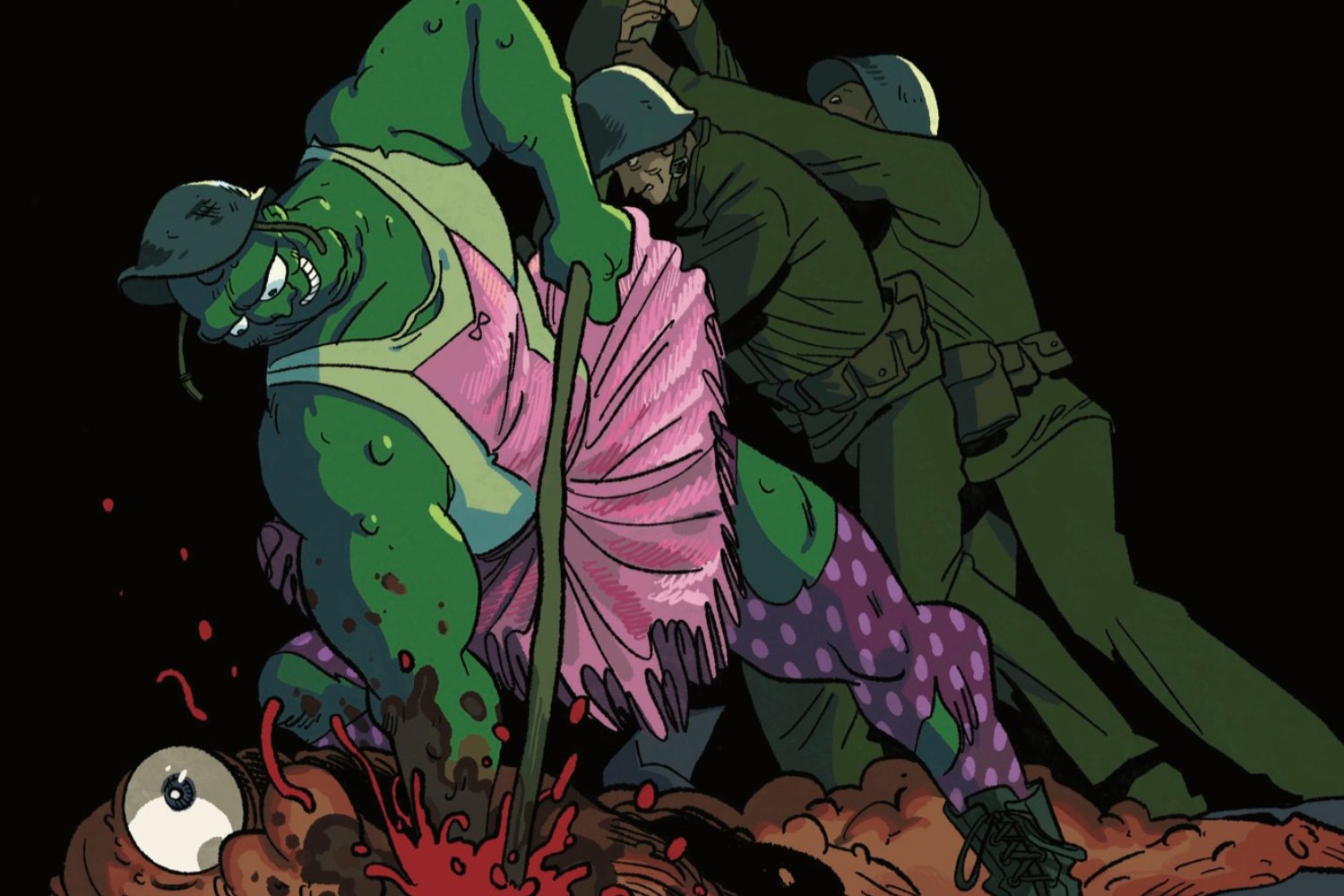

Is my heart truly big enough for the entirety of Toxic Avenger?
Because, yes, I’ve shared heaps of admiration for Toxic Avenger and the ongoing Toxic Crusaders. But I’ve mostly avoided Toxic Avenger Comics (at least when it comes to penning reviews). And not just because I’m afraid of mutating myself — I just don’t really do one-shots given their mostly “inconsequential” nature. Plus, said one-shots each landed differently: I certainly liked the horror bent of issue #1, and the fantasy free-for-all of issue #5, but even the romance of issue #4 couldn’t fully move me.
But Toxic Avenger Comics #6 is seemingly quite special. Not only is it the start of a five-issue arc, but it’s one with bonkers potential as the Toxic Avenger takes to D.C. to clean up our nation’s capital. At the same time, this shift could throw off the “formula” within Toxic Avenger Comics, making this just another Toxie book in a decidedly crowded and competitive field.
Who ever said love was easy?

Courtesy of AHOY Comics.
Fortunately, there are some key decisions across this issue that maintain that “special” status. Giving Fred Harper a larger story, for instance, is one such move that automatically sets up this arc for success. Some of it’s just the sense of cohesion with Toxic Avenger — as if that storyline garnered new life after a little break while still maintaining our immersion. (Harper penned mini-comics across Toxic Avenger Comics #1-5 as a kind of lead-up.) Similarly, this storyline employs that novel format of starting at the end/in media res and then telling the story proper. That’s also a small but mighty choice for both cohesion and also spiking our interest when it’s doubly important for this “transition.”
Still, any effectiveness is mostly due to the quality of Harper’s art (as joined by colorist Lee Loughridge and letterer Rob Steen, who also have appeared throughout Toxic Avenger Comics). Whether Toxie is breaking the arm of some “protestor,” or awkwardly keeping his hand up during Congressional testimony on the state of Tromaville, the art team bring balance without ever being boring. The whole world is both a horror show of mutant weirdos and this slightly drab place full of geeks — the story permanently exits in between because that’s where the true power of this larger book lies.
Everything is both horrifying and deeply relatable, and it’s that very narrow strip of reality that makes this storyline (and Toxie tales in general) feel effective — it’s the Goldilocks porridge of absurdity and believability. It’s a similar quality that made some of the other one-shots work well enough: You can play around with tone, emotions, perception, etc. if you ground people just enough. Nothing is ever too much or not enough, and it’s just right for Toxie’s singular misadventures.

Courtesy of AHOY Comics.
It’s a sense that you can also feel churning at the center of the storyline proper. Across all these varied Toxie tales, I’ve continually applauded writer Matt Bors for his measured approach to satire. In Crusaders, for instance, the satire is sharp, but I could see folks getting “distracted” by the playfulness and vivid hue of Tristan Wright’s art. But here (aided by this art’s “sturdier” foundation), we really see just how careful and thoughtful Bors is in lampooning and spoofing modern politics and American culture.
Yes, there is a rather ridiculous moment that kicks off this tale (given the reverse storytelling approach), but as Bors deliberately plots the story back to that intense, extreme moment, it all feels fully earned. It’s a level of ridiculousness that comes across through this knowing and careful analysis of this weird moment in time, a snapshot of some insanity that is often hard to fully grasp if you don’t recall how silly it all can be most of the time. (But always very, very real.)
It’s an approach that reminds me a lot of what’s happening lately on South Park. That creative team clearly realized that MAGA is just too dumb and weird to ever be out-done, and so the key is to try and present the moment for what it is as best they truly can. You feel that with the storyline and dialogue here: Toxie may be a giant mutant, but he’s got good ideas about community development and transparency and accountability in government. Or, some politician may mean well, but you can also see them positioning themselves for a book deal or some sweet pork belly spending. Either way, it all feels just elevated enough (or maybe just the right tinge of familiar?), and so we understand just how bizarre and oddly complicated this moment in time is comparatively.

Courtesy of AHOY Comics.
To just call this the “worst timeline,” as so many of us have already, ignores that there’s real room for meaningful change here. This book’s satire isn’t just about pointing out things for the LOLz, but fostering a sense of true revolution because that’s what this moment is — the great dissolution of any steadfast notions that the system is “simply broken” before we burn it all down and start over entirely.
That’s very much where the intro of this arc places us, and even working backwards (which somehow feels oddly fitting for this moment in time), the creative team transform a ridiculous, unimaginable moment into the spark for meaningful understanding and lasting change. It’s not necessarily satire as a salve, but something that should remind us all that there’s at least the pangs of hope to be found. It just exists as a giant mutant with more guts and heart than brains and political know-how.
Beyond that, I did have a few semi-important qualms with this issue. For one, as much as I love this art team, Wright and company on Crusaders gives me such a head-rush of nostalgia and genuine geeky joy. Or, that the downside of this “backwards” approach does strip out some of the mystery, discovery, etc. (Even if, again, it becomes the best kind of wish fulfillment.) Plus, the lack of overt gore in this debut was a little disappointing (severed arms aside, of course).

Courtesy of AHOY Comics.
And, sure, those are valid complaints — it feels like Toxic Avenger but without the sense of community. (Although Yvonne does have a seemingly bigger role here, and her “step-up” as a witty and knowledgeable counter to Toxie is awesome.)
But when I really thought about it all, most of those issues just didn’t seem nearly as important. A lot of that’s because the satire really works, the art is robust and multifaceted, and there’s important issues and ideas being explored here with maximum gusto and joy. But mostly, those issues don’t matter because Toxic Avenger Comics feels different and exciting. It’s clearly connected to some big ideas and themes, but it’s novel enough that it’s clear this “universe” has proper, long-term potential. This book can clearly pivot into something truly important in this character’s ongoing “resurrection.”
My heart might not be larger enough for Toxic Avenger Comics, but that won’t stop me for falling for this storyline in wide-eyed defiance.



You must be logged in to post a comment.