


Ever since New History of the DC Universe made a Frankenstein monster of the main DC canon by haphazardly stitching together bits and pieces of all 80+ years of DC history (sometimes in the wrong order), stories have fallen into two categories: creators are either ignoring the “new history” and just focusing on telling new stories like Matt Fraction’s Batman, or they’re telling stories where continuity is the story like Mark Waid’s Justice League Unlimited.
In the best case scenario, creators just ignore the larger DC continuity (that’s practically non-existent at this point) and aim to tell the best story they can with what they have available. These are the stories that tend to resonate more strongly with readers and are the types of stories fans tend to revisit over and over again. In the not-so-great scenario where continuity is the story, they make for fun one-time reads at best, but are largely inconsequential. For JSA’s “Year One” storyline, Jeff Lemire and Gavin Guidry attempt to find a middle ground between both case scenarios, though this is yielding mixed results.

DC Comics
In terms of story, this is where Lemire and Guidry’s JSA “Year One” storyline truly shines. Though JSA #13 and #14 gave the impression that “Year One” would be a prequel to the groundbreaking All-Star Comics #3 (set on pre-Crisis Earth-2), JSA #15 confirms this is not entirely the case. This is the best case scenario. Apart from the fact that it never made sense to graft pre-Crisis Earth-2 lore on the post-Crisis Earth (as this created glaring continuity holes that were rarely successfully patched), this also gives Lemire and Guidry maximum creative freedom to tell their best version of the JSA’s origin akin to Frank Miller and David Mazzucchelli’s Batman: Year One.
Whereas All-Star Comics #3 originally just depicted the founding members of the JSA coming together for the first time and sharing stories of their individual exploits, Lemire and Guidry deliver something different and exciting. Instead of Johnny Thunder simply bringing the JSA’s founding members together (though he still wants to do that in “Year One”), they are all drawn together by something else entirely: an unnerving noir-style mystery that reveals an underground Nazi movement taking place in Gotham. This tone is even captured by Guidry’s artwork, which perfectly uses film noir imagery. It even looks good in color.
In addition to the fact that this makes for a strong, self-contained story that fans can revisit again and again, it also does what JSA stories set in the 1940s does best: react to real-world events for peak emotional impact. Though it’s obviously not 1940 in our time, the United States is still seeing in 2026 what no one in 1940 could have anticipated: America embracing Neo-Nazism, complete with an unhinged US government that’s following every page of Hitler’s playbook to a terrifying degree. This makes the JSA’s “Year One” storyline that much more relevant, similar to Absolute Batman’s 2025 annual that tackled the same topic.

DC
Another thing Lemire and Guidry do in the “Year One” storyline is follow up on the ending of the previous storyline with the Spectre. This is admittedly where mileage is going to vary for fans. Though it’s clear that Lemire and Guidry are setting up plot threads for a future story arc involving the Spectre, this also sees the introduction of many more characters that slow down the progression of “Year One’s” main storyline for its third issue. For instance, it does make sense to bring in Kent Nelson’s Doctor Fate into the story as he is a founding JSA member, and involving him in the Spectre’s arc adds intrigue to the story.
The same sequence, however, also officially introduces the Justice Society Dark, which was first name-dropped in Geoff Johns’ and Mikel Janín’s Justice Society of America run. This development also aligns with New History of the DC Universe #1, confirming that Johns’ recent retcon is still canon. Though the Justice Society Dark’s appearance is brief and doesn’t add much to the story, their inclusion also slows down the story’s pacing due to the limited page space. This is most notably spotlighted in the sequence with Hourman, Sandman, and Cyclotron (not Ray Palmer as previously assumed).
Like in JSA #14, Cyclotron once more appears to warn Hourman and Sandman of impending danger, but doesn’t reveal in issue #15 what that is. At best, it’s hinted that all three of them walked into a deadly trap, and are likely to be experimented on by American Nazis, similar to what Hitler is doing with Jews and other vulnerable communities in Europe. The major upside to this sequence, however, is Cyclotron being given a more significant role in a JSA story for the first time since All-Star Squadron and Infinity, Inc., both of which are also set on pre-Crisis Earth-2. Apart from further fleshing out Atom Smasher’s ancestry, Cyclotron’s inclusion could do wonders for allowing him to appear in more future stories.

DC Comics
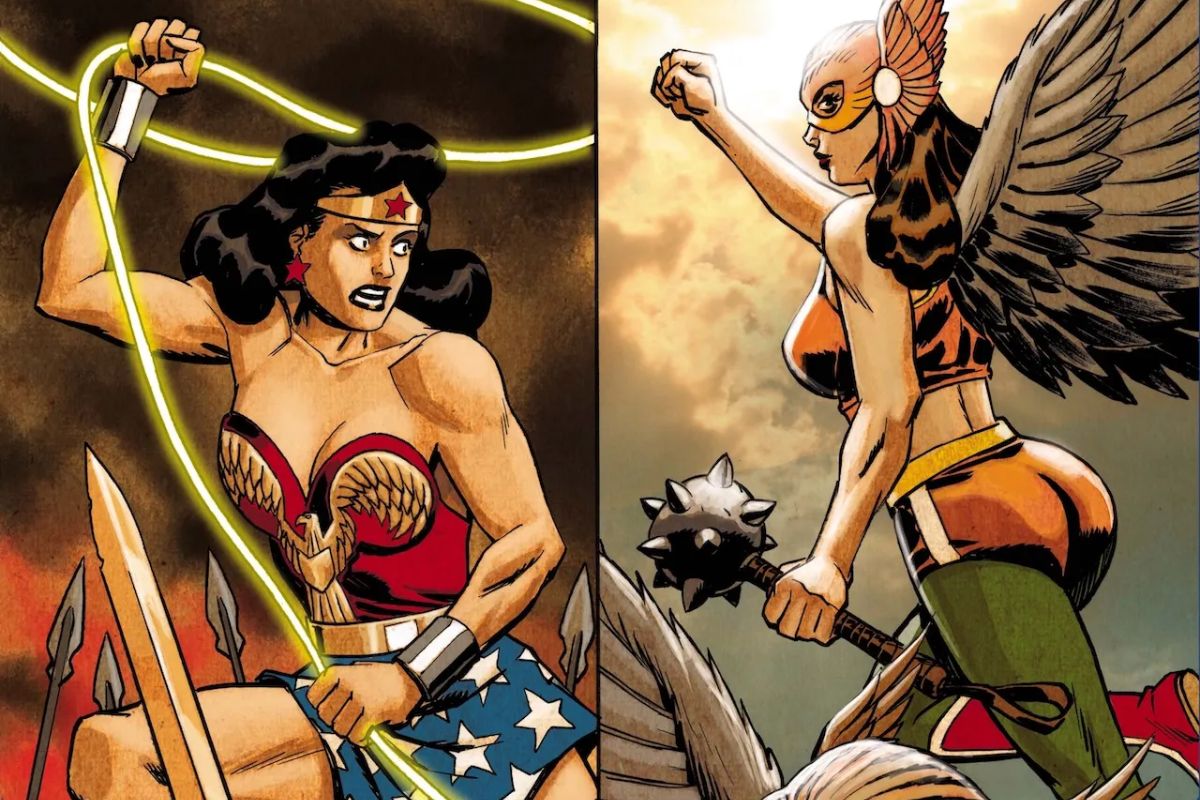
The only other moving part that continues to not work in JSA #15 is the inclusion of Queen Hippolyta as the “Golden Age Wonder Woman,” due to how this needlessly convolutes Diana’s core mythology. But his is more of a New History of the DC Universe problem than an issue with Jeff Lemire’s writing. At best, Lemire doesn’t go with the “warrior princess” trope this time around like he did in issue #14, which is a major improvement. At the same time, he’s also characterising the Queen of the Amazons similarly to the actual Golden Age Diana Prince from Earth-2.
In this case, it’s reasonable to ask why not just use Diana herself and use time travel shenanigans to explain her sudden presence in 1940, similar to what Geoff Johns did to explain the “Golden Age Green Arrow?” Though not a perfect solution to the “Golden Age Wonder Woman” problem on Earth-0, it would still be preferable to further convoluting Diana’s own mythology. Even more so, since there’s no real reason to make Queen Hippolyta the “Golden Age Wonder Woman” for the sake of facilitating an unpopular post-Crisis retcon that didn’t need to be restored.
As a whole, JSA “Year One” continues to be a pleasant read, and may turn out to be Lemire’s and Guidry’s most defining work of their JSA run, similar to Batman: Year One and JSA: The Golden Age by James Robinson and Paul Smith. It can be easily read on its own, as well as a small part of Lemire’s larger JSA run. The only drawback to the storyline thus far is that in trying to comply with the retcons of New History of the DC Universe, some elements of the story feel inorganic (like Queen Hipployta) and the story itself hasn’t progressed from the previous two issues. But other than that, “Year One” remains a treat for JSA fans.




You must be logged in to post a comment.