

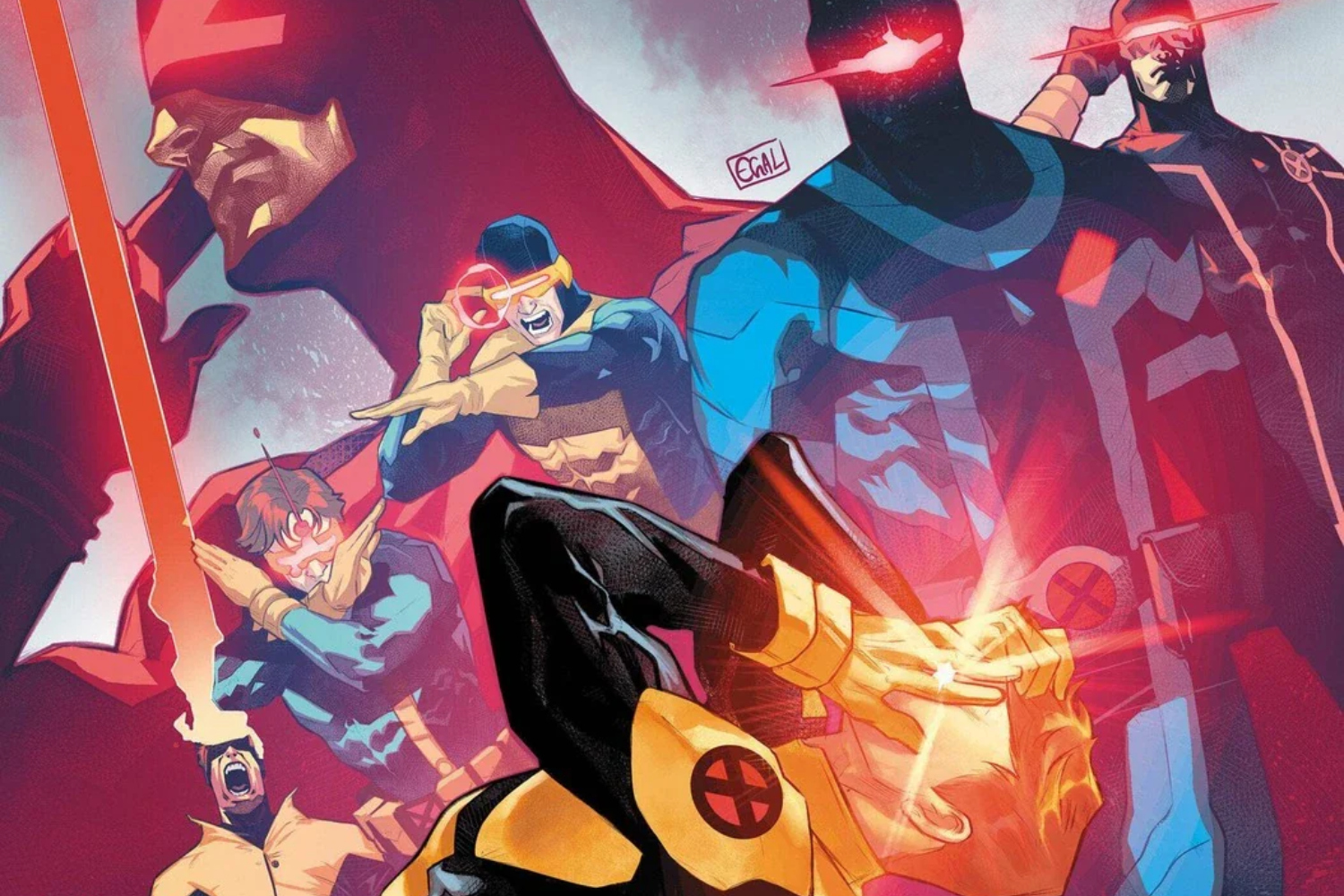

I hate Cyclops.
It’s a central belief I’ve held for a very long time – dating back to when I discovered the X-Men in time for 1993’s Fatal Attractions crossover. Even though he played a pivotal enough role in that event, Cyclops always came off as a major square. (Which seemed wildly impossible amid the “xtreme era” of the early ’90s.) He tried too hard to be a righteous leader among an era of anti-heroes, and even when he was cut loose and was trying to be “cool,” Cyclops was always X-Men’s Ultimate Boy Scout. While Scott Summers has his share of supporters, there’s enough of us to start up a veritable “We Hate Cyclops Club.”
Admittedly, some of my venom over Cyclops has cooled in recent years. Spurred on by rampant nostalgia, as well as a star turn in the X-Men ’97 cartoon, I’ve seen what some of Summers’ biggest fans have seen all along. Sure, he’s a bit of a square, but maybe that’s the point: In a world full of badasses like Logan, the MCU needs someone to do the right thing (and maybe, like, sign all of the paperwork or whatever). But even with that “softening,” my Cyclops animosity isn’t exactly a distant memory. Even if I’m not Hater No. 1 anymore, I still have deeply complicated feelings about the X leader and his larger value.
Cue Alex Paknadel.
Alongside artist Rogê Antônio, Paknadel is behind an all-new five-issue Cyclops solo book. In the book, Scott finds himself “separated from the X-Men, lost in a mountain wilderness without the visor that keeps his devastating powers in check.” When Donald Pierce and the Reavers come after him, Cyclops will have to tap into “his most savage core” to survive. It’s very much like Rambo, but with way more personal discovery, as Paknadel and Antônio attempt to tell a story that explores Cyclops’ need for control as well as question his connection to the world and his beloved X-Men.
But is it enough to make even bona fide Cyclops haters rethink their bile? To answer that question, Paknadel and I recently engaged in a little back-and-forth via email. It’s less about me complaining about Cyclops and Paknadel supporting his latest “star”; it’s a convo about fully, earnestly understanding a complicated character. By looking at his publishing history and the greater context behind these stories, we can re-assess Cyclops as this more robust hero and among the X-Men’s more interesting stand-outs. Maybe I’m still not fully sold, but Paknadel and Antônio’s Cyclops should have everyone giving it up to the X-Men’s resident boy-next-door.
OK, I hate begrudgingly respect Cyclops.

Main cover by Federico Vicentini. Courtesy of Marvel.
AIPT: What’s your “relationship” like with Cyclops/Scott Summers? Why does he stand out to you as an interesting or significant character?
Alex Paknadel: To be honest with you, he stands out to me because he reminds me so much of my father. I’m the helpless artsy jelly of the family, but he’s this stoic guy who everybody comes to when they have a problem. Then, he literally and metaphorically picks up a screwdriver and handles it without a murmur of complaint. The thing is, he’s not allowed to explode because everyone looks to him to be the rock. I often wonder how that makes him feel – whether that pressure gets to him – but I’ll never know because that’s not how he chooses to communicate. To me, that’s Scott Summers. If he isn’t in control of every situation, people get hurt.
AIPT: Do you have a favorite Cyclops-centric story that supports your level of fandom? Maybe something that inspired your own story/title?
AP: My favorite Scott-centric story is probably X-Factor #68 (1991). It’s right before the blue and gold team era, so it’s semi-legendary and I’m so lucky to have been there to see it. Anyway, issue #68 is the issue where Scott has to make the brutal call to hand baby Nate over to the Askani to save him from the techno-organic virus that’s killing him. We also see him leave Apocalypse’s shit in ruins, which is still such a powerful and haunting moment. I think it’s a perfect encapsulation of the character in terms of what he’s willing to sacrifice to keep the people he loves safe.
He’s the guy who makes the painful choice that keeps everyone alive, and whatever you do, don’t get in his way. In terms of what inspired the story, there are several X-Men evergreens I wanted to emulate – notably Weapon X, the Chris Claremont-Frank Miller Wolverine mini, Magneto: Testament, and, most notably, “Wounded Wolf” by Claremont and BWS from Uncanny X-Men #205. The whole Reaver and Lone Wolf and Cub dynamic was inspired directly by that extraordinary issue.
AIPT: What other writer/creator nailed Cyclops’ characterization? And why that “version”?
AP: There are so many to choose from, but in terms of the characterization I’m drawing from the most, I’d probably say Messiah Complex. The Cyclops-was-right era is its own beast (and I love that visor, HAHA!), but this is where you see Scott wrest control of the X-Men from his surrogate father and make a bunch of really brutal decisions because he’s been backed into a corner. It’s a real window into his character and I’ve tried to bottle some of that lightning in my series.

Variant cover by Clayton Crain. Courtesy of Marvel.
AIPT: I feel like Cyclops gets a lot of slack for being a Boy Scout or a square (that’s often duly earned and only slightly unearned). Why do you think that is, and is that somehow part of the character’s larger appeal?
AP: I feel like people who think he’s a square aren’t looking closely enough. He presents as a square because he betrays so little, but he had a deep relationship with one of the most sexually liberated X-Men characters ever, and of course during the Cyclops-was-right era (which I love), we see just how ruthless he can be. He doesn’t give away a lot, true, but part of that is just a function of readers not being able to see his eyes. As human beings, we’re hardwired to read emotions in the eyes, and with Cyclops that arsenal is taken away from you as a dramatist.
It’s a smirk here or a scowl there, but for the most part you have to treat him like an iceberg in the sense that you’re only seeing 10% of him at any given time. There are ways to play with that, certainly. I remember Walt Simonson used to do this thing with Scott where he’d have these thin wisps of optic blast coiling out of his visor when he wanted to show him being really mad. But, yeah, for the most part you have to follow subtler cues to read his emotional state. That’s a gift for a storyteller who likes a challenge.
AIPT: I think my biggest qualm with Cyclops is he feels tenuous – Logan, for instance, may be a big jerk, but he owns it. Scott’s always felt like he’s trying to be everything to everyone all at once. Is that a fair assessment of the X-Men’s leading lad?
AP: I would agree with that assessment to an extent, but I think that’s what makes him fascinating. Someone pointed out recently that a frequently used panel is a speaker reflected in Scott’s visor. They see themselves in him because he’s almost this cipher. But the fact, is he has to be a paramilitary leader, a statesman, a rebel king, a husband, a father, and more. Xavier chose him to be mutantkind’s David, and he didn’t have a great deal of choice in the matter, so I think it’s fair to cut the poor guy some slack, HAHA!
AIPT: I feel like (maybe in line with the X-Men ’97 cartoon from 2024) Cyclops has undergone an image overhaul of sorts. Do you think people have “seen the light,” as it were, and why do you think that’s the case?
AP: To be honest, I think it’s a reflection of the maturity of the audience. There are many, many adult X-Men fans now, so it’s easier to relate to the person who has to juggle 80,000 responsibilities without falling apart. That’s just life in the 21st century. I also think the fact that he’s this barely contained pressure cooker is intensely relatable. Wolverine is very easy to relate to when you’re a teenager because – and I say this with love – he gets to cut loose and sulk in the woods from time to time. Scott has to keep the plates spinning.

Variant cover by Godtail. Courtesy of Marvel.
AIPT: I love the idea behind your story, which basically forces Scott to try and survive some mountainous wilderness. What kind of questions or ideas do you want to stir up by pitting him against Mother Nature?
AP: It’s about taking away the illusion of control for Scott. He’s been in wilderness environments before, but the removal of his visor removes his last control mechanism. He’s in a wild place with only his own wildness – which he strenuously and constantly has to suppress – to keep him alive. He’s terrified of it, but the real question is, does he need it?
AIPT: Similarly, the solicitations for the book talk about his visor and fears around his devastating powers. Why is that an interesting direction – is Scott someone who fears losing control and/or someone who fears his own strength?
AP: Yes, absolutely. Elsewhere I’ve likened Scott’s visor to a control rod in a nuclear reactor. If you remove it, a meltdown begins that almost always ends explosively. That is inherently interesting to me because it places him in the same archetypal category as, for instance, The Hulk. He may not turn into a rampaging rage monster, but he has one behind his eyes and – like Bruce Banner – part of his job is to be that rage monster’s jailer 24/7. So, in addition to his leadership responsibilities, he has to always govern himself. That’s a lot of pressure for a guy in his mid-20s.
AIPT: You’ve also chosen Donald Pierce and the Reavers as the book’s big bad. Why is Pierce a good foil for the specific kind of hero that is Cyclops?
AP: Pierce is perfect for Scott because I see him almost as an anti-Scott. He treats his Reavers as totally expendable cannon fodder, and the first thing he takes from them – in order to “defend” humanity – is their humanity. Scott never leaves anyone behind, and the survival of every single mutant is what keeps him up at night. For Pierce, that’s his great weakness. He’ll throw as many misguided cyborgs at mutantkind as it takes to drive them back into the gene pool.
AIPT: You’re working with the talented Rogê Antônio on this book. What about Cyclops do you both agree on, and how do you try and uplift and/or dissect the character collectively?
AP: Our discussions have always been mediated through editorial, but I can say that he viscerally understands that the book needs to deliver first and foremost as survival horror. I worked with Rogê on Carnage a couple years ago, and I knew his formidable horror chops would be perfect for this book. Boy, has he delivered. One of the things we agreed early on was that all damage to Scott would be cumulative, so you’re going to see him really fight for his life in this book, and, crucially, get hurt. Rogê and I are throwing a forest at him, so it’s going to get bloody.
AIPT: What’s one thing/element about this book that would make me, a long-time Cyclops detractor, possibly change his mind?
AP: We beat the crap out of him. Repeatedly.

Variant cover by Hicham Habachi. Courtesy of Marvel.
AIPT: What moment/tidbits can you tease from the story proper? How do you truly test Cyclops across this entire tale?
AP: This is a story about Scott without his visor in the wilderness, with only a teenage mutant for company. He’s effectively blind and he has to take on the Reavers without any of his support systems. Suffice it to say, the Reavers have underestimated this man. They think he’s helpless without his powers, but that only makes him more ruthless.
AIPT: Is it dumb to hate on, or even love, a fictional character? Cyclops to me, even when I really disliked the character, was a sign of my simple but profound engagement with stories and comics.
AP: I don’t think it’s dumb. As I’ve gotten older, I’d say I don’t love or hate unconditionally anymore, because so much of what I love or hate is a function of who happens to be handling the character(s). I love Scott when he’s written by Grant Morrison, Claremont, Louise Simonson, Hickman, Ed Brubaker, Greg Rucka, Matt Fraction, Kieron Gillen, etc. It’s very tempting to think of these characters as real – especially if you strongly identify with them and see yourself in them – but they’re never more real than the people chronicling their stories. That’s the difference, I’d say.
AIPT: When this story is all said and done, what do you hope it does for Cyclops’ reputation as a whole? How do you hope people see the character afterward?
AP: I hope it dispels the Boy Scout myth once and for all, honestly. Scott is and always has been the most dangerous X-Man. He just does everyone the courtesy of keeping himself tightly locked down so you think he’s not a threat. God help humanity if he ever misses a step.
AIPT: One final, totally dumb Q for ya. Cyclops is missing a really good catchphrase. What’s one you think would cement his status as a genuine badass and S-tier hero?
AP: “Go go heat vision!”
Cyclops #1 drops February 11. (The FOC is Monday, January 12.)



You must be logged in to post a comment.