

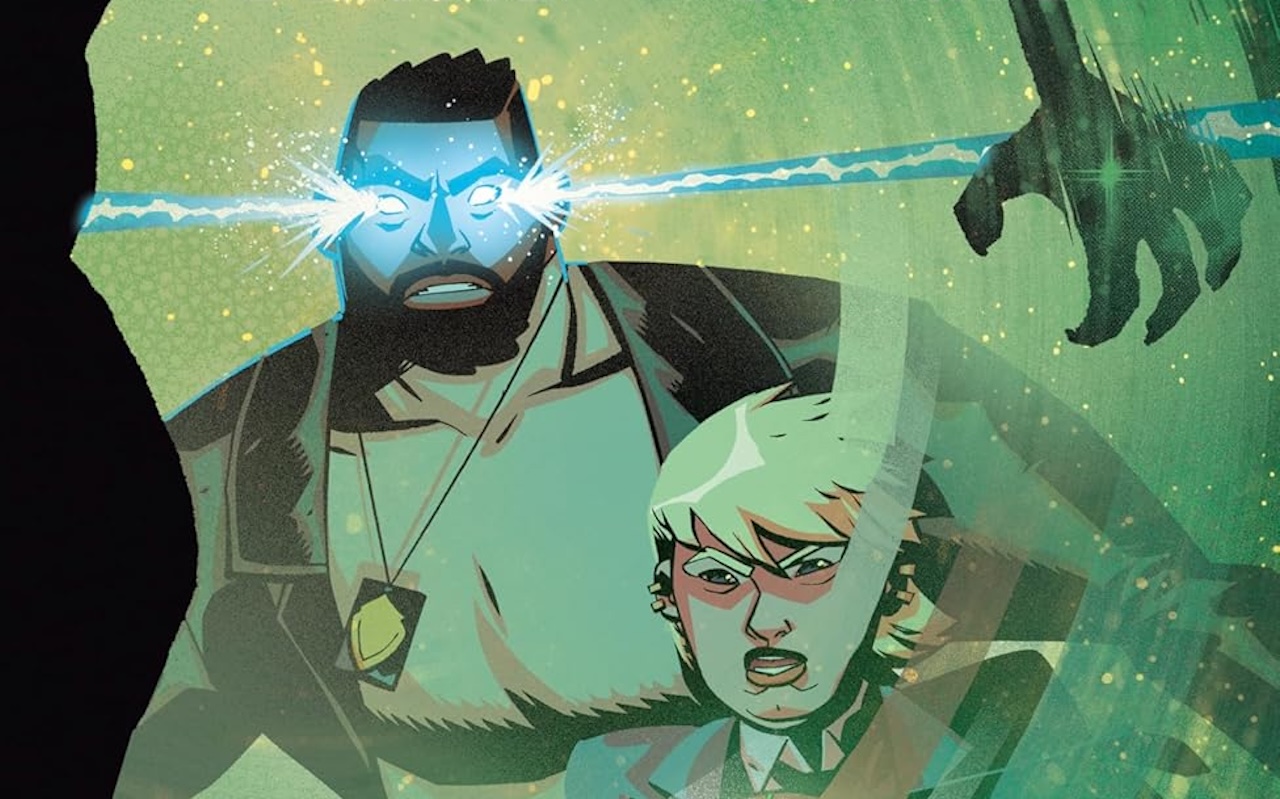

For all the police procedurals and buddy cop films in popular media, very few of them show off the mountain of work that actually goes into being a detective. It’s not all shootouts and toppling crime syndicates; there’s paperwork to be done, lines to toe, and there’s the simple fact that some people can wriggle free of consequences due to money or influence. Brian Michael Bendis and Michael Avon Oeming don’t shy away from this difficulty in Powers 25; in fact, the conflict in Powers 25 #5 stems from detectives Kutter and Moon deciding to arrest super-genius Archie Gates.
This immediately leads to a dressing-down from their superior, who’s concerned that arresting Gates will spark a media firestorm. Kutter and Moon rightfully point out that Gates stole a body that’s part of the murder investigation they’ve been conducting, which is extremely suspicious – not to mention illegal. It’s Deena Pilgrim who adds another wrinkle to the discussion, pointing out that the world’s smartest man, by letting himself be arrested, benefits no one but himself, and that any attempt to interrogate him will backfire.
It’s moments like these that highlight the special blend of crime fiction and superheroics that makes Powers what it is, and Bendis’ script makes a meal out of many tense moments. From Moon returning to the scene of the crime that kicked off the series, to Kutter ignoring Pilgrim’s advice and talking to Gates, to a face-off between Gates’ lawyer and the Powers division’s captain, Bendis packs each scene full of pointed dialogue, a volley of barbs, and some great one-liners. Probably my favorite exchange in the book happens between Moon and Pilgrim, where they discuss the possibility of whether he can fly or not.

Dark Horse
Oeming matches that energy with his artwork, effortlessly shifting between scenes while also letting characters’ facial expressions say what dialogue can’t. Gates is the biggest example of this; he only speaks when he chooses to, but his face betrays irritation at being held against his will, not to mention having to deal with people who aren’t on his intellectual level. Another page cuts from the relatively peaceful situation at Powers HQ to the inside of Legacy Star Labs, where Kutter and Moon are surrounded by a group of high-tech scientists brandishing weapons and armor that feel Kirbyesque in design.
What really stands out in Powers 25 #5 is Nick Filardi’s color art. Based on the setting, the colors will change, but never fail to catch the eye. Legacy Star is a vibrant, burning red that sticks out like a sore thumb; compare that to the cool blues and blacks that make up Powers HQ. The cell where Gates is being held pulses with a sickly green light, representing the technology that suppresses suspects’ powers. Even the Powers themselves have distinct color hues, whether it’s a man glowing bright orange as he grows to a massive size or Moon’s eyes growing a bright blue (complete with Kirby Krackle).
Powers 25 #5 underlines the reality that the pursuit of justice isn’t as black-and-white as it seems and throws in a few new wrinkles into its ongoing narrative. In short, it’s the perfect noir, with a dash of capes and cowls – just how I like my Powers.




You must be logged in to post a comment.