



From the very first frames of Return to Silent Hill, something immediately feels wrong, and this will only make sense to those who remember the source material. Originated as the 2001 survival horror game Silent Hill 2, which was less interested in being a direct sequel to the first entry of Konami’s horror series, and told a more personal psychological story that added another perspective to the fictional town set in Maine. Considered a high point in the Silent Hill series and a key example of video games as an art form, adapting Silent Hill 2 to the big screen is a daunting task.

First announced in late 2022 – around the same time that Bloober Team announced their remake of the video game – Return to Silent Hill also marks a return for director Christophe Gans who had previously put his own stamp on Silent Hill with the original 2006 film, a visually impressive if narratively incomprehensible adaptation. Although Gans had initial plans to adapt the second game decades ago, what we got is something that fundamentally misses the point of what that game was about.
In terms of the basic premise, Return to Silent Hill at least gets that right as James Sunderland (Jeremy Irvine) receives a letter from his lost love Mary (Hannah Emily Anderson). As James heads back to the town of Silent Hill expecting to find Mary at their special place, the town itself is plagued by terrifying creatures and begins to question his own sanity.
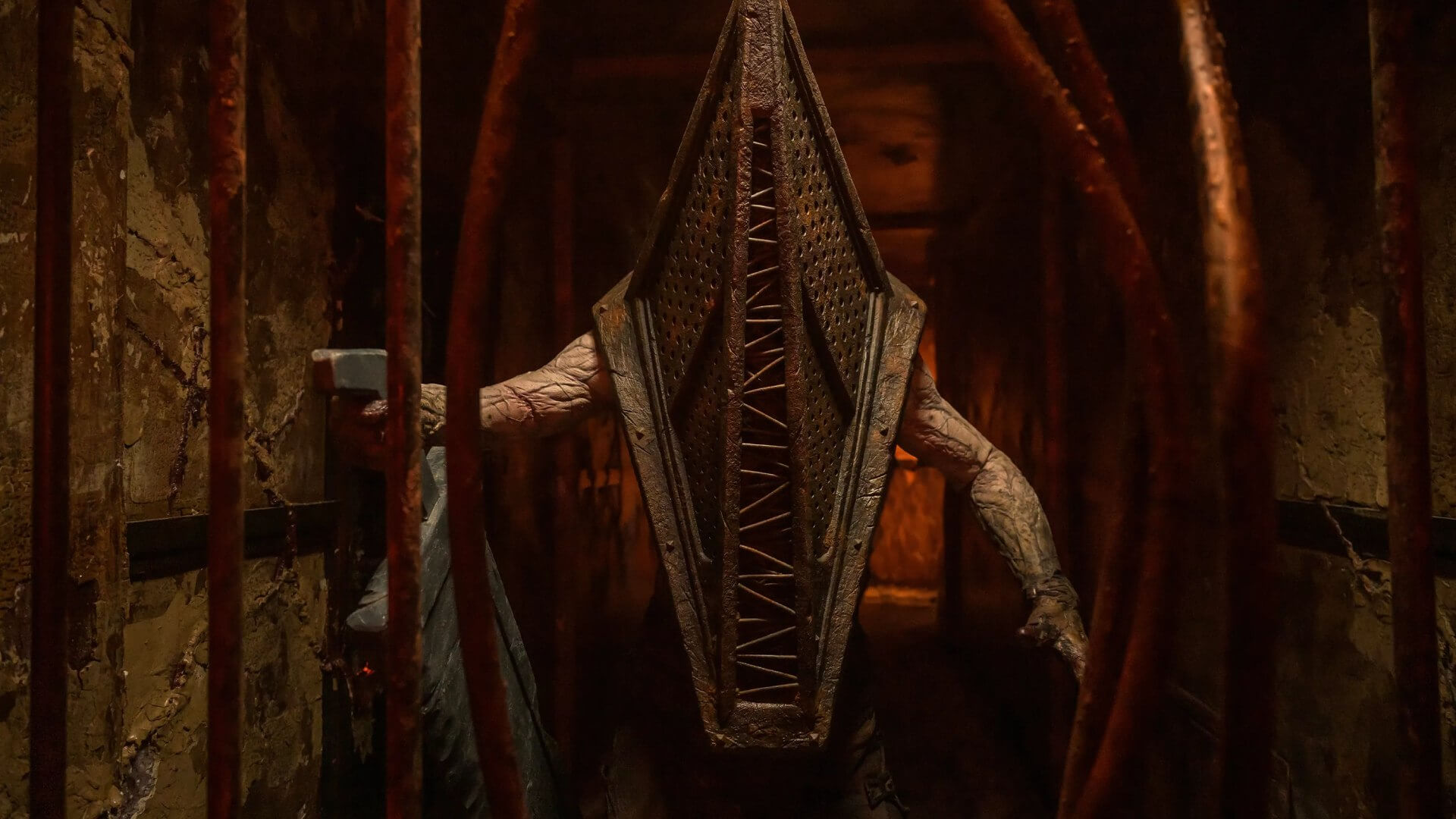
Christophe Gans has always been an interesting genre director as prior to 2006’s Silent Hill, he made Crying Freeman, an early example of live-action anime made in the west, and Brotherhood of the Hood, a horny and stylish blending of multiple genres, ranging from French historical drama, swashbuckling martial arts actioner and monster horror. From a technical standpoint, Return to Silent Hill is visually solid in creating the town that is consumed by fog, not just the well-realized creature designs from the game, where there is a semblance of humanity that has been distorted and twisted into something horrific. Even threats like the iconic Pyramid Head or the Bubble Head Nurses are performers in prosthetic makeup, so there is practicality in the art design without always relying on CG.
However, whatever horrific creature scuttles their way into the screen and gory mishaps that occur, it doesn’t make the horror that effective. While there is the occasional jump scare, Gans just doesn’t know how to translate the gameplay of surviving your way through one level to the next into a coherent cinematic piece. As James goes from an apartment building to a hospital – each having their own threat for our protagonist to just run away from, as opposed to being equipped in a pipe or a gun like he does in the game – the whole thing feels disjointed as that is largely down to how Return to Silent Hill tells its story.
More so than the monster bashing, Silent Hill 2 is about the psychology of its characters, something that Return to Silent Hill adaptation just negates the whole way through. While Jeremy Irvine captures the mental torment of James Sunderland as seen during the initial minutes, the film itself focuses on other aspects which deviate from the source material. The film or indeed the other inhabitants of the town never challenges its protagonist who is troubled and clearly has demons that we should know throughout his hellish journey, but instead the story is more about confronting external threats that tie into the town’s backstory.

At the time of this installment’s release, it will have been twenty years since Christophe Gans’ first visit to Silent Hill, and much like James Sunderland, the French director can’t seem to let go of the past with the attempt to recapture what he achieved back in 2006, which wasn’t that great the first time. In his attempt to recapture former glory whilst putting his own spin on a specific narrative that is beloved as it is disturbing, Gans’ latest entry is overall a disappointment. But at least, we got the game’s composer Akira Yamaoka doing the film’s score that will touch on the players’ nostalgia.




You must be logged in to post a comment.