

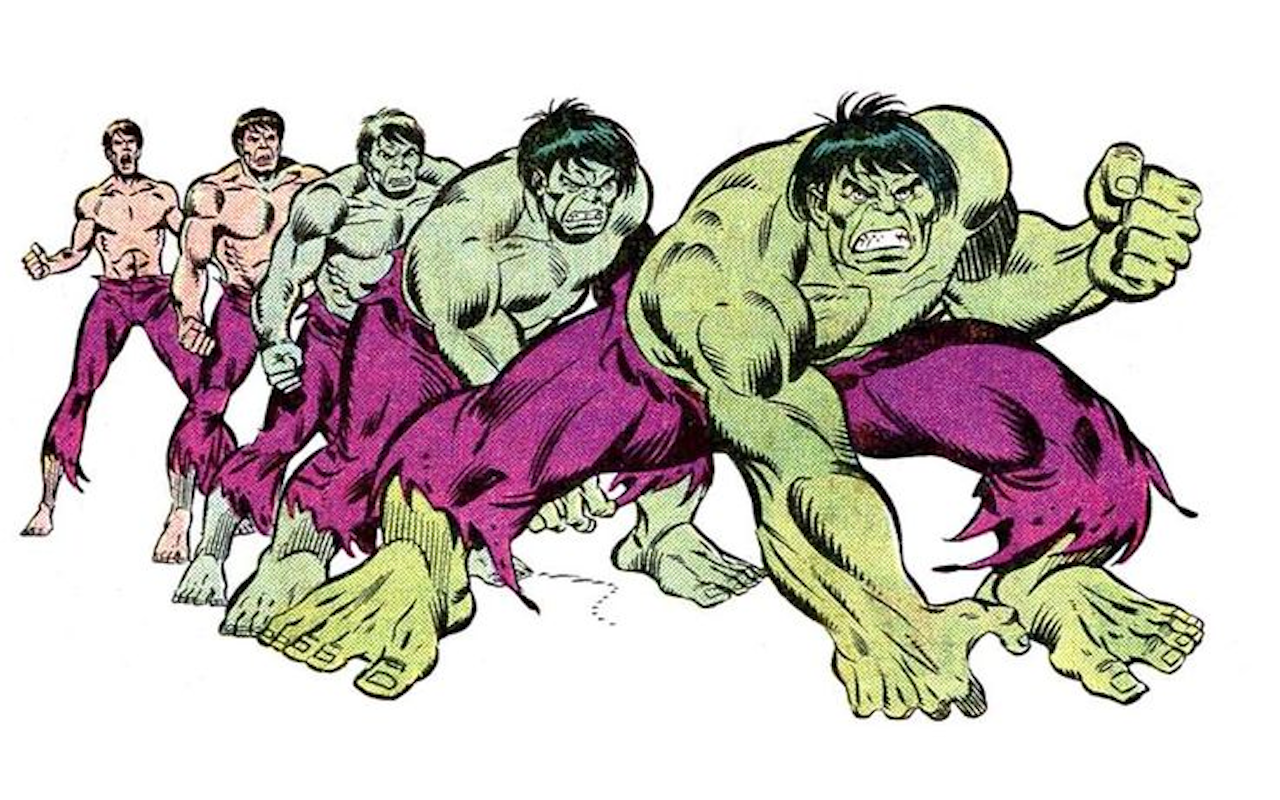

Sal Buscema didn’t draw “flashy,” and that’s exactly why his work still hits. His lines moved deliberately. His visual storytelling was clean without being sterile. And when action needed to land, when a punch had to feel like it reached the bone, Buscema knew how to make your eyes snap to the impact before your brain even caught up.
On January 24, 2026, Buscema passed away at age 89, leaving behind one of the most quietly essential bodies of work in mainstream comics. Over more than four decades, he penciled and inked across the Marvel Universe, helping define the look and rhythm of The Avengers, Captain America, Defenders, Spectacular Spider-Man, ROM, New Mutants, Thor, and, of course, The Incredible Hulk, his signature character.
Buscema was born on January 26, 1936, in Brooklyn, and he often credited his older brother John as the gravitational pull that directed his path. But far from a footnote to somebody else’s career, Sal was a pillar of an era, especially once Marvel’s monthly machine needed artists who could deliver strong storytelling on time, every time.
He started in commercial art, and that training mattered. In an interview with Bryan D. Stroud, Buscema described his Army years as an illustrator for the Engineer Corps as one of the earliest stretches of “professionally published” work he could point to. That pragmatic, problem-solving mindset never really left his comics. A Sal Buscema page doesn’t ask you to admire it. No, it asks you to follow it. And you do.
That might be the most underrated skill in superhero comics: making the story read like it’s happening in real time. Buscema had it. He also understood the unglamorous truth of the job: the monthly pace rewards artists who can make decisions, not just drawings. He could be fast, yes, but speed wasn’t the point. The point was momentum.
That’s one reason his Hulk run remains such a defining stretch. From the mid-’70s into the mid-’80s, Buscema’s Incredible Hulk wasn’t just a steady hand on a flagship title—it was the book’s visual identity. He drew the Hulk as a force with weight and temper, but also as a character who could be monstrous, tragic, and weirdly funny without breaking tone. Buscema himself told Stroud, “My favorite would be the Incredible Hulk. Far and away.”

Spectacular Spider-Man #215.
Credit: Marvel
For me, though, it was Buscema’s Spectacular Spider-Man run that really flipped the switch. As a younger reader, those issues were my first clue that superhero comics didn’t have to feel safe or sanitized. They could be tense, unsettling, and emotionally sharp. His style on Spectacular felt literally edgier: figures built with harder angles, punches and kicks thrown with a sharper snap, bodies crashing in ways that appeared aggressive rather than choreographed. The book carried a darker, more adult mood than I expected from Spider-Man, and Buscema’s art did much of the heavy lifting. The line work, the staging, and the violence itself told you this wasn’t the same playground. That run taught me early on that superhero comics could grow up with their readers.

Spectacular Spider-Man #215.
Credit: Marvel
Remembering him, Spider-Man writer J.M. DeMatteis called Buscema “an impeccable visual storyteller and a total professional,” adding that he was “a gentleman.” It’s a description that fits not just the work, but the way he approached it: Without ego, without excess, and without ever losing sight of the reader.
He also had strong opinions about what made comics comics. Buscema championed the Marvel method and felt that full-script storytelling should be restrictive, arguing that artists think visually in a way that’s hard to replicate panel by panel from prose. Whether you agree or not, it’s hard to read his best work and not see the case he’s making. When Buscema is firing, the pictures do the heavy lifting.
In the interview with Stroud, Buscema discussed his formal training at the High School of Music and Art in New York, the same institution later associated with the TV show Fame. He admitted, with real humility, that he didn’t take full advantage of it as a kid, but he stuck with it to build a career. He also said something that looks like the thesis statement for his life in comics: “I wanted to get right into the business and am not sorry that I did… it worked out for me, and I’ve never regretted it.”
That lack of regret is earned. Buscema wasn’t a myth; he was a worker. He did the jobs, hit the deadlines, and made the characters look like themselves. He drew heroes the way readers needed them drawn: clear, dynamic, and alive on the page. And he contributed to shaping a “family legacy” at Marvel, not just through his brother, John, but also through decades of work that made the Marvel Universe feel consistent month to month.
It’s easy to celebrate comics history through the loudest innovators. Sal Buscema deserves to be remembered for something else: reliability as artistry. He was the artist you could trust to deliver a story with clean motion, strong emotion, and no wasted beats. In a medium built on momentum, that’s foundational.



You must be logged in to post a comment.