

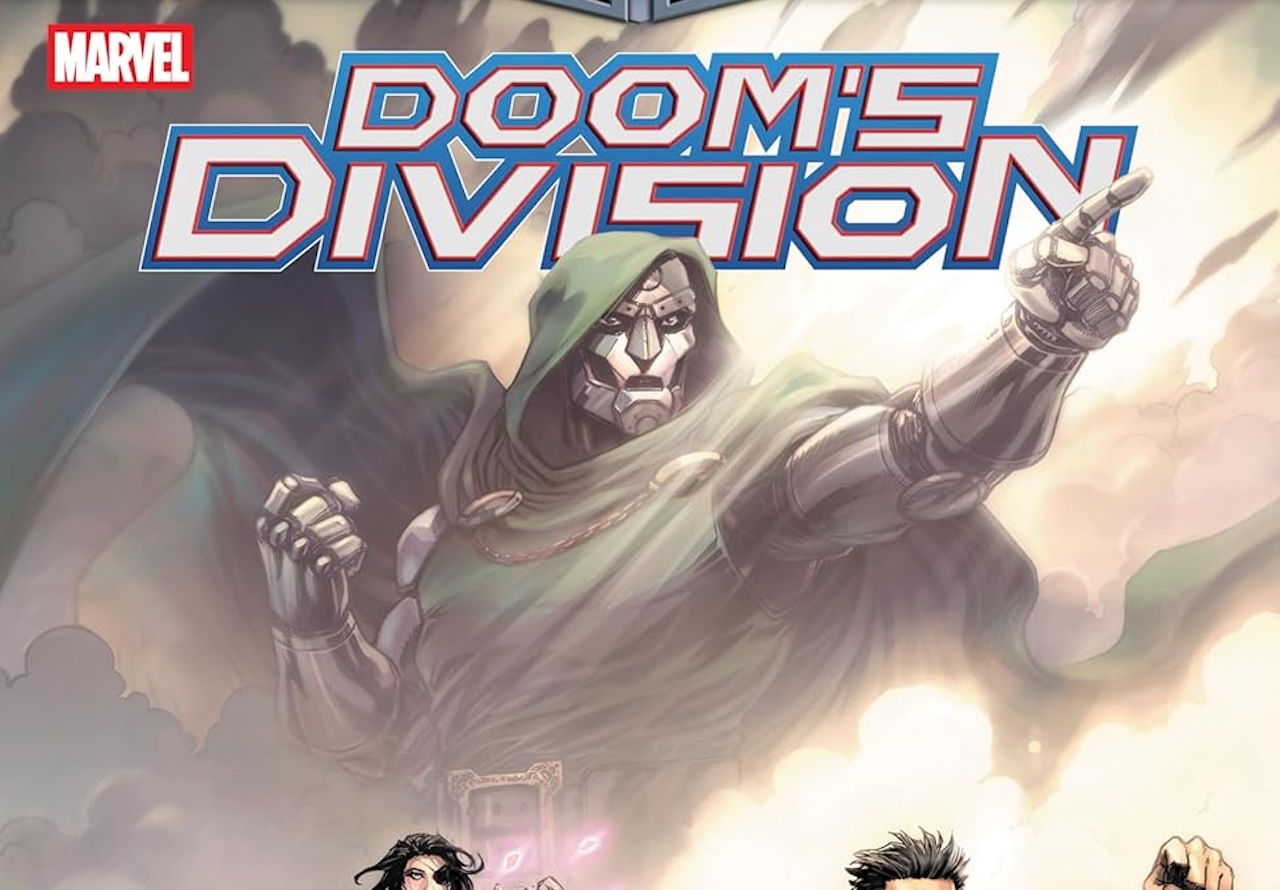

Instead of another tour through Doctor Doom’s iron ego, Doom’s Division zooms out to the people who have been made to enforce his will—a state-sponsored super-team tasked with keeping the myths intact. What starts as a clever genre remix (superhero book as authoritarian workplace drama) quickly reveals itself as a sharp study in loyalty, propaganda, and what heroism looks like when your boss is a dictator with a god complex.
The story reframes superheroics as a state utility, a public service shaped by propaganda and fear. Doom’s handpicked team isn’t assembled to save the world (he already did that himself) but is instead tasked with stabilizing his regime. Their missions feel less like classic Marvel spectacle and more like counterintelligence operations: crush dissent, neutralize outside influence, and keep the image of Doom-as-savior perfectly intact. It’s a smart pivot from the usual “evil genius monologues” into something colder and more systemic.
Like any event tie-in, most of the plot is tied to the Marvel universe-at-large, which was at the time under the metal thumb of Doctor Doom, who had taken up the Sorcerer Supreme mantle as well as the role of, well, Emperor-of-the-Entire-Earth. This is a large, ever-present framing device for the story, and Yoon Ha Lee navigates its intricacies with skill and enough heart to possibly save this world from its malevolent leader.

Marvel
The book finds its tension not in whether Doom is evil (Marvel settled that decades ago) but in how people justify working for him anyway. Some believe in Doom’s will. Some are terrified. Some just want a uniform and a paycheck. That moral murkiness is where the series does its best work, turning every action scene into an ethical compromise instead of a clean victory.
As a collected trade, the story reads like a compact political thriller disguised as a superhero story. It doesn’t aim for cosmic stakes; instead, it interrogates the machinery of power at street level. Doom looms over every page, but he barely needs to appear.
The bulk of the heroes in this book are from one of Marvel’s most interesting and least utilized teams: Tiger Division, a collection of heroes from South Korea. A new book with these characters (like Taegukgi, Mr. Enigma, The General, Luna Snow, and more) is exciting no matter what the situation is, but the follow through on this trade makes it a dream come true for fans of this team. Tiger Division is expanded with the addition of with other heroes from across Asia, like Wave and Karma, who add to the dynamic and broaden the cultural scope of the book.
The ease with which this team works belies the complicated truth behind its existence. They are tasked with being part of Doom’s regime, and no small part of it, at that. This would create moral quandaries for any of your favorite Marvel heroes, but the geopolitical nature of this book takes those dilemmas to a new level. While General Ross was busy bombarding Latveria with his giant, red, American fists, Tiger Division was thinking, planning, and playing the long game. Doom’s Division would be a great book in a vacuum, but reading it alongside some of the other One World Under Doom titles adds to the spectacle.
One of the more effective structural choices in Doom’s Division is how rarely Doom himself needs to take center stage. The book treats him less like a character and more like a governing principle. Orders arrive, consequences follow, and the team reacts. This distance keeps Doom mythic without diluting his menace, and it allows the narrative to focus on the psychological toll of operating under an absolute authority.
The thematic focus on institutional critique doesn’t come at the expense of emotional immediacy; if anything, this book is all about emotions and the more human, detailed aspects of living under fascism, especially when that fascism appears as paradise to so many regular people in the Marvel universe. As readers, we (mostly) know what’s up with Doom, the how and why of White Fox’s capitulation, and Sunfire’s ardent rebellion. But how does it really feel to do the wrong thing for the right reasons? To give up your own sovereignty for the potential safety of your family and loved ones, your nation as a whole? These questions are asked and answered in these pages in subtle and effective ways.

Marvel
The art by Minkyu Jung rises to meet the quality of this high-concept story. The character designs themselves are physically diverse, from the surreal living-totem of The General to Gun-R II’s robotic nature, and then across the spectrum of mystical magic users and macho powerhouses. The action sequences often explode within the bounds of each panel without cluttering the page. Scenes with large crowds and even larger enemies are matched with stark, sometimes abstract personal moments.
Mattia Iacono uses color in big, bright swaths that always jump off the page. Each scene brings a barrage of colors that shouldn’t work—this many different colors from opposite ends of the spectrum should clash. Instead, they dance. Iacono’s even-handed palette gives powers, super-suits, and magic blasts the same visual importance as the book’s emotional beats.
Doom’s Division is easily one of the high points from this otherwise underwhelming event. This book, more so than any other book in the event, gives the reader an idea of how complicated Doom’s takeover was. If you’re reading this event, don’t miss this integral book. If you aren’t reading this event, let this be the one book you read from it.



You must be logged in to post a comment.