


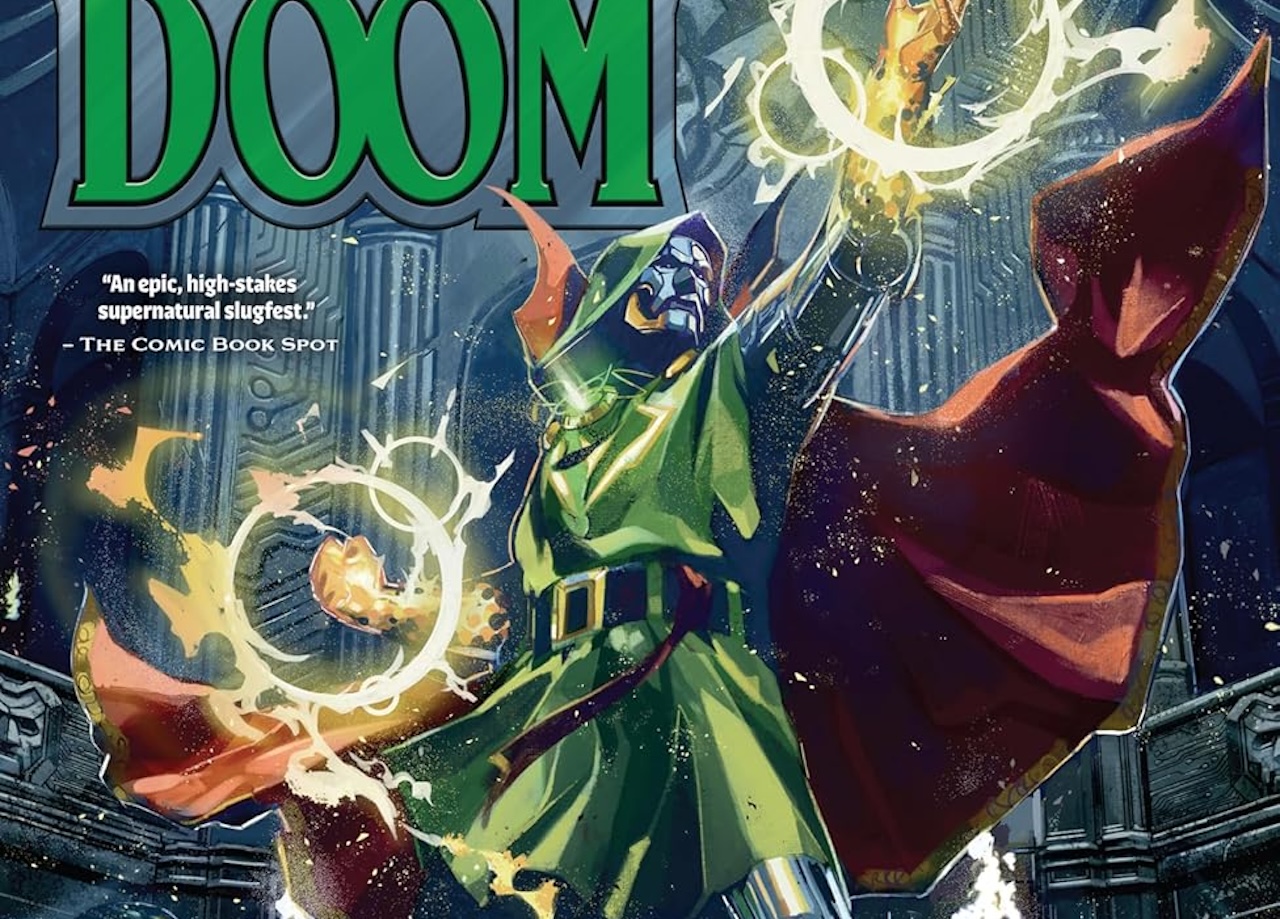

One World Under Doom continues the storyline of Doom assuming the mantle of the Sorcerer Supreme. He has re-emerged from his absence and declared himself ruler of the planet with full support from global leadership. It’s up to the usual cast of heroes, Fantastic Four, Avengers, Spider-Man, and the X-Men, to put a stop to this new status quo.

Or should they?
Like all good Fantastic Four stories, a complex moral quandary drives the event. This one has a really fun build, but it just didn’t dare to go all the way. “Doom was right”, and his winning the public favor and the Avengers and Fantastic Four being presented as the bad guys goes much longer than expected in the trade. This refusal by the heroes to believe that, since they can’t save the world’s problems, how dare Doom try to? An almost arrogant attitude from the heroes that they have to justify Doom being in the wrong because the status quo of them having a villain to punch was more important than Doom actually solving the world’s problems and creating harmony. This out-of-touch feeling from the heroes and their “knowing” what’s best for the citizens of the world, while Doom actually begins to give people what they want (thus eliminating the need for our heroes in their current state), I got to tell you, I was really digging it. The “heroes” even bring in super villains to help them topple Doom. And not to fight anything Doom has done so far in the One World Under Doom story, because at this point, he has just given everyone universal basic health care and higher quality education, but just because they need to find something, anything to get dirt on him so they can justify punching him.
Then it stops being interesting. Doom is actually bad, and everything he was doing was because he is a super villain and womp womp.

Marvel
Where it gets thematically murky for me is that Ryan North uses current-day language and events to evoke the idea that there has to be something sinister bubbling under the surface, but there shouldn’t be at this point in the story. They make it clear that Doctor Doom has done nothing to the leaders or used any of his newfound cosmic power as Sorcerer Supreme to do anything nefarious; he was just the first one to convince the world that our artificial borders are silly and that all humans should be guaranteed a certain level of basic needs. It gets even stranger because after the reveal of what made him evil, it seems unnecessary for the master plan to succeed. The reveal makes you believe that he needed to juice up his magic powers, but throughout the first act its established he barely used any of his magic (only to be in multiple places at the same time), which seems low-level for a Sorcerer Supreme, so why did he do the evil thing? Just because? The suggestion of fascism is presented at the end of the event, but to me, fascism doesn’t occur until after his evilness is revealed. With this storytelling structure, the villain will come to the conclusion that “I have to do this bad thing for everyone to have a good thing,” but the bad thing did not need to occur. So if the bad thing was removed, isn’t it just a good thing? I struggled with what I feel to be positives for humankind with charged language layered on top of them, but no real driver or connection to justify the heinous act.
One World Under Doom becomes a standard superhero story after the big reveal, and the story works well. Nicely paced and with an exciting final act. It acts as a tidy reset button for the Fantastic Four universe and allows the Sorcerer Supreme story to move to another realm of Marvel.

Marvel
We should talk about the dinosaur in the room. I could have done without T. rex Doom. Up until that point, the series had developed a very serious air about it that was really sucking me in. And then the T. rex came. That isn’t to say the design and use of the T. rex wasn’t great – R.B. Silva graced us with some absolutely beautiful splash pages, but I just didn’t love the inclusion. It felt like if they would have done a Thanos-Copter bit right before Thanos ripped the infinity stone out of Vision’s head.
Art was great. Some minor issues, like inconsistent character reactions, such as a nitpicky example of a key panel where the Thing was involved, but all of the characters’ lines of sight were not on the primary shock, and were focused elsewhere. Fantastic Four, especially Reed Richards and Doctor Doom, are known for their philosophical debates. An event dedicated to Doctor Doom is going to have that. As such, R.B. Silva was expected to draw action panels as the new Sorcerer Supreme fights all of Earth’s heroes, but he also needed to do the exact opposite when Reed and Doom engage in a battle of ideas.
A highlight of the series was a televised exchange of ideas between Reed and Doom. It’s a debate, so it is what you imagine of two people talking back and forth. Still, R.B. Silva was able to create interesting new panel layouts or character movement to keep the energy up in a format that does not do “two people sitting and talking” very well. Many of the quieter moments had either a gorgeous backdrop or intricate character design to elevate the pages, and a fantastic job overall by R.B Silva of capturing the full spectrum of the series.
I really enjoyed the color palette used throughout the series. The subdued, washed-out bright colors, with the overwhelming darker colors, highlight the oppressive feeling of the entire series.
For a $19.99 trade, One World Under Doom is a great value. The trade contains nine meaty issues with a whole slew of characters. Marvel also makes sure to include all of the alternate covers of each issue, which I love. My interpretation of the themes of One World Under Doom will surely vary from everyone else’s, but there’s enough meat here to create plenty of discussion for your next comic book club (Join AIPT’s!)




You must be logged in to post a comment.