

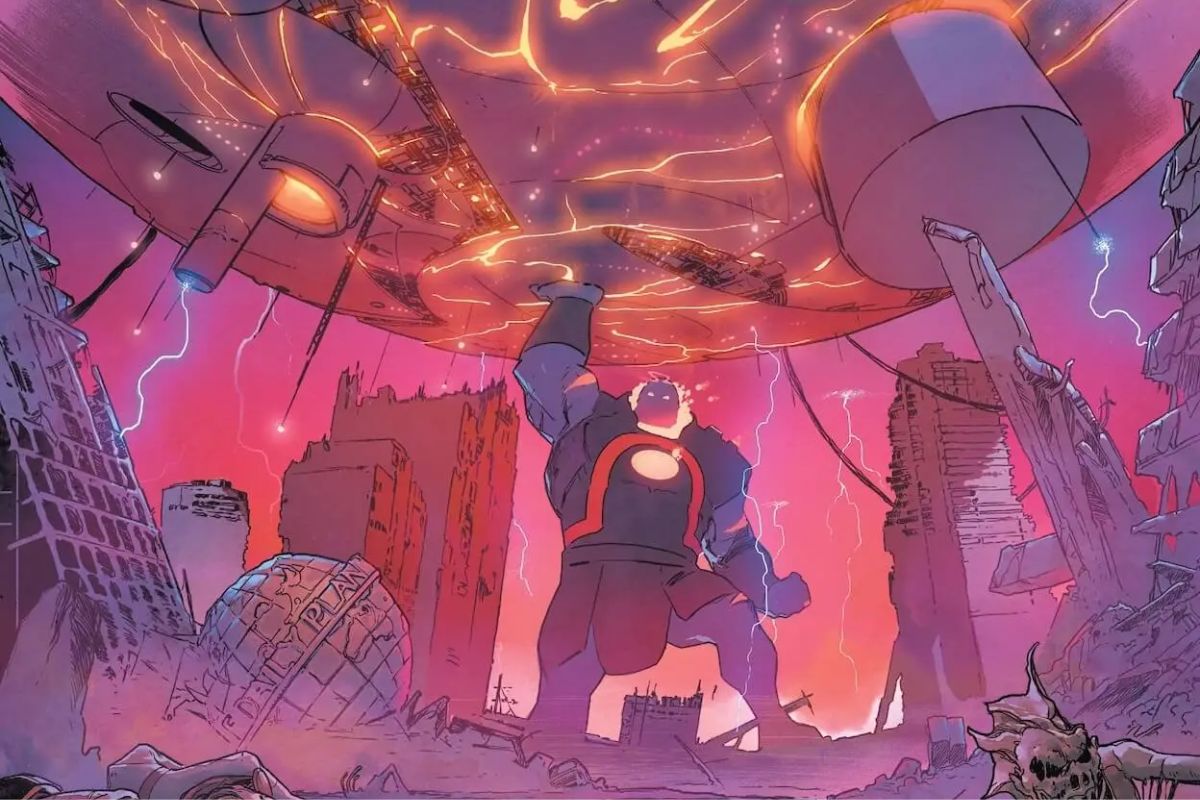

DC K.O.’s epic finale is here, but how fans feel about the overall ride is where the mileage will vary. At best, fans are likely to fall into two camps after reading DC K.O. #5: those who enjoyed the event for what it was and those who will scratch their heads asking, “What exactly is the message here?”
For fans who only showed up for the ride and enjoyed DC K.O. for what it was, Scott Snyder and Javier Fernández deliver a straightforward epic finale in issue #5. This makes sense since the whole story is practically an RPG in comic form. It has even alluded to this fact by consistently juxtaposing the fight inside the Heart of Apokolips with DC’s Trinity playing a board game at Superman’s house. This continues into issue #5, with Xermanico handling art duties for these interlude sequences.
Similarly, every issue has depicted fun, battle-royale-style fights where fan-favorite heroes and villains fought each other to progress to the next level until the final level was reached. Like an actual RPG, DC K.O. #5 sees the newly crowned King Omega fight the final boss – in this case, Darkseid. The rest of the issue plays out exactly the way it would at the final level of an actual game: the King Omega dukes it out with Darkseid until one of them is left standing – in this case Superman. This epic final boss fight is even captured in the artwork by Javier Fernández and Alejandro Sánchez’s bright color palette.

DC Comics
Though he ditches the “board game” panel layout of the previous issues, Fernández still delivers energetic and dynamic action sequences for the fight between Superman and Darkseid. This momentum especially comes through in sequences where Darkseid and Superman fight across different eras of the DC Multiverse – namely the previous Crisis events that marked a new beginning, such as 2011’s Flashpoint and 1985’s Crisis on Infinite Earths. It even sees them pass through the actual beginning of the DC Universe – the one that started with Superman’s arrival in 1938, and the world that canonically later became known as Earth-2.
It’s important to note, however, that Snyder and Fernández don’t aim for spectacle alone for the finale – they also answer the biggest burning question of the DC K.O. event: should any one person decide the trajectory of the DC Universe? Though it ends with the meta answer that the DC Universe needs new voices to thrive (which is absolutely true), it also begs the question of whether or not this initiative required another world-ending Crisis event to achieve. Even more so since DC K.O. follows the pattern of every post-Crisis event where the universe (or multiverse) is threatened, but a cosmic deus ex machina saves the day.
This is where the other side of DC fandom will likely ask, “What exactly is the message here?”, which is also a valid question. Despite being ambitious in its scope, DC K.O. #5 doesn’t exactly end with any observable changes to the DC Universe outside of its pillar hero, Superman, going away to parts unknown. Characters are also not shown to be significantly changed or profoundly impacted by the story’s events outside of Lois Lane. For the most part, they just resume their lives as if nothing had happened.
Where the message really starts to lose itself, however, is in the epilogue by Joshua Williamson, Xermanico and Wes Craig. Rather than reach a definitive conclusion that launches DC Next Level, the epilogue also teases another future event involving DC’s Absolute Universe and another revision to Mark Waid’s already polarizing New History of the DC Universe involving Barry Allen. It even teases – to quote Grant Morrison – the “nineteenth nervous re-run of Crisis on Infinite Earths“.

DC Comics
With an epilogue like this, DC’s editors and creators really need to ask themselves an important question: “What do you want the main DC Universe to be?” If one major lesson needs to be learned from the high success of the Absolute Universe, it’s that it has a clearly defined throughline that’s successfully connecting with readers. In this case, the Absolute Universe is tackling today’s real-world problems with DC characters, but without losing sight of why people love them.
So what is the throughline for the main DC Universe? It definitely needs to break its cycle of canon revisions (which was never popular with fans to start with) and needs to go back to what truly matters to readers: telling stories that add meaningful new chapters to these characters’ publication histories. If the throughline suggested by DC K.O. #5 is a fully diverse DC Universe that embraces all types of stories and puts many more obscure characters at the forefront, then that should be the selling point.
DC Next Level being creator-forward is already an excellent first step in this direction, as DC characters need vision to succeed. Prioritizing creators for Next Level also honors the larger message of DC K.O. #5 of letting more people “win” and not having one single voice shape the entire DC Universe. If there are two things teased in the epilogue that DC can absolutely afford to drop, it’s the future nineteenth nervous rerun of Crisis on Infinite Earths, followed by another canon revision no one wants.
Future crossovers with the Absolute Universe are welcome, but the story still needs to justify the crossover to not negatively impact the success of the Absolute line.




You must be logged in to post a comment.