


One of the best anime series in recent years is Odd Taxi, which takes place in a world of anthropomorphic animals, where a walrus taxi driver converses with his passengers and learns about various mysteries and oddities occurring in Tokyo. Although its final episode revealed the truth behind its central mystery as well as the gimmick that all the anthropomorphic characters are actually human, the show was about the hidden truth that humanity can possess, which can be quite dark.
Considering that director Baku Kinoshita and screenwriter Kazuya Konomoto, both of whom worked on Odd Taxi, are interested in human psychology, they take a somewhat softer approach with their debut feature film. The Last Blossom centers on Minoru Akutsu, an aging yakuza who is serving a life sentence in prison. In the final moments of his life, a potted balsam flower begins to talk to him, provoking him to reflect on his life and his regrets about what got him there.
While the yakuza was a key element in the many moving parts of Odd Taxi, by solely focusing on one man whose life is built because of his involvement in the yakuza, The Last Blossom paints an interesting picture in interpreting the Japanese Mafia, which has always had a complicated history with the country. There is a discussion between Minoru and two young men about why they would join the yakuza, when one of them has the skills to get into college. For the younglings, it may seem cool to join a criminal organization, but we also see adults being ruthless in that position of power.
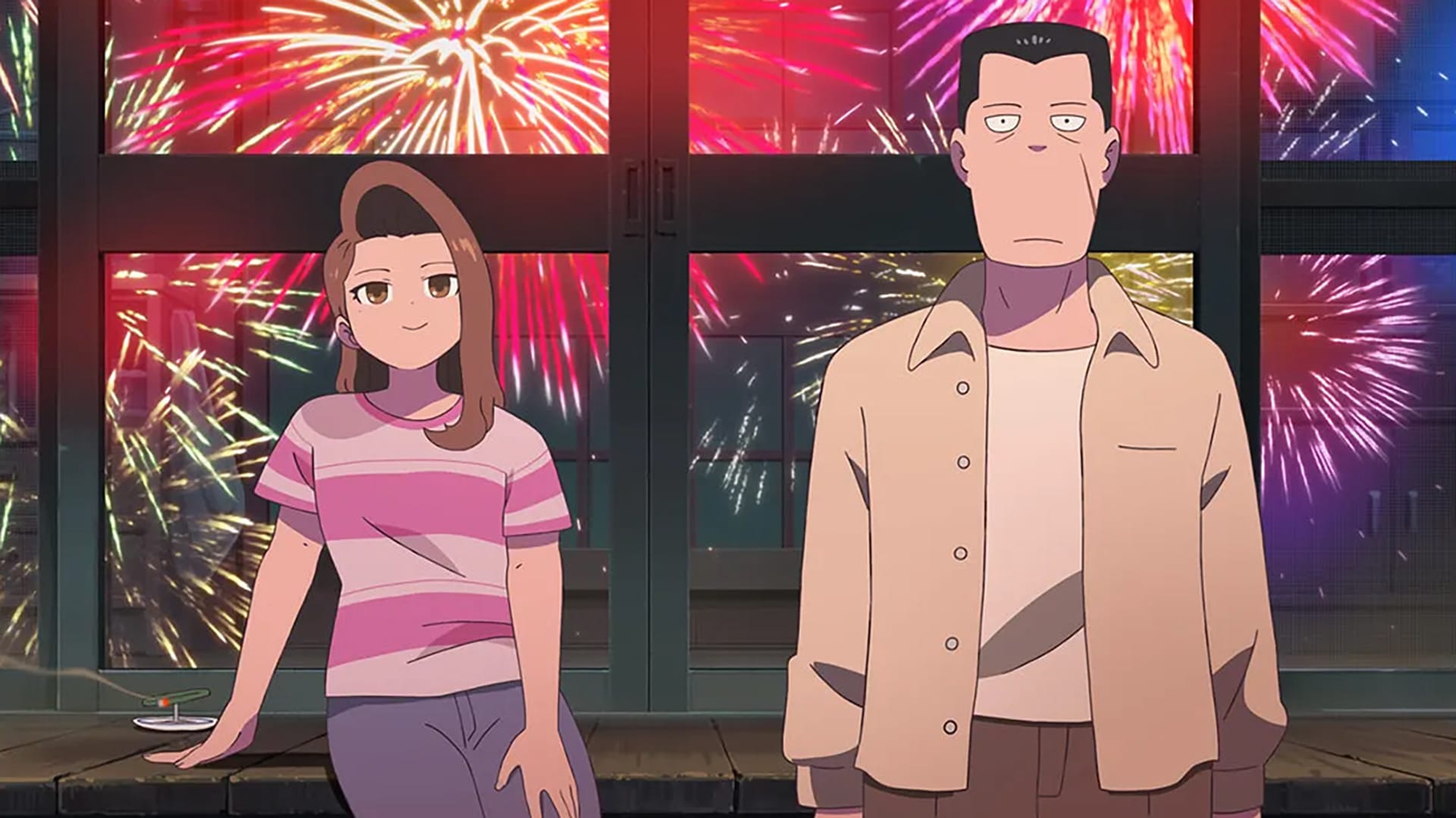
Animated by Studio CLAP, who previously done Pompo: The Cinéphile and The Tunnel to Summer, the Exit of Goodbyes, this film may open with a spectacular sequence featuring fireworks sparkling over the central setting, it is really a drama that showcases Kinoshita’s simplistic character designs. With the exception of the film’s one and only violent scene that becomes a turning point in the overall narrative, most of the drama is about Minoru and his newfound family with a woman he secretly loves and her son. He never opens to Nana and Kensuke emotionally, due to his occupation, but when medical troubles start to become life-threatening, Minoru starts to bite off more than he can chew.
As the film jumps back and forth between the 80s and the present day where Minoru spends his dying moments in prison, the one element that didn’t always sit well is ironically the titular blossom. While Kaoru Kobayashi and Junki Tozuka deliver soft vocal performances as the present and past versions of Minoru, you have Pierre Taki voicing the Hōsenka Flower with a loud and sneering tone. The flower may serve as a little devil that is constantly criticizing Minoru’s subdued introspection, the more that the film leans into this fantasy element, it occasionally drifts away from the straight drama which is when The Last Blossom works best.




