

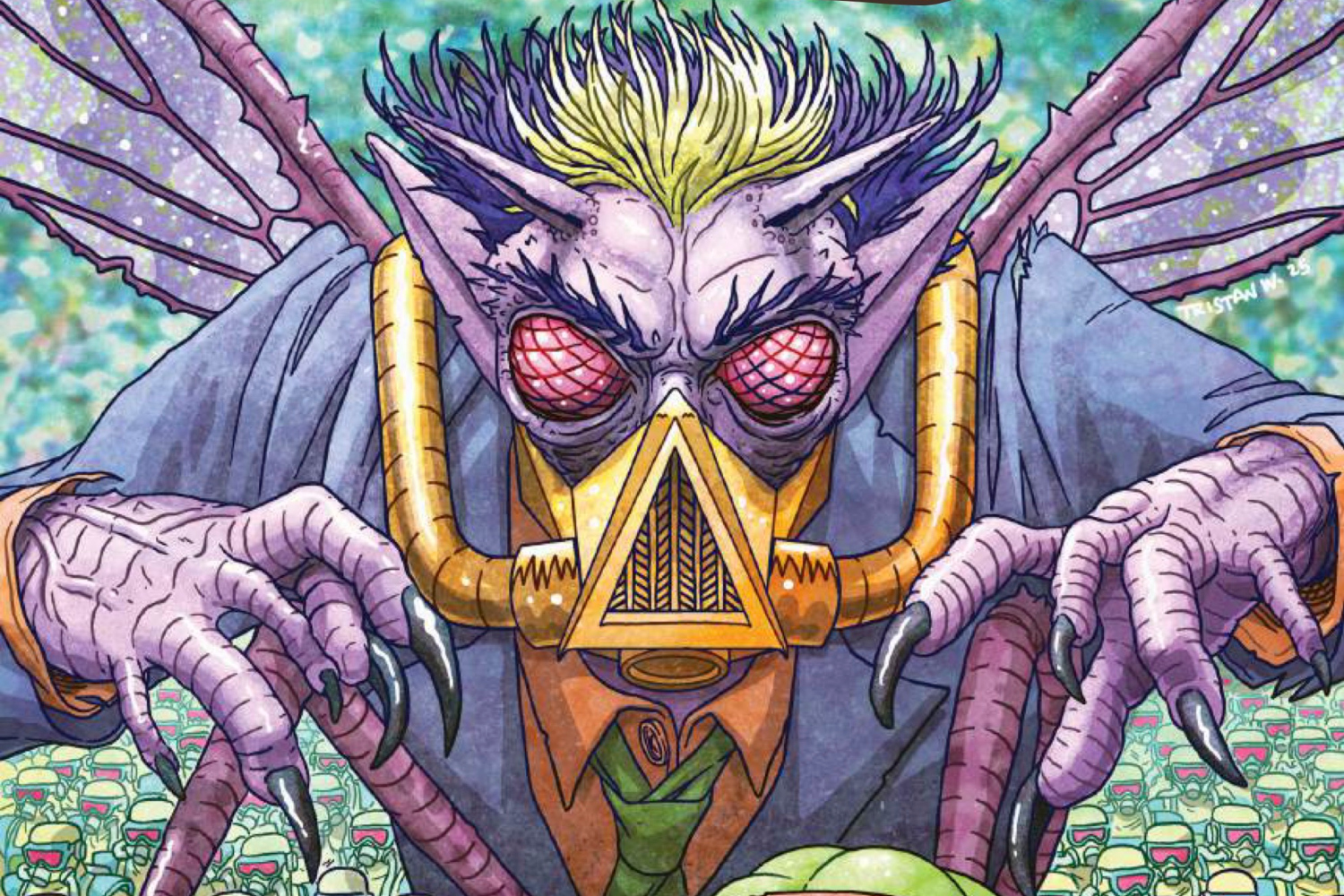

Toxic Crusaders does things a little different.
For instance, issue #4 saw the brilliant introduction of Headbanger to the Crusaders. Would most other books introduce a main character in the penultimate chapter of a five-issue miniseries? No, and for a myriad of narrative and world-building reasons. But Matt Bors and Tristan Wright did, and Toxic Crusaders still managed to be both a great platform for that multi-headed mutant and another daring entry in the Crusaders’ ongoing war with the Smogulans.
And like its predecessor, Toxic Crusaders #5 makes some important decisions that might go against the grain, but ultimately work in favor of this weird and wonderful story.

Courtesy of AHOY Comics.
Here’s what you need to know going in: The Toxic Crusaders weren’t just contending with the continued antagonism of Mr. K and his cohorts. After basically blowing up a power plant in issue #1, they also faced internal tension and the possibility of being “outed” by the young indie journalist Mesra. (Good kid, damn important work.) All of that came to a proper head in issue #5 as the Smogulans finally launched their big invasion of Earth, and that meant the Crusaders would have to come together to save the day.
Now, I won’t insult your intelligence: Of course they save the day (mostly) — it wouldn’t be a very good book if they left Earth to be conquered by gross bugs. (Again, it’s mostly un-conquered.) But it’s ultimately about the execution of this moment above all else, and what it means for both the long-term for Toxic Crusaders and the larger Toxie story from Bors and company. And so in that way, the creative team managed to buck expectations even as they knew they’d have to effectively wind up in one specific enough place by the issue’s end.

Courtesy of AHOY Comics.
And, again, you can mostly guess that place, but I still wouldn’t call it a “victory.” Without spoiling too much, let’s call it a draw, and while that’s not as deeply satisfying as an outright win, the result has a few key upsides. For one, it means this tale ain’t over, and so what we really got across these five issues is just a slow build to the first encounter, and that was more satisfying than anything (and without seeming needlessly deliberate).
Part of the magic of the Bors-led Toxic resurgence is the dedication to proper character development and world-building, and that’s exactly what we got: a thorough build-up of all the background and intricacies of this world so that things mattered and everything was in service of this world. (Plus, everything else from here on out gets to focus more on the team dynamics, witty banter, mutant-on-bug action, etc.)
But even more than that, this “draw” allowed the creative team a chance to compare and contrast both sides in an interesting way. It’s not about some false equivalency or feckless morality; rather, it’s about letting us see this lovable gang of losers as having more depth, and understanding that the Smogulans are just as desperate as they may be evil. Heck, Mr. K even got his own “origin” in the intro, and it goes a long way to contextualizing Smogulan culture.
And that kind of understanding (without promoting acceptance, mind you) is just another way Toxic Crusaders is such a compelling, human-centric tale at its core, and that it makes room for this truly thoughtful engagement as much as mutant-dog people. It’s about elevating the existing story, and finding ways to make it sing that really engage and challenge us beyond the wonderful mutant insanity.
Case in point: the action scenes across issue #5. The whole art team (with Wright joined by colorist Lee Loughridge and letterer Rob Steen) have done a damn good job of giving us lots of gross-out moments to coincide with the peak character designs and light touches that inform Tromaville.
But this feels like the first instance where we got deeper, more extensive fight scenes (and not just entertaining flourishes), and it was such a rush. Did this involve any absolutely stomach-churning displays? Yes, like Major Disaster throwing NoZone’s boogers like grenades. (A perfect visual encapsulation of the joy and novelty fostered by this series.) And those are important: This book isn’t just about being gross, but doing so in the name of using these instances as a springboard for greater character interactions or exploring certain team dynamics with a perpetual eye for fun.
But these action bits were mostly about generating tension and claustrophobic vibes as the Crusaders and the Smogulans fought their way through the neighborhood. That approach managed to 1) create a real sense of movement, and add a narrative arc to the “random” violence; 2) leave space for ample visual gags, which made the extended run of combat feel more textured; and 3) offer plenty of space for added development and character interactions, and that is, once again, always a draw no matter the mutant madness across each page. As much as this issue feels like a payoff or some kind of irradiated desert, it’s never empty calories.
This book is continually fostering and pushing toward some larger understanding of these people and what we’re really talking about here. It’s generally the same stuff (capitalist greed, environmental destruction, human ignorance and apathy, etc.), but after issue #5, it’s also about the need for conflict and revolution, and what it means to truly fight an enemy that maybe has it coming but also has clearly their own issues/dreams that they’re addressing.
And that’s when we arrive at another important point about Toxic Crusaders: the satire and social commentary. I’ve applauded Bors (and will continue to do so forever) for the whip-smart approach he’s taken to A) exploring the book’s many social themes with fresh depth and integrity and B) aligning those to our current moment in a really thoughtful manner. And while there’s plenty of that in this issue (there’s a perfect Trump joke/comparison that lands as both a chuckle and a gut-shot all at once), things felt different in this chapter.
I’d touch on earlier about the slightly sympathetic quality applied to the Smogulans, and how aligning our heroes and bad guys is a brilliant move to make readers really work through these themes in their gut and not just as mere though experiments. But there was also this decidedly feel-good tinge to this issue (which, again, they countered with a frustrating outcome that expertly tempered our expectations). That feel-good energy really felt like the first time Bors was “lecturing” us, and I’m not even that mad. Not that he was telling us to fight evil or be good (no, those messages felt ingrained to the story).
Rather, it felt like by the time we got a few monologues toward the end, he was trying to engage with us more directly. He was cutting through the story for just a sec, and reminding us of the real people at this book’s gooey heart. People, mind you, who not only wanted to show you the layers of this storytelling function, but also to give you a kind of gift. That if finales are about fan service, then the kind that Toxic Crusaders prefers is about connecting with others around problems, feeling the heft of community as an anti-venom for desperation, and hoping that we’d walk away with a surge of hope that maybe it’s not all lost. (Or, if it is all lost, there’s a certain camaraderie to be found in this shared misery.)

Courtesy of AHOY Comics.
Clearly, the fight’s not over — for us or the Crusaders, and in that way, we’re not just watching the team do their collective thang, but we’re now part of this toxic squad more than ever before. If we’re lucky, there will be more actual story to tell down the road, and we can keep rooting for the Crusaders as they reach the really tricky part of their efforts. (That’d be keeping their team going as the Smogulans reach new levels of desperation/violence.)
But even if we don’t get another series, Toxic Crusaders was deeply satisfying, and this finale is a snapshot of all that goodness. It was rich in people and their ugly dreams and disappointing shortcomings; it gave us hope but never blew smoke up our shared bum; it cut down our institutions but never made it feel cheap (quite perfectly American, I’d say); and showed us that the way forward remains through one another (and our ability to fight).
Toxic Crusaders really did things a little differently, and for that I’m perpetually grateful.




You must be logged in to post a comment.