

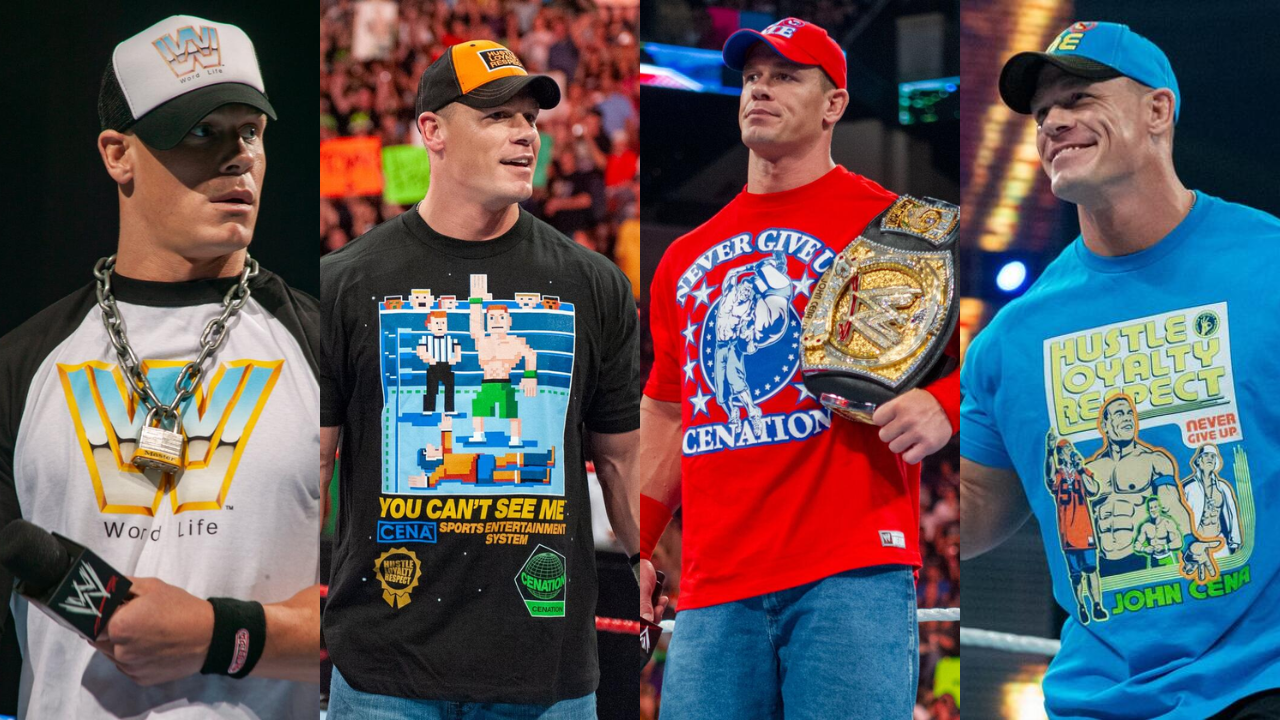

When you picture a John Cena entrance in your mind, what color shirt is he wearing? The answer to this question likely depends on when you started watching wrestling, what your relationship to Cena has been, and potentially which video game you’ve most frequently played.
I started watching WWE on a regular basis in January 2011, so the first color I associated with Cena was purple. This was the era of “Super Cena,” right before The Rock started calling him “Fruity Pebbles,” and I certainly remembered this Cena being super. He won an Elimination Chamber match that February and went on to main event WrestleMania XXVII that April, where he’d debut his red attire.
Looking back at that time, though, I don’t remember “Purple Cena” being as strong as “Red Cena.” Part of this was due to Purple Cena starting a small losing streak right as I got into WWE. The other part is me distinctly remembering that, despite losing that WrestleMania main event, Red Cena still went on to win the WWE Championship twice.
If Purple Cena is “my” Cena, I felt it a shame to recognize that Red Cena would probably beat my Cena in a fight. But what about the other colorful Cena variants?
Was Red Cena truly the winningest Cena of them all, even knowing he lost both of his WWE Championships before switching shirts? How about Purple Cena’s accolades from before I started watching, when he demolished the Nexus and won the tag titles twice? How about Baby Blue Cena, who had a crazy run as United States Champion? Or, perhaps, was the strongest Cena the one whose run came before The Rock could get away with calling him “Fruity Pebbles?”
So in honor of Cena’s retirement this past December and ahead of his hosting duties at WrestleMania 42, I’ve mapped out Cena’s various “eras” — according to his T-shirt designs — and looked at his wins, losses, major accomplishments, and major opponents to see which Cena shirt indicated that he was truly at his strongest.

Notes and considerations
First thing’s first: correlation does not necessarily mean causation. I’m not doing this research because I think the dyes of Cena’s green shirt from 2012 secretly mixed with his blood and sweat to make him stronger. I’m approaching Cena’s various shirt hues like I’d approach the world of sports (sans “entertainment”). LeBron James had a 68.8% win percentage in his second stint with the Cleveland Cavaliers, and a 73.1% win percentage with the Miami Heat. This doesn’t mean that LeBron plays better in red and black than he plays in maroon and gold, but it might mean that 2012 LeBron James would beat 2016 LeBron.
If you really wanted to know if Cena’s success is dependent on shirt color, you’d have to devise an experiment from this observational data and make some predictions about what happens. Put him against opponents of similar toughness in the differently colored shirts, and see if future results match what we’d expect from what we’ll see here. It’s pretty clear for this fun example that the correlation wouldn’t hold, so remember that when you see someone try to extrapolate future events from some unrelated pattern!
During this research, I had to look into Cena’s win-loss-draw record for 718 matches. I did not watch 718 entrances, however, instead opting to first research the time periods when Cena switched shirts and then watch all of the matches around that time to see when he officially switched.
For example, I know that Cena’s black-and-white, Hustle, Loyalty, and Respect era began on the February 13, 2006, episode of Monday Night Raw because I watched his entrance the previous week, when he still had his second white Chain Gang T-shirt for a mixed tag match. Similar methods were used to find that Cena’s “Chain Gang Assault” era began with a match against Matt Striker on July 31, 2006, or that Cena’s transition from the “Ruck Fules” era to the first “Chain Gang” era was the night Cena lost the United States Championship to Orlando Jordan on SmackDown, in April 2005.
Things are not entirely clean-cut, though, as there are multiple eras when Cena either switches back and forth between shirts, or wears a short-term shirt between two much longer eras. Just so you can check my work, here are the time periods for which I will readily admit that I made arguable judgment calls:
- While Cena’s early days of walking out in trunks can be neatly packaged as the “Chest Naked” era — ending with the December 7, 2002, episode of Velocity when Cena came out rapping while still wearing trunks — Cena’s first “Word Life” period, as defined in this article, does combine a bunch of different shirt colors. Though Cena debuted his first ever Word Life shirt and a few Word Life variant shirts and hoodies, he generally wore different sportswear from the December 19, 2002, episode of SmackDown (when he wore a Lugz shirt) until the “Ruck Fules” era began at Armageddon 2004.
- After the short “Ruck Fules” Era from December 2004 to April 2005, I’ve labeled the whole span from WrestleMania 21 (when Cena entered in his Chain Gang jersey) until February 2006 (when Cena wore his second Chain Gang Tee for the last time) as the “Chain Gang” era. This actually comprised of seven different Chain Gang shirts (a basketball jersey, a baseball jersey, three white shirts, a green shirt, and a camouflage jersey), but as I looked at various entrances from the era, he seemed to swap between these shirts regularly.
- For example, he wore the basketball jersey at WrestleMania 21, then swapped between that, “The Champ is Here,” and his first white “Chain Gang” shirt in the next few months. At the end of this era, Cena wore his second white Chain Gang tee, followed by a month of wearing a camo jersey in January 2007, followed by him returning to that same second Chain Gang tee. While eras after these first few are more clear-cut, “Word Life” and “Chain Gang” are both two long, lumpy eras comprised of multiple different but thematically similar shirts.
- For the same reasons as above, Cena’s entire retirement run of 2025 is also one era.
- In keeping with those last points, any era in which Cena wore a one-off shirt in the middle of an otherwise prolonged run, or swapped back and forth between two very similar shirts in one run, were also counted as the same era. Cena wore pink a few times in October 2012, but that was still firmly within the era of Green Cena. Similarly, Cena’s various blue-and-black shirts from 2015 are all tied to Baby Blue Cena, just as Cena’s camouflage outfits from mid-2006 to early 2007 are all considered the “Chain Gang Assault” era.
- Finally, my trickiest conundrum, and one where neither answer really satisfied, me was Cena’s run from late 2013 to early 2014. Generally, if Cena wore a specific shirt for one night or a short time period between two well-defined eras (like Cena’s one-off black-and-orange jersey from WrestleMania XXIV), I counted the shirt on its lonesome. Here, however, Cena wore a new pink outfit for a week in October, began wearing his “Even Stronger” shirt in November, then randomly wore his pink outfit again at Survivor Series. The shirts look nothing alike, nor did the pink fit look much like his blue-and-yellow fits from earlier in the year before he got injured, so I didn’t feel right just claiming that this was all one era.
- However, because I’d already combined a bunch of other outfits together, and only know that Cena randomly wore the pink shirt a fourth time outside of October because I accidentally watched the Survivor Series entrance, I also didn’t feel right treating this little 14-match stretch differently than other similar-length stretches. Instead of ignoring two valid arguments, I just aggregated the data twice, once with Pink Cena and Even Stronger Cena being treated as individuals, and once with both Cenas being treated like the same guy.
It turns out that, when you’re looking at over 700 matches of one man’s career, you run into a lot of specific scenarios which start to drive you crazy. But with all those definitions out of the way, let’s get into the rules of how I’ve judged the strongest Cenas.

Ranking rules
This part is generally simple: I found the exact televised matches when any era started and ended, then I counted every win, loss, and no contest of that era. After finding Cena’s win percentage for each era, I looked at which percentages were the highest. That part you’d expect.
The other thing I looked at were Cena’s accomplishments and which era of Cena accomplished each thing. John Cena is a 17-time world champion, a grand slam champion, a 2-time Royal Rumble winner, a 5-time WrestleMania main eventer, and the winner of 1 Money in the Bank match, 4 Elimination Chambers, and 1 Hell in a Cell, among various other match stipulation wins over the years. Any of these major accolades — especially championship wins, WrestleMania main event wins, and a Royal Rumble win — is prioritized when considering Peak Cena.
Another priority is longevity. An era in which Cena wins most of his matches, but only wrestled four times, isn’t going to be as highly regarded as a run when he wrestled 40 times and got a slightly lower win percentage. Nor will I claim that Orange-and-Black Jersey Cena or Dark Green Cena are catastrophic failures because they lost their only matches and, thus, have 0% win rates. The various Cena eras are only in contention for his best (or worst) run if they include at least 10 matches.
With all that in mind, I’m also going to tell you the five Cena eras when he appears to be the strongest, plus two dishonorable mentions when Cena was surprisingly weak. Also, while the win-loss percentages may jump up and down for these entries, the five Cena shirts here are being loosely presented from weakest to strongest. While Cena’s true “strongest” era here is debatable, I have my personal argument for Cena’s best run listed at the fifth spot.

Strong Cena #1: The Ruck Fules Era (90% win-rate)
Though it’s a short one, clocking in at only 4 months and 10 matches, this run from Armageddon 2004 until the month before Cena’s WWE Championship match at WrestleMania 21 is one of Cena’s strongest, simply because his only loss was a Royal Rumble match.
Cena debuted this shirt while in his third United States Championship run, and he won his first match, a US title defense and street fight against Carlito’s bodyguard, Jesus. During this era, Cena defended his US Championship five times, then won a #1 Contender tournament for the WWE Championship by beating Orlando Jordan, Booker T, and Kurt Angle.
Though it wouldn’t be long before Cena lost his US Championship, he did so while wearing his next shirt — his first white Chain Gang tee — meaning Cena spent his entire run wearing this shirt and hoodie as a champion and a tournament winner, save for one loss in a match with 29 opponents. Not bad for a man only three years into his career, and it’s no wonder that he’d soon be the WWE Champion.

Strong Cena #2: The Red and Yellow Era (81% win-wate)
An era comprised of two shirts and two hats which swapped colors, Cena’s “Ketchup and Mustard” phase from August 2014 to January 2015 saw him win some major matches, even if he was light on title accolades. In fact, this era actually started in embarrassing fashion, with Cena brutally losing his WWE Championship to Brock Lesnar at SummerSlam 2014.
Clearly, Ketchup and Mustard Cena was not as unbeatable as WWE’s other red-and-yellow hero from the ’80s, but all four of his losses from this time period required either a streak-beating monster or lots of interference from The Authority, with his other losses being two matches against Seth Rollins, a match against Dean Ambrose, and a 3-on-2 handicap street fight in which Rollins, Kane, and Randy Orton got to freely beat Cena and Ambrose up — no shenanigans needed when you already have the numbers game.
As for wins, Cena won his rematch with Lesnar at Night of Champions 2014, though it was via disqualification. Cena would go on to beat Orton in a #1 contender’s Hell in a Cell match at the titular pay-per-view, and he led that year’s winning Survivor Series team, getting rid of The Authority in the process. After, Cena won a bunch of matches with his partners from Survivor Series, including a 3-on-2 handicap match in which he and Ziggler beat Rollins and J & J Security.
This may not have been Cena at his most super, but he did pick up 21 wins versus 5 losses, so it’s still very impressive.

Strong Cena #3: The Neon Cena Era (82% win-rate)
While there are multiple Cena eras during which he wore neon colors, such as Neon Blue Cena or Neon Orange Cena from 2017, the “Neon Era” here refers to the span from Royal Rumble 2014 until right before his SummerSlam loss to Lesnar as Red-and-Yellow Cena. Wearing a black shirt with neon highlights both on the tee itself and on his hat and wristbands, Cena started off with a few major duds before picking up some insane accolades.
Neon Cena started with a major loss at the 2014 Royal Rumble, failing to take the unified WWE World Heavyweight Championship from Orton. His next major match was another loss to Orton in an Elimination Chamber bout, again failing to become world champion.
However, even if Cena did lose a few matches in his next feud with the Wyatt Family—including two TV tag matches against the Wyatts and a steel cage loss to Bray Wyatt at Extreme Rules—Cena still walked out of that feud with two singles wins to Bray’s one, with one of those wins coming at WrestleMania XXX.
During this run, Cena won the vacant WWE Championship at Money in the Bank in an 8-man ladder match, then defended the title in a 4-way against Kane, Randy Orton, and Roman Reigns at Battleground. These were Cena’s 10th and 14th wins, respectively, in his 15-match winning streak, the longest win streak of all the runs I’ve recorded. If not for the rocky start of losses, this Cena might have taken top spot overall.

Strong Cena #4: Pink/Even Stronger Cena (93% win-rate)
The source of lots of deliberation earlier in this article, this short, combined era of Cena matches from October 2013 to January 2014 saw Cena go 13-for-14, with his only loss being the most important match of his entire run.
Whether it’s Pink Cena’s 100% win-rate or Even Stronger Cena’s 90% win-rate, this Cena’s late 2013 was a strong one. He returned from injury at Hell in a Cell in October and won the World Heavyweight title from Alberto Del Rio. The next night on Raw, Cena defended the title against Damien Sandow, causing the first ever Money in the Bank cash-in to result in a pinfall loss. Even Stronger Cena beat the Real Americans in a handicap match on Raw. At Survivor Series, Cena again donned the pink to defeat Alberto in a rematch for the title.
The TLC match loss to Orton was historic, in that it combined two WWE world titles but specifically saw Cena lose his chance to make that history. Losing a gimmick match to Randy Orton is nothing to be ashamed of, especially as one’s only loss, but it’s such a major smudge on an otherwise stellar, if short, run, that it’s hard to ignore.

Dishonorable mentions: two surprisingly weak Cena runs
As one last side note before we get to my top Cena, I wanted to look at the two biggest personal surprises from this research. Though I wouldn’t exactly call any version of Cena an easy win, there are two eras in which his win-percentage was just under 50%, even if one of those stats is a bit more misleading than the other.
While many fans may point to Orange, Purple, Red, Green, or even US Champion Baby Blue Cena as the picture of Super Cena, none of those five landed highly on this list. In fact, Orange Cena actually ended his run with 20 wins, 16 losses, and 5 draws, meaning he only won about 49% of his matches.
Cena had plenty to brag about at this time, debuting his orange look at Survivor Series 2009, where he successfully defended the WWE Championship against Triple H and Shawn Michaels. He also beat CM Punk and Randy Orton the next month to win the Superstar of the Year 2009 tournament. And, after losing the title, Cena won it back in an Elimination Chamber match, though he would lose it again moments later to Batista.
That’s the story of Orange Cena in a nutshell: he’d earn an accolade, then lose everything. Cena was WWE Champion three times during this era, but he also lost the title three times, plus two tag title shots in the same night when he battled Miz and Big Show. After beating Batista to regain the WWE Championship at WrestleMania XXVI, Cena lost it to Sheamus at Fatal 4-Way, and subsequently lost the whole feud to Sheamus in a steel cage. Even Cena’s last two matches before switching to purple at SummerSlam 2010 were a tag team loss and a tag team no-contest.

To Orange Cena’s credit, this was an era of non-finishes, with more draws then than any other point, and his losses include both a 5-on-1 and a 6-on-1 handicap match, plus a Royal Rumble loss. Orange Cena wasn’t bad, per se, but he did do worse than most of the others. The worst of all the substantial Cena eras, however, is PBR Cena.
While donning his Pabst Blue Ribbon-inspired gear from May 2016 to January 2017, Cena was the victim of the WWE main event scene beginning to pass him by. With no draws to hide behind, Cena’s record at this time was a straight-up 6 wins to 7 losses, landing him with 46% win-rate.
During this time period, Cena lost his first two matches to AJ Styles, lost a singles match to Dean Ambrose, and lost a WWE Championship triple threat against both those men at No Mercy, with Styles taking his third win over Cena in a row. Plus, earlier in the year, Seth Rollins also beat Cena 1-on-1 on Raw.
To give PBR Cena some credit, two of his losses included a 12-man tag team match and a six-pack challenge, two matches where the odds were against him playing a part in the fall. However, one of his wins was also a DQ win over Karl Anderson, so taking out the oddities doesn’t help Cena too much. All-in-all, Cena’s 2016 was simply a bad run, and the fact that his first match after this era saw him win his record-tying 16th world title makes PBR Cena look even worse in retrospect.

Strong Cena #5: The Orange Hustle, Loyalty, and Respect Era (89% win-rate)
While both Ruck Fules Cena and Pink/Even Stronger Cena may have had higher win-percentages, Cena’s second “Hustle, Loyalty, and Respect” era — with the shirt’s white text now replaced with orange — has one thing that the other two Cena eras don’t have: longevity.
Orange HLR Cena was WWE Champion for the first two months of this era, debuting the new attire in a non-title win over Carlito at Saturday Night’s Main Event, and wearing it again ahead of his successful title defense over Randy Orton in the main event of SummerSlam. Though Cena did suffer a DQ loss to Orton in a title match at Vengeance in November, Cena still held his championship until October, when he went out with an injury.
Historians know that this was the same injury which was supposed to keep Cena out for most of a year, but instead saw him return — still in his orange-text Hustle, Loyalty, and Respect shirt — as entrant #30 in the 2008 Royal Rumble, winning the whole thing. From there, Cena would go on to beat Orton twice, first in a title match via DQ and then in a non-title match with Triple H as guest referee.
Outside of his insane return from injury, Cena also went 16-for-17 in one run, with his only loss coming via DQ. Whether it was Cena getting emotional revenge on Orton for him attacking Cena’s father, or Orton attacking Michaels to cause Cena a loss ahead of WrestleMania XXIV, the only way that Orange HLR Cena could lose during this era was the referee calling the match off.
No one could straight-up beat this version Cena. He was WWE Champion for a year before his injury, won WWE’s biggest annual gimmick match upon returning from said injury, and couldn’t even lose a match to the man who became WWE Champion in his absence. I’m not saying that Cena lost his match at WrestleMania because he switched to an orange football jersey — again, correlation is not causation. However, I am saying that I’d wager that the John Cena who happened to wear a Hustle, Loyalty, and Respect shirt with orange text could probably beat the John Cena of any other era, orange jersey or otherwise.
Conclusion (and some data)
You’ve heard my argument for Cena’s strongest era, even if the raw numbers may say otherwise. If you disagree with my reasoning and do just want to see those numbers, here are four charts featuring all of the data I collected. Half of these charts look at all of Cena’s color eras, while the other half look at “substantial” eras in which he had at least 10 matches. They’re also still split between the data in which I combine Cena’s “Pink” and “Even Stronger” eras and the data in which I don’t, as it affects the percentages of the top spot.





You must be logged in to post a comment.