

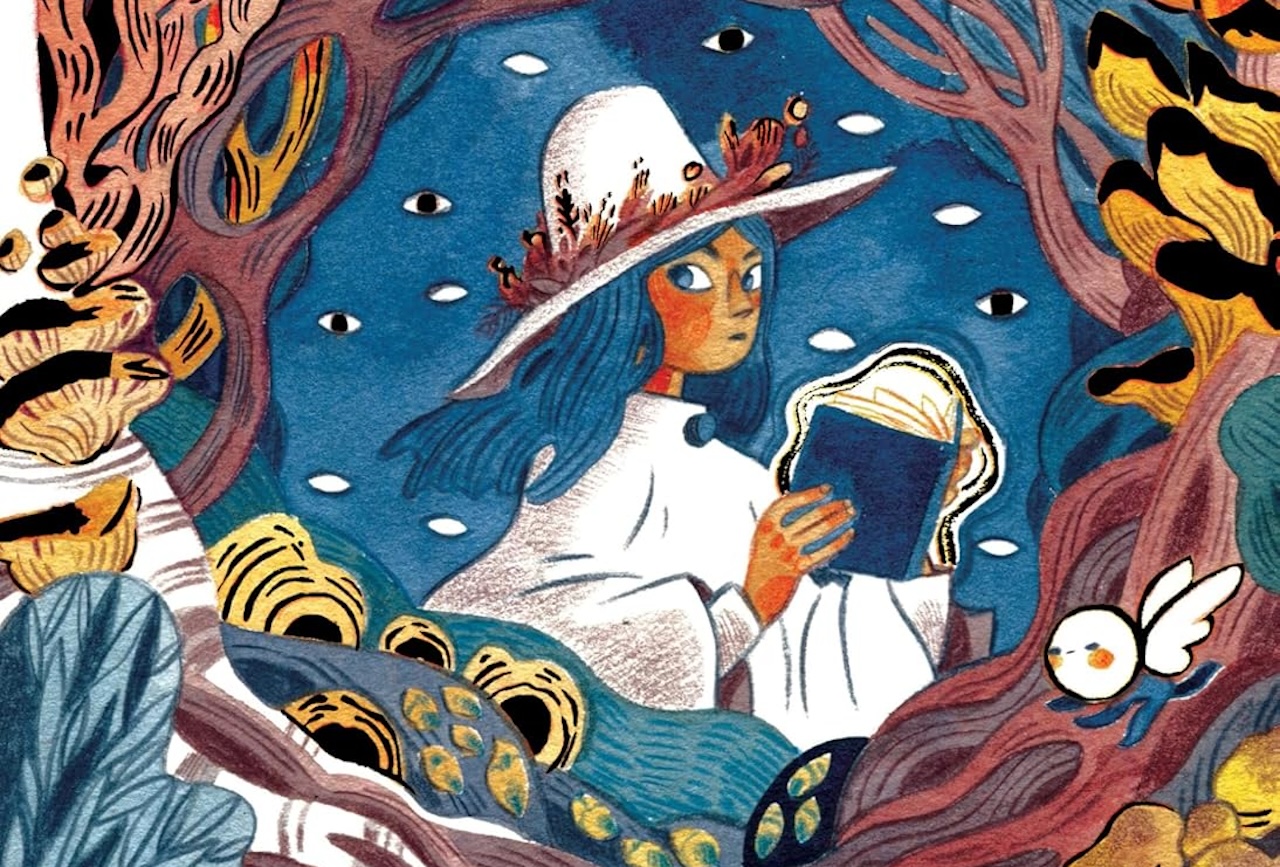

With charming artwork and dazzling colors, Book of Murmurs instantly drags you into a world of evil spirits, witches, and goblins; the deeper it drags you, however, the more confounding the lore and muddied the narrative.
It starts bright and airy: a young girl finds her home overwhelmed by an evil spirit called the Shenk; her parents are distressingly dispatched, and her name is taken from her, and though she tries to escape this bleak truth by going to school, the evil is too overwhelming to avoid. She is secreted into a fantastic world by helpful witches.

Fantagraphics
Interspersed with black and white sections that read as world-building fables, the girl’s adventure into the utterly unique fantasy world progresses apace: she meets magical residents who, like the witches, ostensibly aim to help her. The first half of the book endeavors to uncover that world by narrative means; the girl’s adventure leads us to understand her surroundings, the stakes of her flight from the Shenk, and the workings of magic.
The adventure soon gets somewhat halted, however, by a massive burden of lore; the artist seems so enamored with the world she has created that the book becomes a bit of a history and geography of the place. While completely compelling, the lengthy lore dumps near the middle of the book feel somewhat burdensome. Some of the wonder of the book bleeds out when our protagonist is reading about the world rather than experiencing it firsthand.

Fantagraphics
That the world is incredible and rich enough to deserve this sort of exploration does little to aid the narrative, which becomes more and more abstract as the book progresses. It seems that the more information the reader has about the myth and fabric of the world, the less concrete our nameless protagonist is in their journey. A myriad of supporting characters join her journey, each with their own deep lore and black and white fable chapters, and each new cat witch and giant seems to diminish our hero.
As the book speeds toward its conclusion, the action itself becomes somewhat abstracted, and major events – the death of a supporting character here, the transformation of the protagonist there – seem swept up and bowled over by revelation after revelation.
The Book of Murmurs seems unable to decide what it wants to be: travelogue or guidebook, adventure or world-builder. The richness of the work means that the reader is locked in, whichever direction the book decides to go: it’s impossible to say no to that lush artwork and those big, big ideas. It seems to be a deeply personal book, and its conclusion feels packed with meaning; the reader yearns to be on the same page with those feelings, but the tumult of the preceding story has left them disoriented, uncertain, but somehow in love with the endeavor.




You must be logged in to post a comment.