

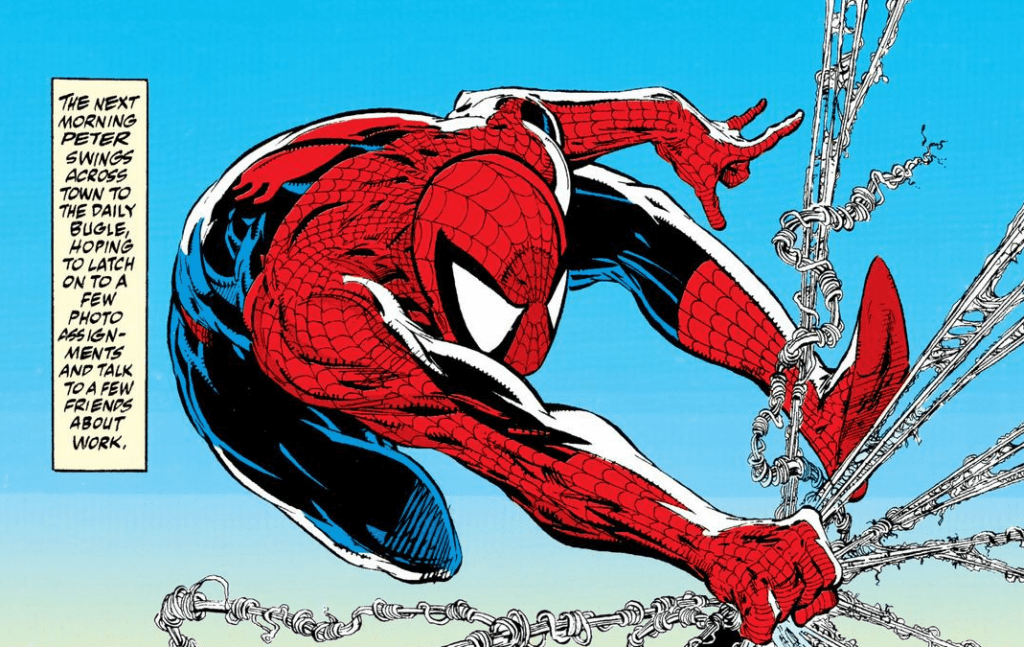

Peter Parker is known as the Amazing Spider-Man thanks to a radioactive spider bite that grants him arachnid-like abilities. He’s also a brilliant scientist; half of his victories are due to his MacGuyvering a cutting-edge invention in his own bedroom. Most fans have wondered if Spidey’s powers could work in real life, and at Fan Expo Denver, a trio of scientists broke down how his powers actually have roots in real science. True to the “Parker Luck”, the TV that was meant to have a PowerPoint presentation was on the fritz, but the panelists bravely forged ahead (and even got lucky when another TV was brought in!).
First up was Peter’s spider-strength. He’s been able to lift heavy machinery, outfight people far stronger than he is, and take hits that would break a normal human in half. One of the scientists calculated that if such a thing was possible, then Peter is lifting roughly 20,000 times his own weight. This isn’t just impressive, but it also reinforces why Spidey pulls his punches. Imagine if he hit a human at full force? His bones would also be extremely dense, meaning he can pull objects with his webs without spraining himself.

Next up was the biggest question: how, exactly, was Peter Parker’s DNA altered by the bite of a radioactive spider? While getting bitten by an irradiated arachnid would more than likely cause someone to die, the concept of horizontal gene transfer was brought up. Horizontal gene transfer lets organisms absorb traits from their peers, so it’s quite likely that Peter absorbed all of the spider’s abilities this way. The radiation was just a bonus thanks to some inventive ideas from Stan Lee and Steve Ditko.
You can’t talk about Spider-Man without talking about his webbing, especially since he created it in a lab. The closest real-life equivalent is carbon nanotubes, which exhibit extraordinary tensile strength and are used in aerospace engineering; they can also absorb radiation to some extent. One of the panelists put forth the insane theory that Spidey’s webs are so strong because they’re absorbing radiation from his body. It’s a wild theory, but then again, what is science if not the creation and testing of theories? Another comparison was a line of genetically engineered goats whose milk would produce the same proteins in spider silk.

Finally, the subject of Spidey’s ability to stick to walls was brought up. Contrary to what the Sam Raimi films brought up, he wouldn’t have hooks in his hands. Rather, he’d be able to create Van der Waals forces, the electrostatic attraction between molecules. For comparison, a gecko was brought up: it can use Van der Waals forces to stick to walls. In closing, the panelists stressed that they loved that Spider-Man was a scientist and praised both the Andrew Garfield and Tom Holland-led films for sticking to that element of the character.
We’ve all wondered how superpowers would work in real life, and it turns out that Spider-Man might be one of the few heroes who actually could walk among us. The “Science of Spider-Man” panel is a great reminder that the Marvel Universe lies at the crossroads of science and fantasy.



You must be logged in to post a comment.