

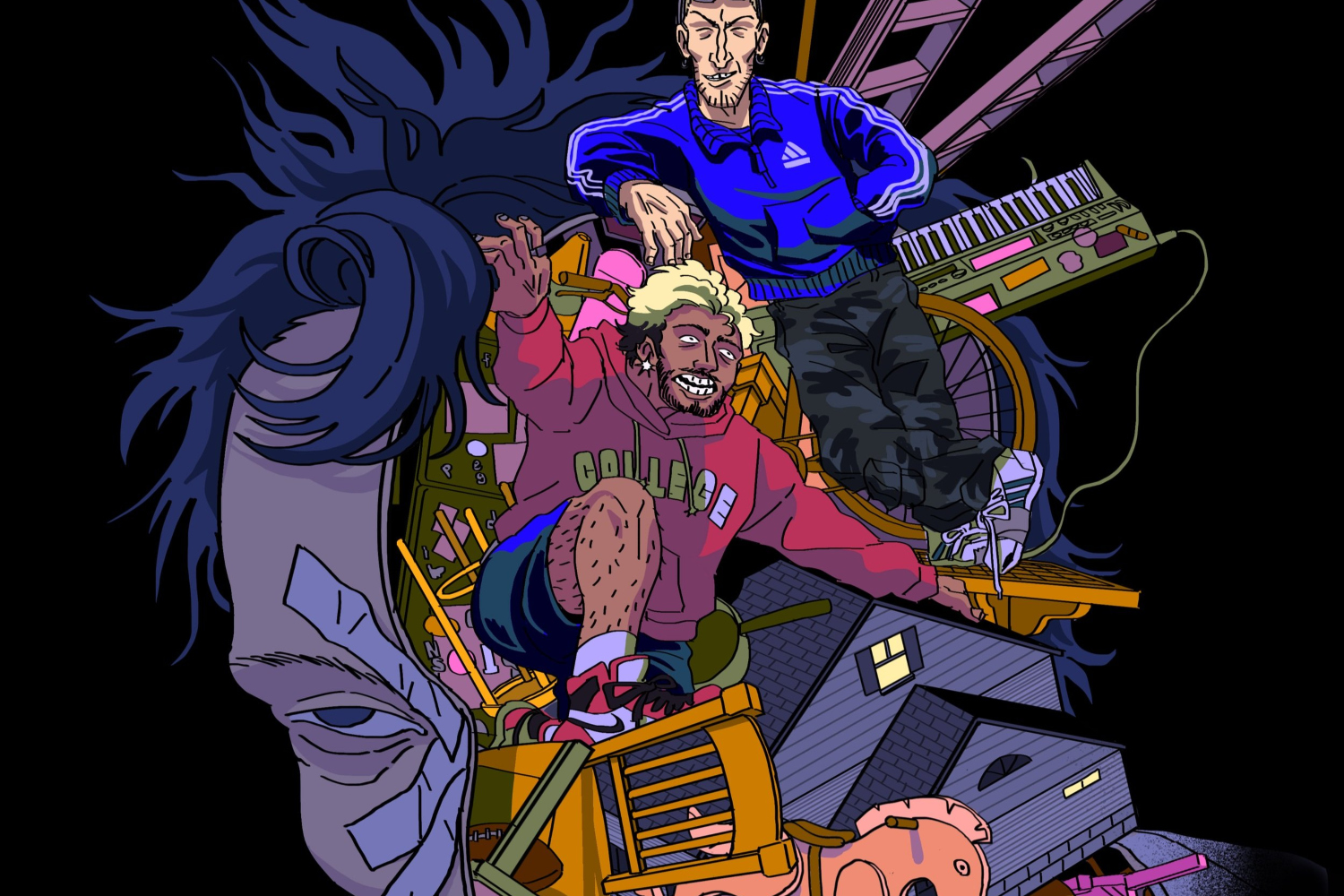

Instead of being named after Edward Hopper’s iconic painting, Nighthawks should’ve been called A Tale of Two Cities.
Because all across Jimmy Li’s debut graphic novel — the young man reportedly graduated from Brooklyn’s Pratt Institute just last month — I felt the pull and pull of a great duality. I tumbled between robust immersion and feeling absolutely out of sync. I was all in one second and then pushed right out the other.
And, God help me, I loved it so dang much. (Generally.)
While I don’t know Li personally, I know dudes of his age bracket, and so the approach across Nighthawks seems intentional enough. It starts with a kind of riff on Dude, Where’s My Car? Only instead of stoner hijinks, our three leads — who we come to know as Aussie, Nose, and Blondie for most of the story — find the house party they stumbled into individually has emptied and the actual domicile now floats in an endless void. All the rest of the “trademarks” are there: the harsh sting of hangovers; repetitive gags and jokes (Nose is injury prone in a device that’s as hilarious as it is disarming); and the tension and unease of three strangers hoping they’re still just blacked out.
It’s basically The Hangover — if it were 1,000% more metaphysical and also everyone was Zach Galifianakis.
For even more from Goats Flying Press, check out our reviews of The Consumption and Texas Kid, My Brother.
But I get it — Nighthawks is riffing on a whole genre of movie that had its heyday in the ‘90s (and also somewhat into he mid-2000s). These “slacker bro” films where men mostly bash against one another to varying degrees of humor and idiocy, trying just to get back to center and maybe stop being such huge fuck-ups. (Aside from Hangover, see also Old School, Harold & Kumar…, Road Trip, etc.) All three leads are certainly likable enough — Aussie may be the most level-headed of the bunch, Nose is the intense weirdo (he’ll stand out the most in your reading for reasons both compelling and disturbing), and Blondie seems nice enough (if not also quite whiny).
Of course, they’re also capable of being extra feckless and irritating, spending most of the time arguing and fretting over their situation rather than actively trying to solve it. There’s a version of this book circa 2001 where they’re, like, making ropes from bed sheets to explore the void, OK?

Courtesy of Goats Flying Press.
But that ain’t this “movie,” and these aren’t those dudes. It all got me thinking about Backrooms — that movie basically riffs on the old haunted house “genre.” But since Gen Z ain’t ever gonna own homes, and because they’re wracked with near-genetic nostalgia, they end up exploring and pining for shopping malls and water parks, these hugely familiar locales transformed by the insidious creep of late -stage capitalism.
Li simply turned his attentions to the realm of “slacker bro,” exploring male dynamics and friendships when isolation, social media, and right-wing ideologies have stripped these dynamics to the bone. So we don’t get three bros chilling and hijinks galore — we get three strangers in an only slightly stranger circumstance, thrust alone in a moment where they’re forced to connect when they simply haven’t got the tools. Or, they’re pushed together into an intimacy in which they can’t and won’t fully acquiesce. There’s hijinks, but man do they land so much deeper.
Either way, Nighthawks does and doesn’t work as this kind of post-ironic “slacker bro” rumination. I found myself not truly rooting for them much, and even feeling like maybe this is less a mystery to solve and more punishment for three of the most pointless dudes I’ve ever encountered. But at the same time, I couldn’t deny the yummy appeal of their struggle — it lit up all the same neurons as its “predecessors,” but in ways that felt off and wrong.

Courtesy of Goats Flying Press.
However, if it wasn’t clear already, I’m choosing to believe that said “discomfort” is the point: it’s a story of different dudes surviving a different world, and how they can find their way to a different kind of camaraderie that suits their situation. At least Li is a skilled enough storyteller — and dialogue like “They say you’re a mixtape of your friend’s personalities” is truly top shelf — to lure us into their dynamic and experience every truthful high point and corresponding awkward low with genuine enthusiasm (that’s like watching the most awkward car crash).
A big part of Li’s core ability is that Nighthawks does demonstrate some restraint. Li spends 200-plus pages really letting their relationship dynamic expertly simmer. It’s subtle and understated, and while their actions and personalities are over-the-top in ways both pleasing and agitating, ultimately Li makes us commit through the slow-burn power of his character work, relentless energy, and keen ear for the right tone and temper required by this tale. That ability extends even to the visuals — mostly.
If you told me that Li made this book in MS Paint within Windows 96, I’d absolutely believe you. You can see and feel that youthful energy play out across those frenetic but unfocused lines of digital color. It’s like Smiling Friends, but if they only used their mom’s iPad and not all that mixed media madness to undercut and augment both the characters and the reader.

Courtesy of Goats Flying Press.
The character designs are both under- and over-developed, sliding back and forth in ways I hope are part of a thematic dissection of humanity (but I can’t be completely certain). The layout of the home itself is done with a noticeable depth and precision that makes it basically feel like another character — and yet the impossibility of this place perhaps isn’t always this deliberate storytelling device. And while there’s a grit and weight assigned to the book’s overarching aesthetic, I can’t help but also find it adorable in a decidedly counterintuitive manner.
And, once again, my back-and-forth is precisely the point (I reckon). Not only for all the right reasons — the story demands a certain look and feel that’s Gen Z-coded if the genre experimentation can truly take hold — but in further keeping with the Backrooms-esque nature. Just as that movie leaned into discarded internet materials because that’s what was readily available and most prolific among this generation, Nighthawks really leans into the enshitification of the World Wide Web.
More specifically, it’s Gen Z using what assets and aesthetics they have available to transcend the shit platter they’ve been handed, and to make gold from digital rubbish. In that way, the visual style is another layer of commentary, with Li championing a simple style and approach to create something that is truly childish as to underplay the messaging but also absurd and jarring to really strike at the disconnect and isolation in a way that’s viscerally apparent.

Courtesy of Goats Flying Press.
Perhaps my biggest issue with the visuals, then, is the inconsistency of it all. Li more than showed himself as being this deeply effective storyteller, having the chutzpah and wit to shape characters and an overarching narrative that, while appearing volatile and unpredictable, are a precise display of genuine male dynamics. That steadiness just feels lacking in the art “department” in some integral ways.
Yes, when it all completely locks in, we get genuine weirdo magic. It’s Li playing with the size of frames/page borders to create a sense that the house is alive and moving and thinking; the sharp zoom on Nose’s bloody face as a means of jazz-ifying the story’s pacing; any number of gentle, Twin Peaks-ian pops of oddball metaphysical waltzes (Nose and the TV share a deep moment that’s absolutely rich with context and emotion); and even the color palette that’s both muted and maddeningly vibrant. Those “instances” and more not only add to Nighthawks’ effectiveness as this dissection of dude friendship in 2026, but let us see a side of Li that’s more playful and joyous than his writing, abandoning pretense for a more pure expression.
However, in the rest of the story — those moments where the trio are instead stumbling about than more actively furthering the story — the world seems to fade or over-rely on detail-less blobs and big swathes of less meaningful color. There’s decisions and instances that strip away some of the intent and magic so it’s just dudes from a lo-fi flash cartoon awkwardly standing around. Now, I don’t expect entertainment across the entire story — although given the stereotypes about Gen Z, this could be a really great commentary on attention spans and how we have to let stories develop as they need to develop.

Courtesy of Goats Flying Press.
However, it just felt like a strong instance of the authorial intent and corresponding wit and intellect abruptly dipping out. As if Li were maybe coasting a bit until the next really big moment, and rather than keeping my attention all the time, he almost allowed it to wane. And in a book like Nighthawks, with its various demands and objectives, that kind of lackadaisical management “style” can be harmful. It’s the difference between quite a good book and a really great one, and in a story so dependent on playing with our engagement and patience, it certainly made this book a little less deserving.
Do I think this is just a case of a young creator still sorting it out? Not really — unlike that “debate” with Backrooms (and Obsession) about youth as some detriment to making great art, Li is proof that you can be young and lethally effective in your field. But I do think that my issues with Nighthawks are instead evidence of this project’s larger parameters.
It’s a story that is meant to critique but also extend a “genre,” and that carries with it a certain preciousness from the audience that the book couldn’t always engage. It’s a comedy and a metaphysical horror, and while it can do both very well, it often felt like it couldn’t spin both plates at once quite as efficiently. Similarly, this book wants to entertain and unsettle, and while it can also do both, the breakdown between both “states” doesn’t always even out as it should. Even just that so much of the book’s real lasting emotional developments happen toward the very end, and that proves that this book needs a lot of room to operate (again, it’s a huge responsibility for any creator).

Courtesy of Goats Flying Press.
And Nighthawks isn’t even done, as volume one ends on something of a cliffhanger. Without revealing too much, it sees our trio step up toward a kind of threshold that serves as a bridge for the next phase of their “test.” It’s a satisfying enough ending, sure, bur mostly it’s a really apt metaphor for the larger story. One because it’s an actual connection (beyond my proposed name-swap) to A Tale of Two Cities. (In that book, doors are a thematic gold mine, representing barriers between rich and poor, freedom and oppression, etc.) But mostly because doors and thresholds are a choice — you either move through them or you don’t.
In the case of Nighthawks, you must choose as well — to pick up the book in the first place, duh, but also how to eventually feel. Do you lean into the uneven experience of it all, working to connect even when the narrative proves decidedly complicated? Or, do you avoid the effort and let a potentially important story pass you by?
I guess now I’m making it sound more like a Robert Frost poem instead, but I made the choice to grapple with this book through its many layers and moods. And the difference that made is a mostly undeniable slice of oddball comics wonder.
Nighthawks is currently crowdfunding via Kickstarter; pledge your support here. (The campaign runs through Thursday, June 25.)




You must be logged in to post a comment.