

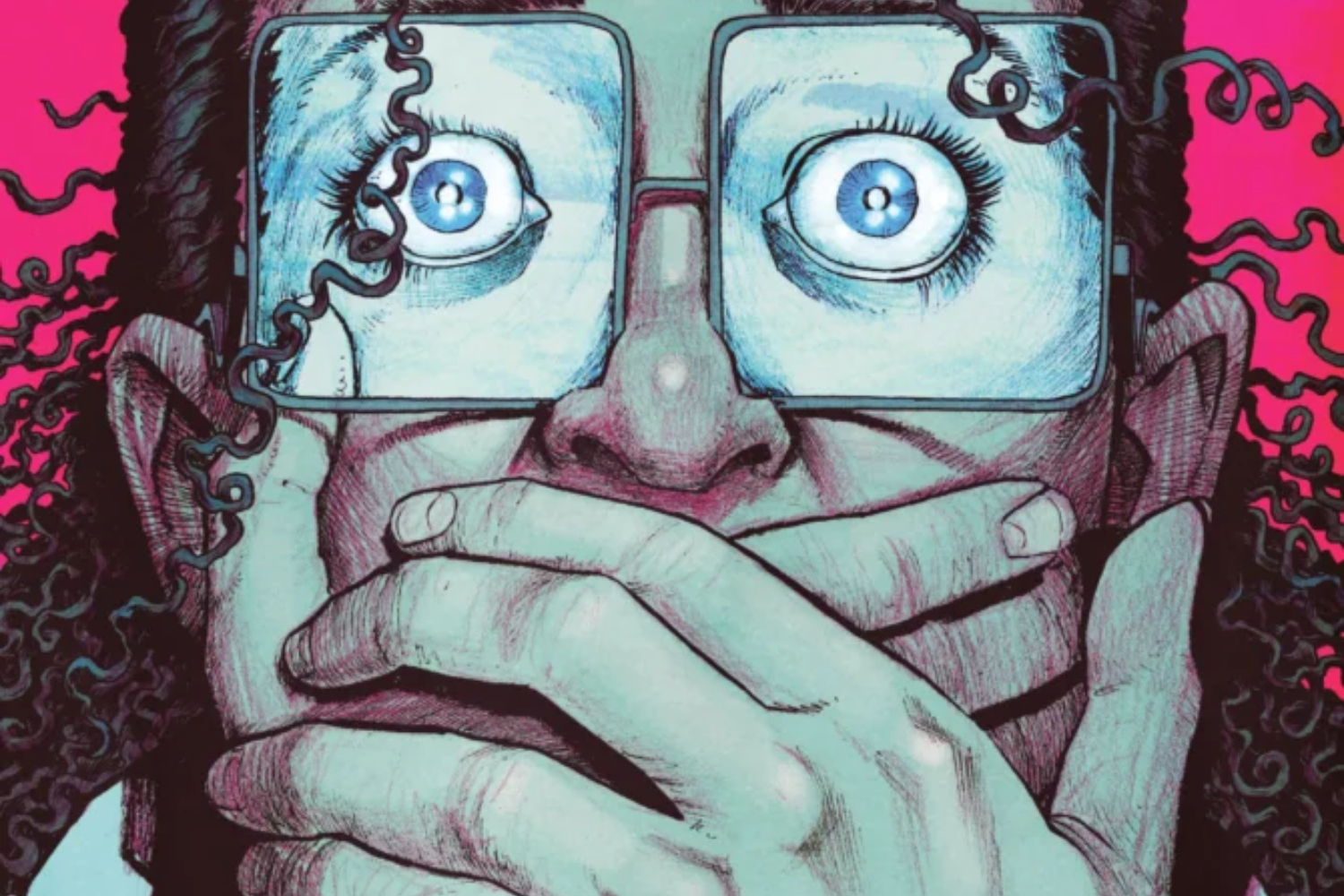

If Narco #4 is a case of a penultimate issue doing only well enough, then Is Ted OK? #5 is the case of just such a chapter genuinely flourishing.
Perhaps the biggest component of its success is this idea of “ramping up.” As we’re heading into any grand finale, a story needs to both surge and settle in equal measure to properly prepare for the finest conclusion. In the case of Ted, however, there was no need to explode forward, as it were, and instead creator Dave Chisholm opted to really slow things with a long, drawn-out chat between Ted, Sarah, and Dr. Paganni.
And in a book where our lead can fly and has already been shot in the head and exploded, having a “lull” felt like the absolute most brilliant move right now.
Only, if the air quotes hadn’t already clued you in, Ted #5 is no lull whatsoever, but rather a different kind of excitement and intensity. I don’t always do so well with extended exposition and conversation (comics are always best at showing, not telling), but Chisholm has not only made Ted worth it as a story experience but the way he approaches things as someone with a strong voice and a genuine love of the craft.

Courtesy of Mad Cave Studios.
I’ve said from issue #1 that so much of this book’s power has been watching Chisholm work at such a high level, and while he’s dazzled us with these technically robust, utterly beguiling feats of sci-fi madness, he’s just as capable of nailing down our attentions with nothing more than a conversation on a couch. You could call this book “Dave,” and I think nothing would change, if you catch my meaning.
It helps, of course, that said conversation is wildly important and deeply interesting, a back-and-forth that works on a few different levels. The first level is exploring the dynamics of our characters — that’s mostly as Paganni recounts her relationship with Noah (TM), and how they came to be employee and employer.
It’s a testament to Chisholm once again that he only needs a few lines to contextualize Noah (TM) as this trillionaire man-baby, someone who has caused so much of the story’s problems with his nuclear ineptitude. It’s a way to tie Ted to current conversations around the elite and social inequality, but done with a little more intent and novelty. In fact, Noah (TM) even gets to be the one to dump on AI in an absolutely brilliant takedown that feels satisfying even as he remains this preening, whining idiot who basically pushed world to the very brink of this grand tragedy.
At the same time, Paganni is never made to seem any less “guilty” for basically giving Noah (TM) the keys to run over our future. She certainly tried to stop him, or at the very least mitigate his efforts, but ultimately gave in for sentimental reasons (that are framed as our general limitations as people). It’s her explanations and resulting context — where Chisholm expertly shows the quiet power of a certain stare or a bit of body language — that sympathize without explaining away Paganni’s involvement.

Courtesy of Mad Cave Studios.
In the same way even Noah (TM) earned some respect, so too does the good doctor get to stand in for the complicated morality and ethics of here and now, serving as icon for our own failures and triumphs as we try to sort out the next stage of our shared evolution. Paganni dominates so much of this issue, and even though she was only introduced in Ted #4, she’s already such a real and vital part of this story’s robust thematic interests.
It also helps, of course, that we need Paganni as the filter to truly understand what Ted is actually all about; boy howdy is it a doozy of a nut if there ever was one. I don’t want to spoil it because Chisholm’s deliberate, pseudo-science-leaning explanation (in a good way) is a genuine treat, and it reminded me of why folks worship Philip K. Dick (because he makes the smart seem so obvious and not just because of all the dope drug references).
It’s a world-building exercise that feels familiar enough with certain sci-fi tropes, but organized and disseminated in a way that feels utterly refreshing. It effectively emphasizes themes of evolution, human consciousness, and community, making real these ideas with a surge in appeal and power. There’s so much info here, but I never feel like it’s not as cool as, like, robots and exploding cars.
And in case talk of data and the human soul proves a touch boring, the diagrams and visual explainers deployed across the issue are perfect, the right mix of vivid sci-fi color and whizzbang energy while seeming just real enough to actually be how physics might work. I’m clearly no expert, obviously, but I love the care in which Chisholm has created this world and how much effort he took to really bring us in and let all these massive ideas marinate.

Courtesy of Mad Cave Studios.
The only conceivable downside of this grand reveal, then, is how it casts Ted’s role within this overarching story. The end result feels slightly cliched — although given his superhuman displays across the earlier story, you had to guess he wasn’t entirely human. Still, it initially feels like Ted has been cast as something altogether too familiar, which is irksome given how the book tackles its familiar subject matter and themes and spins in new energies and perspectives.
Ultimately, though, Chisholm structures Ted’s understanding as a deeply, deeply human reaction — it’s less of a shock and more of a slow-burn revelation. There’s no hokey shtick or forced shock; just Ted getting to be as human as ever as he understands his role. There’s a quiet dignity to this world-altering moment, and we feel ourselves in this same journey of large-scale change and growth.
Of course, you’ve got to give ample credit to Sarah, whose role in this issue really makes the final closing moments land with maximum gusto. It’s been my experience that so much of Ted has always been about Sarah, and how she has been our stand-in and facilitator as this book unfolded its grand mission to dissect human thought and evolution. And Ted #5 makes that all the more clear, as it’s her final, enthusiastic push that gets Ted to truly embrace his humanity after all that he learns here.
She reminds him that he isn’t what he was made/born to be, and that he owes it to himself as much as everyone else to celebrate that which makes him human and hold on to it as the only proof of what he is that means a damn thing. She’s the screaming cheerleader of the human species, reminding us all that whatever happens to us, we can still be there for each other, fighting for something actually worthwhile. In that way, she’s not just cementing ideas of communal connection, but moving further from her initial role as voyeur to team player in a character arc that feels massively compelling.

Courtesy of Mad Cave Studios.
There is, of course, a wee bit of a shock ending following Sarah’s speech. Not only does it perfectly set up the finale, but even its humorous sparkle never takes away from the overt high that is Ted #5.
It’s an issue that brings it all way, way down while also turning “fake” science lessons into a visual and educational delight. It’s heavy on the information, but also on what that all means to us right now at our current techno-social-political crossroads. It reminds us of how we’re all special, but how it’s community and connection that give us real power. Ted #5 works because it’s the story unfolding as it said (or at least hinted) that it would this entire time, and that consistency makes any narrative spike feel meaningful and approachable.
In the case of Narco, I definitely need that finale to see if that book will ultimately register as significant or not. In the case of Ted, though, issue #5 was so strong on every conceivable level that it could work as an ending. (I’m still reading #6, though, so no one try to stop me.) It’s an issue where this book’s magic grew, yes, but also it came into itself in a major way. It’s a coalescence, if you will, that proves one undeniable truth no matter how this story actually ends: Ted is a massively important book for 2026 and beyond.



You must be logged in to post a comment.