


For a while, my question around White Sky was whether it could (prepare for a self-quote) “transcend its confines.” Ya know, because a story about a father and daughter (David and Violet) surviving the End Times (this time involving ghosts) still smacks of properties like The Road and The Last of Us. There’s really only so much you can do with roving bands of marauders, failing infrastructure, family drama, and nihilism as palpable as dust in the air.
But it didn’t take long for creators William Harms and JP Mavinga to set White Sky apart from its “siblings.” They almost immediately separated David and Violet: the former got sent to a camp of “survivors” and the latter was teamed up with a mysterious boy named Walter to traipse around the shards of the real world. There was a bloody story of survival (sort of akin to The Walking Dead, to bring yet another reference into the fold), a burgeoning supernatural mystery, and the right amount of tension and uncertainty to push the family drama to new heights.
But now the question isn’t if the series will transcend, but how it achieves said goal. And I think we have some answers in White Sky #4.
That answer is, mostly, added separation. More specifically, it feels like the book has become really, really good at compartmentalizing its various inspirations and story goals/objectives in a way that lets everything really breath as it ought to. Everything still feels connected just enough (otherwise it’d feel awkward and poorly assembled, like some broken teapot), but everything is its own thing first and foremost. Until the magic really happens, of course…

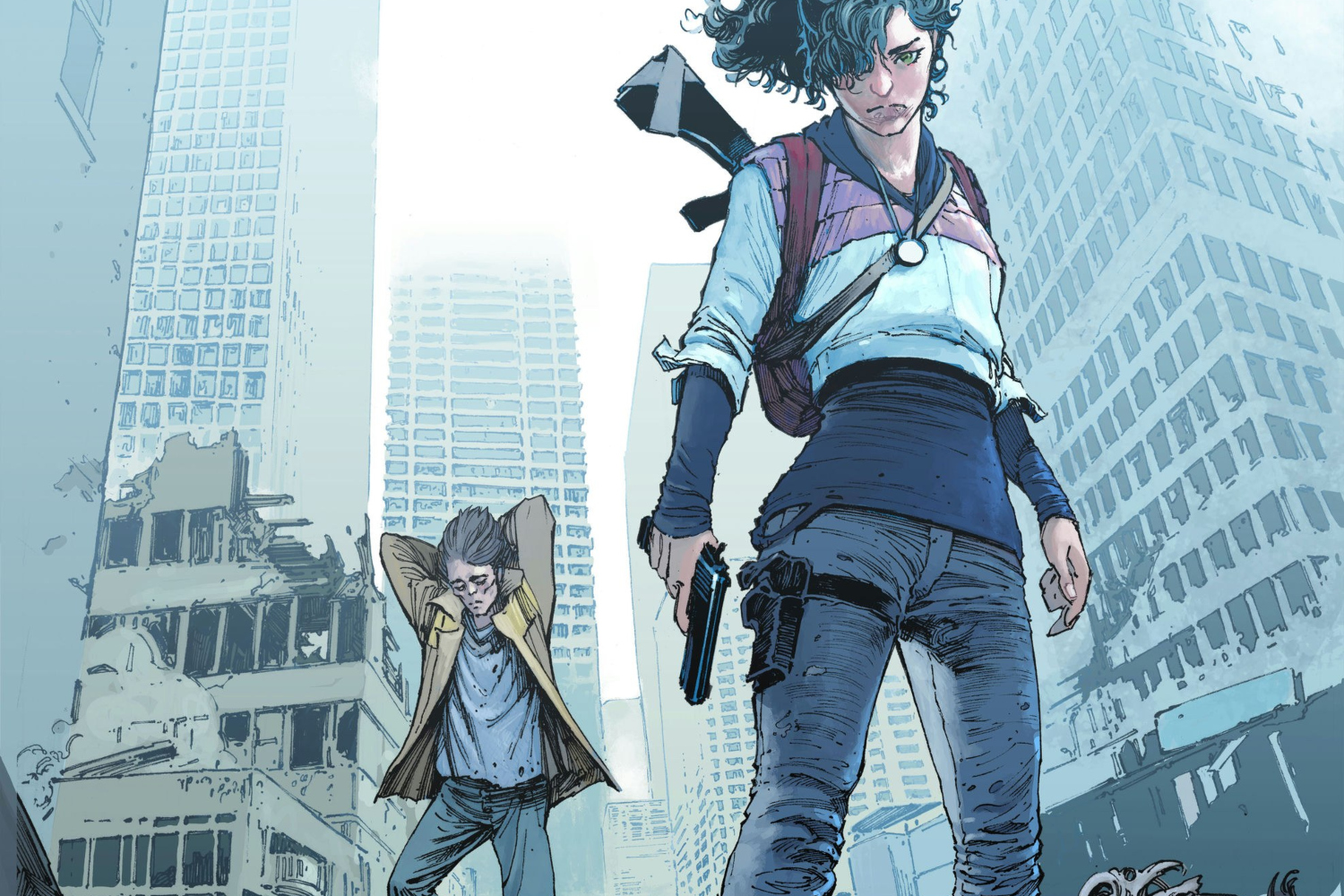
Main cover by JP Mavinga. Courtesy of Image Comics.
In the Violet and Walter story, there’s more overt supernatural energies and tinges. The best I can describe it is like a horror movie: Yes, the ghosts are a threat across the whole dang book, but tone feels different as the supernatural is almost positioned as something to be explored. Violet and Walter come across a pocket of “Sleepers,” and while they remain a mystery, that one little bit reveals heaps of new supernatural ideas/energies across White Sky (and not simply that, like, “ghosts are everywhere”).
I love that this book has increasingly robust lore and canon around these ghosts, and it’s choosing to slowly unfurl this grander narrative to maximize the tension and draw out our curiosity. It’s ultimately about playing with our emotions, and letting us fill in the gaps as the world’s true scope becomes increasingly real and vivid. That to me sings true horror.
In David’s “bubble,” however, ghosts are a threat, but in a far more abstract manner. To revisit The Walking Dead analogy, they’re certainly waiting to destroy folks, but the real threat is whether your fellow man will kill you/leave you to be killed beforehand. As such, we get far less supernatural aspects and more about what remains in the world. I’ve loved our continued look into the haphazard structures and social systems people rely on in this new world; its been a persistent reminder that real horror isn’t fantastical but often a friendly face that reveals some hidden knife.
It’s ultimately this unshakable sense that the dead have it easy, and it’s the living that have it hardest. Even the look and feel of the book in these “sections” feels dirtier and grittier somehow, stripping away the horror ambiance for the unblinking visage of a world that’s eaten itself outright.
There are, however, momentary teases where the worlds lightly come together. Violet and Walter run head-long into an actual threat, and that undercuts their slow-burning immersion into the ghost world in a way that actually feels disarming and exciting. It’s a moment that feels like these youngsters are kicked out of their “fantasy” and reminded of the real stakes, and in turn that feels like the best manifestation of this book’s interest in challenging and growing Violet. It’s these moments where a little blood and intensity go a long way to feeling novel and not more needless suffering a la some of White Sky‘s predecessors.
From there, David’s grounded experience is augmented with just the right amount of the supernatural. Again, though, it very much stems from decisions made by folks within the book, continuing White Sky‘s deliberate theme that we are often the purveyors of our own suffering. Plus, David’s ghostly run-in is also the first time we see ghosts with more personality and human-like appearances (and not just faceless ghouls).

Variant cover by Eliza Ivanova. Courtesy of Image Comics.
That editorial decision doesn’t just add fresh wrinkles to the lore, but it also reminds David (and us) what’s actually going on here. That it’s not just that “people suck,” but the world is just different enough than what we expected to then push our understanding outward. It’s smaller and perhaps less effective than reality pushing into Violet’s experience, but it augments the social criticism here without undercutting the grounded, visceral approach.
Of course, like all good stories, White Sky eventually brings its “two halves” together. Issue #4’s ending sees the reality of one crash into the fantasy of the other, and it all has to do with exactly what role Walter will play in things. From that moment, we get a few takeaways. One is that by coalescing at the very end, things feel doubly exciting, and the story uses that surge of energy in a what that pays off our patience across this “dual-wielding” experience.
It also gives David and Violet a “line” back to each other, and that connection will similarly feel rewarding as they’ve spent time away growing and evolving on their own. And, of course, it manages to put Walter in a moment of vulnerability but also larger significance, and White Sky benefits when this little weirdo is made more concrete and tangible.
But perhaps what this grand coalescence does best is to demonstrate a certain self-awareness by the creative team. That they maybe recognize the familiar waters in which they’re treading, and want to respect our connections with this “genre” as much as they want to do something genuinely novel. It’s nice to perhaps see my own anxieties/worries reflected back, and that the team are working in a way that really and fully connects with this story and its larger context.
And through that awareness, and corresponding creativity, they’re able to make White Sky stand as a mediation on how we contextualize death in our lives and what we really take away from this shared obsession with ghosts. At this point, the only question I don’t have about this book is, “Will this all be worth it?” Cause, duh, yeah it will.




You must be logged in to post a comment.