

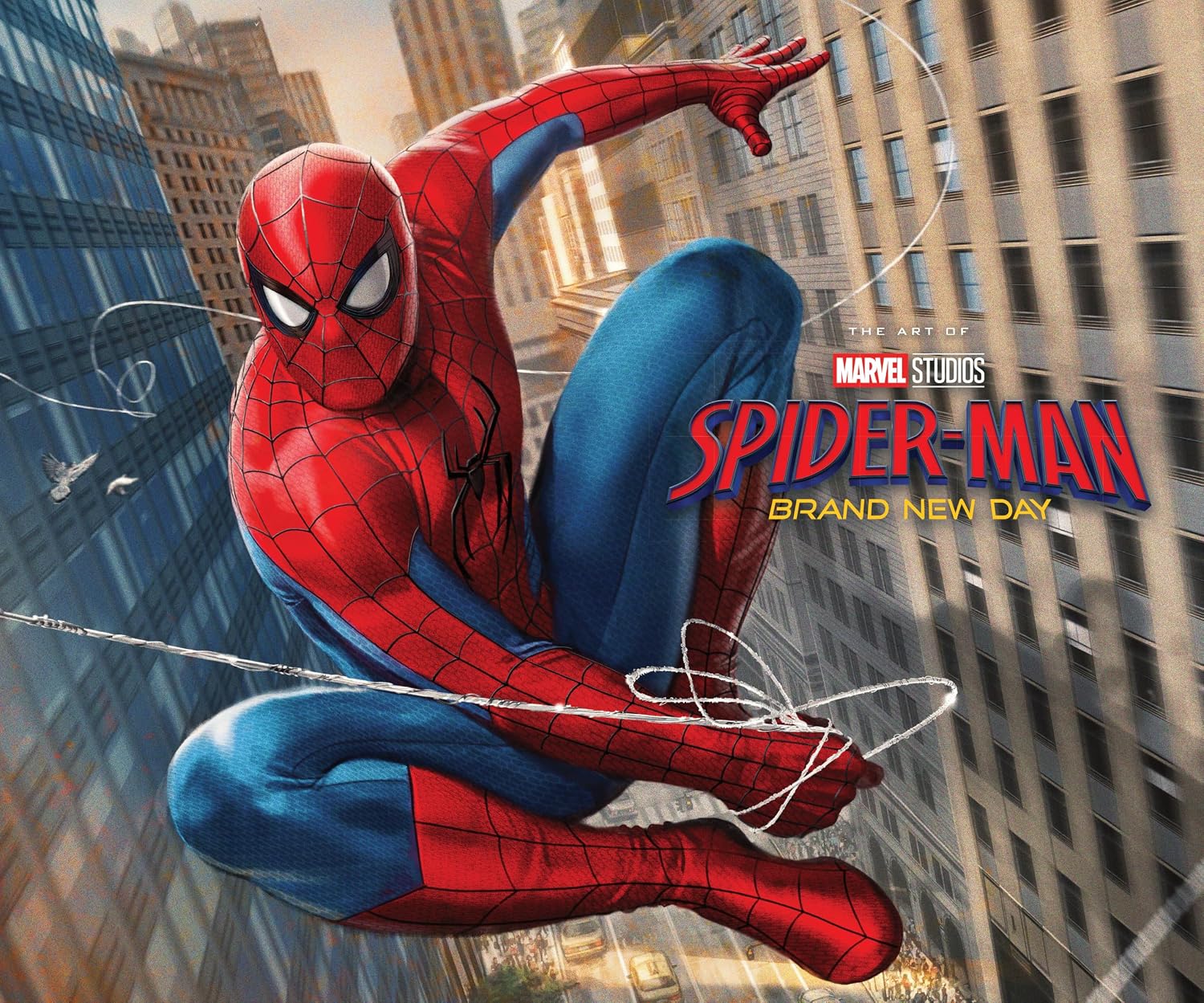

If there’s one thing Marvel Studios has figured out, it’s how to make an art book feel like part preview, part museum exhibit. We saw it with Into the Spider-Verse, and now The Art of Spider-Man: Brand New Day (Out August 4th) continues that tradition with a handsome oversized hardcover that gives fans a meaningful look behind the curtain while carefully avoiding the biggest spoilers.
Like the best entries in Marvel’s art book line, this isn’t simply a collection of concept paintings. It’s a guided tour through the filmmakers’ creative process. Artists, producers, and director Destin Daniel Cretton explain how they built this version of Peter Parker’s world, revealing surprising inspirations while keeping the film’s biggest twists under wraps.
SPOILERS AHEAD for Spider-Man: Brand New Day!
One thing immediately stands out: Marvel knows exactly how much to reveal. We know Sadie Sink appears in the film, yet her character is completely absent from the book. There are no designs, no obvious clues, and no accidental reveals. The same careful restraint carries throughout. One could argue that this makes a book like this not complete, but maybe future art books can fix that.
Instead, the emphasis falls on Peter Parker himself, specifically where he finds himself after the events of No Way Home. The book repeatedly returns to one idea: Peter has chosen Spider-Man over Peter Parker, and that decision defines nearly every artistic choice.
Spider-Man finally looks like Spider-Man
One of the most enjoyable sections explores the redesign of Tom Holland’s costume.
The artists explain they looked closely at Tobey Maguire’s and Andrew Garfield’s suits while still creating something uniquely Holland’s. The tighter mask creates an older silhouette, while the proportions intentionally lean toward the classic John Romita Sr. interpretation of Spider-Man.
As an avid comic reader my whole life, I really appreciated how often the filmmakers reference Spider-Man’s publishing history. One action sequence is directly inspired by Alex Saviuk’s cover for Spider-Man Adventures #2 (1995), while another image recreates the iconic cover of Erik Larsen’s Amazing Spider-Man #345 (1991). Elsewhere, the book includes a rendered homage to Spectacular Spider-Man #142 (1988), showing just how deeply the art department mined decades of Spider-Man history.

The Art of Spider-Man: Brand New Day book featuring art by Todd McFarlane, side by side with a rendering from the movie. Courtesy Marvel Universe
Even the web shooters receive attention.
Rather than relying entirely on Stark technology, Peter now builds much of his own equipment. His workshop includes a fascinating hybrid machine that combines a sewing station with a 3D printer called the Fabricator, allowing him to construct and repair his own costume. If the renderings in this book are any indication, Spider-Man’s headquarters are going to look fantastic. Shabby due to his inability to pay the bills, but with plenty of character and hand-made high-tech stuff to ogle.
Several pages also explore Peter’s evolving spider powers, including organic webbing inspired by “The Other” storyline and visual concepts for how Spider-Sense might finally appear on screen.
New York becomes the co-star
Perhaps the book’s greatest surprise isn’t Spider-Man at all.
It’s New York.
It’s a cliché to say that a location, especially New York City, is a character in a film, but they do a good job of proving that it is in this film. An entire chapter explains how the production recreated Queens while filming largely in Glasgow and on elaborate Pinewood Studios sets. The production built roughly three city blocks of New York, carefully selecting neighborhoods near the Queensboro Bridge while focusing on rooftops rather than street-level locations.
The attention to atmosphere makes the city feel like an active participant instead of a backdrop. That includes an attention to detail above the first floor, but much higher up.
The villains embrace Spider-Man history
The biggest section naturally belongs to the villains.
Marvel appears to have dug deep into Spider-Man comics for inspiration, repeatedly referencing classic covers while redesigning each villain for the MCU. All of the villains in this book have appeared in recent trailers, so no spoilers here.
Scorpion receives perhaps the most attention, with multiple pages explaining the mechanics of his tail and how its counterweight works across his chest to make the character physically believable.
Tarantula is another standout. Concept illustrator Josh Nizzi says his design began with Gil Kane and John Romita’s cover to Amazing Spider-Man #134 (1974). While he abandoned the comic’s chest emblem because it looked too much like Spider-Man’s, he instead used the tactical straps across Tarantula’s costume to subtly recreate the shape of a spider.

Courtesy Marvel
Ramrod also receives a comic-inspired makeover, drawing from Bob Wiacek’s artwork on Amazing Spider-Man #221 (1981).

Courtesy Marvel
Even The Hand receives some surprising attention. Their visual direction references Francis Yu’s cover to New Avengers #27 (2007), with producer Emily Fong teasing that the organization has been without leadership and may finally realize its potential under new guidance.

New Avengers #27 cover.
Courtesy Marvel
Fong explains the philosophy behind the lineup:
“It was a delicate balance of picking ones that fans would recognize as well as some that are more niche, but not too niche. We wanted to focus on the sequence on characters that Peter could take down or handle within maybe a day or two.”
Not quite a villain, Punisher’s section is another highlight.
His appearance draws inspiration from multiple eras of the character, including Jim Lee’s cover for Punisher War Journal #15, while concept artists experimented with numerous versions of Frank Castle’s famous skull emblem.

Courtesy Marvel
Concept modeler Adam Ross explains that they explored everything from Frank hiding in plain clothes to heavily armored tactical gear before settling on something that echoed John Buscema’s classic Punisher, where the large white skull intentionally acts as a bullet magnet over Kevlar armor.
Hulk steals the final act
The final third of the book shifts almost entirely toward Hulk.
Marvel reveals an astonishing amount of concept work showing Bruce Banner’s transformation back into Savage Hulk, including dozens of facial studies that intentionally push him away from resembling Mark Ruffalo.
The filmmakers even considered bringing back Gray Hulk before ultimately deciding that audiences needed the familiar green version.
Likely one of the biggest action scenes in the film, storyboards are shared detailing the cat-and-mouse game Hulk and Spider-Man go through that edges on the horror side. One especially interesting detail is that Hulk becomes increasingly frustrated because Spider-Man simply moves too quickly.
It turns what could have been a straightforward slugfest into something closer to a predator-versus-prey dynamic.
Things I learned from The Art of Spider-Man: Brand New Day
Without giving away the film’s biggest surprises, the art book reveals a surprising amount about Marvel Studios’ direction for Spider-Man’s next chapter.
Light spoilers below:
- Peter Parker has fully committed to life as Spider-Man. As the filmmakers explain, he’s “Spider-Man all the time,” having left Peter Parker behind after No Way Home.
- Tom Holland’s new costume draws inspiration from Tobey Maguire’s and Andrew Garfield’s suits while leaning into John Romita Sr.’s classic Spider-Man silhouette.
- Peter is building much of his own equipment again. The book introduces his “Fabricator,” a hybrid sewing machine and 3D printer that allows him to repair and create his own gear.
- Spider-Man lives near Queensboro Bridge.
- Spider-Man’s powers continue evolving. The filmmakers explore organic web shooters inspired by the 2005 comic storyline “The Other”, multiple web textures, heightened strength, and even early visual concepts for Spider-Sense.
- Director Destin Daniel Cretton describes Peter’s transformation as something frightening at first, with Peter believing he’s becoming a monster before ultimately learning to embrace the changes happening to him.
- Peter’s unhealthy obsession with being Spider-Man becomes a central theme. Producer Rachel O’Connor describes the story as “Spider-Man Too Much,” with Peter struggling to rediscover balance after sacrificing his civilian identity.
- The villain lineup was carefully selected to mix recognizable Spider-Man rogues with deeper cuts. Producer Emily Fong explains the team wanted enemies Peter could realistically defeat over a day or two while still surprising longtime fans.
- Comic readers will spot numerous homages to classic covers, including Spider-Man Adventures #2 (1995) by Alex Saviuk, Amazing Spider-Man #134 (1974) by John Romita Sr., Amazing Spider-Man #345 (1991) by Erik Larsen, Spectacular Spider-Man #142 (1988) by Sal Buscema, Amazing Spider-Man #221 (1981) by Bob Wiacek, New Avengers #27 (2007) by Francis Yu, and Punisher War Journal #15 by Jim Lee.
- Boomerang’s gear was redesigned with surprising practicality, including multiple studies showing how his weapons attach to his back while remaining accessible in combat.
- Jean DeWolff returns in a substantial supporting role. Emily Fong describes her as an important sounding board for Spider-Man as their relationship develops over the course of the film.
- Damage Control gets its own chapter, complete with new headquarters, weapons assembled from salvaged Chitauri, Sakaaran, and Rocket Raccoon technology, and detailed looks at how the MCU’s clean-up crew has evolved.
- Peter visits hospitalized children during one sequence, creating several awkward but heartfelt moments that highlight how disconnected he’s become from ordinary life.
- Punisher operates from a houseboat headquarters built from a converted industrial barge, functioning as both a command center and safe house.
- Hulk receives an entire chapter exploring his return to Savage Hulk after years as Smart Hulk. Early concepts experimented with Gray Hulk before ultimately returning to the classic green version.
- Concept artists pushed Hulk toward a more frightening appearance inspired by his earliest comic stories, even reducing Mark Ruffalo’s recognizable facial features to emphasize the monster.
- Punisher eventually becomes entangled in Spider-Man and Hulk’s battle, not because he’s hunting either of them, but because his own mission collides with theirs.
Final thoughts
Like every Marvel Studios art book, this volume succeeds because it understands exactly what fans want. It offers genuine insight into the filmmaking process without spoiling the emotional beats that will matter most when the movie finally arrives.
The oversized coffee table format serves the artwork beautifully, especially the panoramic spreads showcasing New York and several action sequences. While much of the artwork consists of polished digital renderings, a greater variety of rough sketches, thumbnails, and traditional concept work would have added even more depth to the experience.
Even so, this remains an excellent companion for Spider-Man fans. It captures a hero entering a new stage of his life while offering fascinating glimpses behind one of Marvel Studios’ most anticipated films.




You must be logged in to post a comment.