

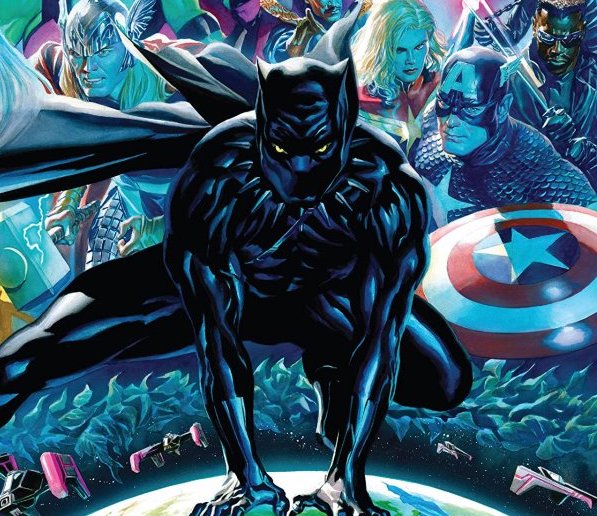

There is a lot going on in The Long Shadow—or, at least, there is the implication of a lot going on, a sort of narrative smoke screen making one central conflict seem much more complicated than it is. It’s almost as if the book is trying to convince you that it is much more thought-provoking and generous than it is; the truth is, it sometimes feels as if it’s providing the bare minimum.
You see, the book sets us up with a compelling bit of intrigue: T’Challa, in the perpetual state of paranoia of an already secretive king, has set up a global network of deep-cover Wakandan spies. These trusted agents have faked their deaths at home and embedded themselves into second lives in every nation of the world.

Marvel Comics
Their purpose, it seems, is to stay embedded until such a point that Wakanda is overtaken by any potential usurping power, at which point they will rise and retake the nation. Just boilerplate paranoid royal stuff.
Our inciting incident for the series is that one of these agents is assassinated; what follows are five issues of incredibly fuzzy logic and jumped-to conclusions. Suspects are named with little evidence but for a tangential, circumstantial cognitive connection. A wise nation is governed by a very flimsy model of democracy; a super-genius tactician, when accused of treasonous activity, proves his innocence by committing more treason.
Over the span of these five issues, remarkably little happens. Or rather, a lot happens—fights with mysterious assassins, a trip to Mars, an explosion, at least two arrests—but this feels like a lot of static overlying an incredibly straightforward story. There’s a sort of pretention to the book, summed up with the final page of its first issue, that this is an important and world-changing story, but at no point is there any evidence of this being true.

Marvel Comics
Dramatic turns are taken throughout the narrative with little or no motivational purpose. An example: in the fourth issue, T’Challa turns on one of his spies and primary colleague, Omolola, based on some evidence given to him by his sister, Shuri.
This would be a compelling turn of the story, a sudden twist the audience would not see coming; the problem, however, is that the evidence Shuri delivers is presented to Black Panther alone, and not the audience. What we understand to be the crux of it is that the assassins fought in a way that suggests that they are Wakandan in origin. That is all; there is no further evidence, in any form, that might suggest that Omolola might be the Wakandan in question.

Marvel Comics
The rest of the issue is then spent with T’Challa battling Omolola, as if to fulfill what little bit of action is required of the book. He does not battle particularly well, with the degree of skill we have come to expect from the Black Panther, but then, he hasn’t exactly been performing to his full potential in any of the dozens of ways the audience has grown accustomed to seeing. In The Long Shadow, T’Challa is not particularly good at being T’Challa.
Nearly every turn of the story is presented with as little motivating evidence, as flimsy a context, and as poor an understanding of the main character, who seems unendingly disdainful of his own people, as possible. The Long Shadow is a book that pretends to do a lot more than it accomplishes, and that’s to the disservice not just to the character and the audience, but to the incredible Black Panther stories that precede it.




You must be logged in to post a comment Login