

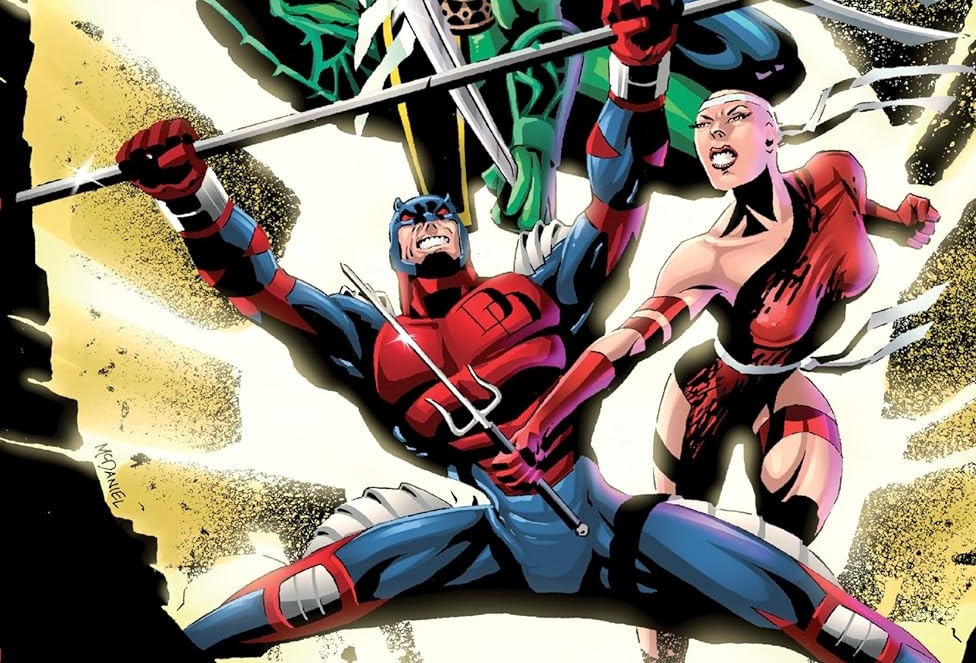

Despite favorable reviews of DG Chichester’s recent return to Daredevil’s black armor period, the costume and the story that introduced it faced a much more divisive reception, both by fans and from Marvel editorial.
In a 2009 interview with fansite ManWithoutFear.com, the creative team (Chichester and artist Scott McDaniel) reflected on that story, Fall From Grace, after its fifteen-year anniversary. The interview provides a wealth of information not only about the issues in question but also concerning the way Daredevil was being treated by its publisher.
“. . the company position toward Daredevil then was supremely dysfunctional,” said Chichester, “There wasn’t a lot of interest in pulling him into other titles, raising his profile. And if it wasn’t Frank Miller (and his oft-times excellent work) on the character, they couldn’t be bothered promoting their own title.”
“. . . Fall From Grace was written from a relatively angry place,” he went on. The team wanted to shake things up and leave their mark on the book. When Chichester pitched what would become Fall From Grace, editor Ralph Macchio was excited about the project, but then-Editor-in-Chief Tom Defalco dismissed many of the ideas. Even the Romitas, in a round table interview, were skeptical.
Chichester decided to go through with it, anyway.
The result, collected in Daredevil Epic Collection: Fall From Grace, is a mess both narratively and visually; it is also an incredibly brave attempt to revitalize a then-neglected character.
The story ostensibly revolves around a McGuffin – a vile of a virus, long lost in the subway system of New York City, which can reshape whoever infects themselves with it. And there are a lot of people who want to infect themselves with it. Regardless of the specifics, the format is fairly standard – so much so that Chichester utilized it during the two issues directly preceding Fall From Grace (the McGuffin there: a bunch of fast food grease).
There are a lot of balls in the air during this run – which isn’t a problem, necessarily; Daredevil stories have been known to have a lot of moving parts. It’s not as if the story notably droped any of those balls so much as tossed them up only for them never to come back down. It is a story with a lot of missed beats.

Marvel Comics
This is because the reader only glimpses the moving parts a fraction at a time, at dizzying speed – a suicide blood ritual in #320 happens without establishing its characters, its intent, the motivations or meaning behind it, and then we’re off to a dream sequence, a S.H.I.E.L.D. lab, a frozen mountaintop, Silver Sable’s embassy, Karen Page’s apartment, on and on and on at one or two pages at a clip. There is no time for the reader to engage with any single concept – or to guess how any of these things coalesce into anything like a narrative. There are a dozen or so characters, from guest stars like Morbius the Living Vampire and Venom and Daredevil’s questionably racist Infinity War doppelgänger to a slew of ninja and/or cybernetic characters so indistinguishable from one another that they read as a single entity. Their motivations are often unclear, as is their impact on Daredevil’s journey.

Marvel Comics
Ultimately, the book establishes three major things for the series: DD gets his new costume, Elektra returns, and Matt Murdock “dies” thanks to the doppelgänger’s transformation into an identical corpse.

Marvel Comics
Because this was McDaniel’s first major job, the artist swings for the fences, hoping to create something dynamic and groundbreaking. Though occasionally brilliant, his impressionistic forms – inspired, he said, by both Image Comics’ many-lined “West Coast style” and Frank Miller’s bold-form shadows in Sin City – often feel unreadable, indecipherable, muddied.
Still, the team succeeded in their goal: no other book on the stands was like Fall From Grace. Due to the massive shift in tone and form, the fan buzz around the new costume, and even some out-of-pocket self-promotion, the story has become a massive landmark in the character’s history. For good or bad.
Both creators admitted to their shortcomings. Said Chichester: “In fairness and through the lens of time, the story’s tendency to spontaneously convolute would have been better served by some injections of [DeFalco]’s inclination toward simplicity. Certainly if I ever get my flux capacitor working, the message I’d send back to that D.G. would be ‘Edit yourself, stupid!’”

Marvel Comics
McDaniel cited the story as a major crossroads in his development: “I finally swayed toward the graphic approach, which helped me compartmentalize the various technical aspects of drawing (composition, form, lighting). Eventually I developed my own vision, but FFG definitely was a positive turning point in my development. I felt the urge to grow, to develop a unique style, and to make a name for myself. FFG was a great opportunity to grow in new areas.”
The lessons learned over the course of Fall From Grace are immediately apparent throughout the rest of the Epic Collection. In the following arc, Tree of Knowledge, the narrative slims down as Chichester declutters the cast and motivations, delivering a more straightforward adventure with fewer interruptions in flow. At the same time, McDaniel begins to ease up on the harsh, impressionistic statement pieces while continuing to experiment with his initial impulses; characters are interesting while still being readily identifiable, and action begins to read as kinetic rather than static.

Marvel Comics
Initially meant to be a sort of coup against Marvel’s staid editorial intentions, Fall From Grace was more transformative on its creators than its character or publisher. Sales increased slightly (according to Comichron, no single issue of Daredevil made it into 1993’s 300 highest-selling comics, but the story’s finale, #325, was the one-hundred-fortieth highest-selling comic of 1994) but the character wouldn’t be a big figure again until his Marvel Knights run kicked off four years later.




You must be logged in to post a comment Login