

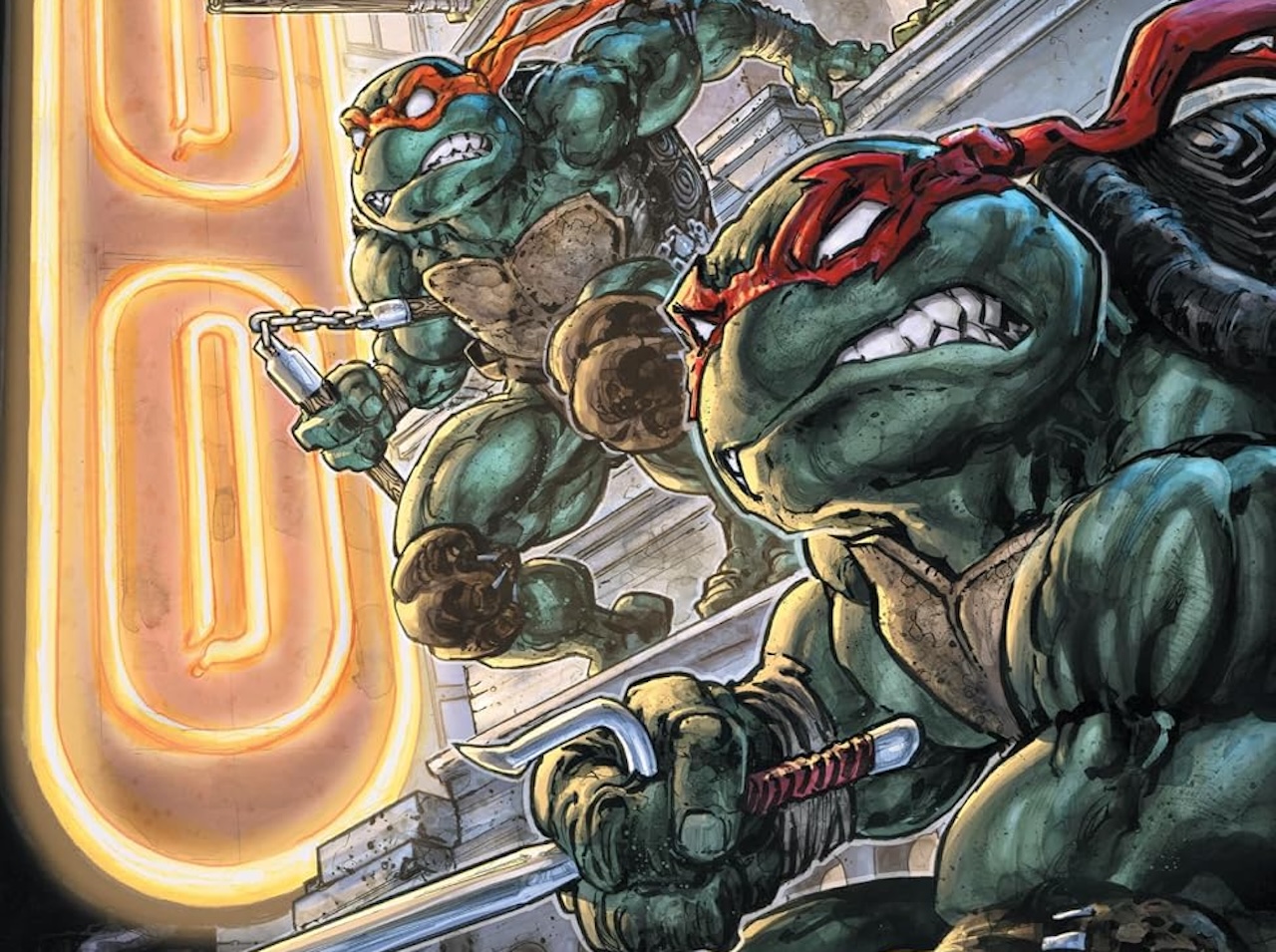

If you go back and read any interview with Kevin Eastman or Peter Laird, the duo always says that they had no idea that the Teenage Mutant Ninja Turtles would become a pop culture phenomenon. They just wanted to make their own comic, and that comic hooked plenty of fans – as did the 1987 animated series, the first live action movie, and so on and so forth. To this day, nearly every decade of TMNT fans has a certain piece of media that was their introduction to the Heroes in a Half-Shell, and IDW’s ongoing series is no exception. That makes Teenage Mutant Ninja Turtles #20, all the more special, since it’s officially considered the 300th TMNT comic printed.
To celebrate the occasion, Teenage Mutant Ninja Turtles #20 is split into two supersized stories. The first, “The Veil,” comes from the current creative team of Gene Luen Yang and Freddie E. Williams II, and finds the Turtles attempting to carve out a new life with their adoptive father, Splinter, and resurrected mother Tang Shen. Things go sideways when representatives from Yomi-no-Kumi, better known as the Land of the Dead, task Tang Shen with reclaiming souls that’ve crossed the barrier between the living and the dead; further complicating matters is the fact that Karai and Baxter Stockman seek to harness souls from Yomi-no-Kumi to bolster the Foot Clan’s grasp on power.
“The Veil” is a gripping read in that it forever shakes up the dynamics between the Teenage Mutant Ninja Turtles and their enemies, and even their allies. Raphael finds himself on the outs with Casey Jones, especially once Casey learns of Yomi-no-Kumi and attempts to bring his mother back to life; he also learns that whatever fragile peace he and his brothers formed with Karai is done. On Karai’s side, she might have her own issues to worry about as her friend Shinigami is less than happy with Stockman’s machinations. Yang does a great job of keeping fans hooked with this character work, which bodes well for the upcoming “The City That Never Dies” story arc.
It doesn’t hurt that he has an excellent artist like Williams backing him up. From quieter moments involving the Hamato family to the rooftop-hopping fight scenes, Williams delivers plenty of imagery that will keep eyes glued to the pages. He also has the chance to illustrate nearly every major figure in TMNT history, from the Turtles themselves to Shredder (playing off the ending of Teenage Mutant Ninja Turtles: Shredder #10). Andew Dalhouse tops off the art with a collection of different colors depending on who’s in the picture; ghosts pulled from Yomi-no-Kumi have a spectral green glow around them, while each Turtle is still rocking their signature colored headband.

IDW
The second half of Teenage Mutant Ninja Turtles #20 is dedicated to the story “Timeline Cleanse,” which picks up in the aftermath of the Teenage Mutant Ninja Turtles: Battle Nexus miniseries. Tasked with cleaning up the damage to the timeline, time traveler Renet takes a look at the various versions of the TMNT across the universe. This leads to a story that’s a tribute to every era of TMNT, from the original Mirage era all the way to the current IDW run. It works because Eastman and Tom Waltz share writing duties; when one is the co-creator of the franchise and the other has written over a hundred issues of TMNT, you couldn’t ask for a better pair of hands to tell this story.
“Timeline Cleanse” also boasts a collection of artists, including Chris Allan, Ben Bates, Dan Duncan, Frank Fosco, Jim Lawson and Eric Talbot. All of them manage to replicate the distinct energy of different eras, whether it’s the grittiness of classic Mirage or the wackiness of the original animated series. In Lawson and Talbot’s case, they have a chance to revisit TMNT: Journeys, which continued the Mirage era under Peter Laird and led to some truly wild plot twists. But it’s a reminder that all of TMNT is worth revisiting.
Teenage Mutant Ninja Turtles #300 not only celebrates the franchise’s history, but also moves the main story forward with developments that are sure to be game-changing. While Kevin Eastman and Peter Laird might not have expected a massive pop culture juggernaut to spring out of their indie comic, I’m forever glad they published it.




You must be logged in to post a comment.