

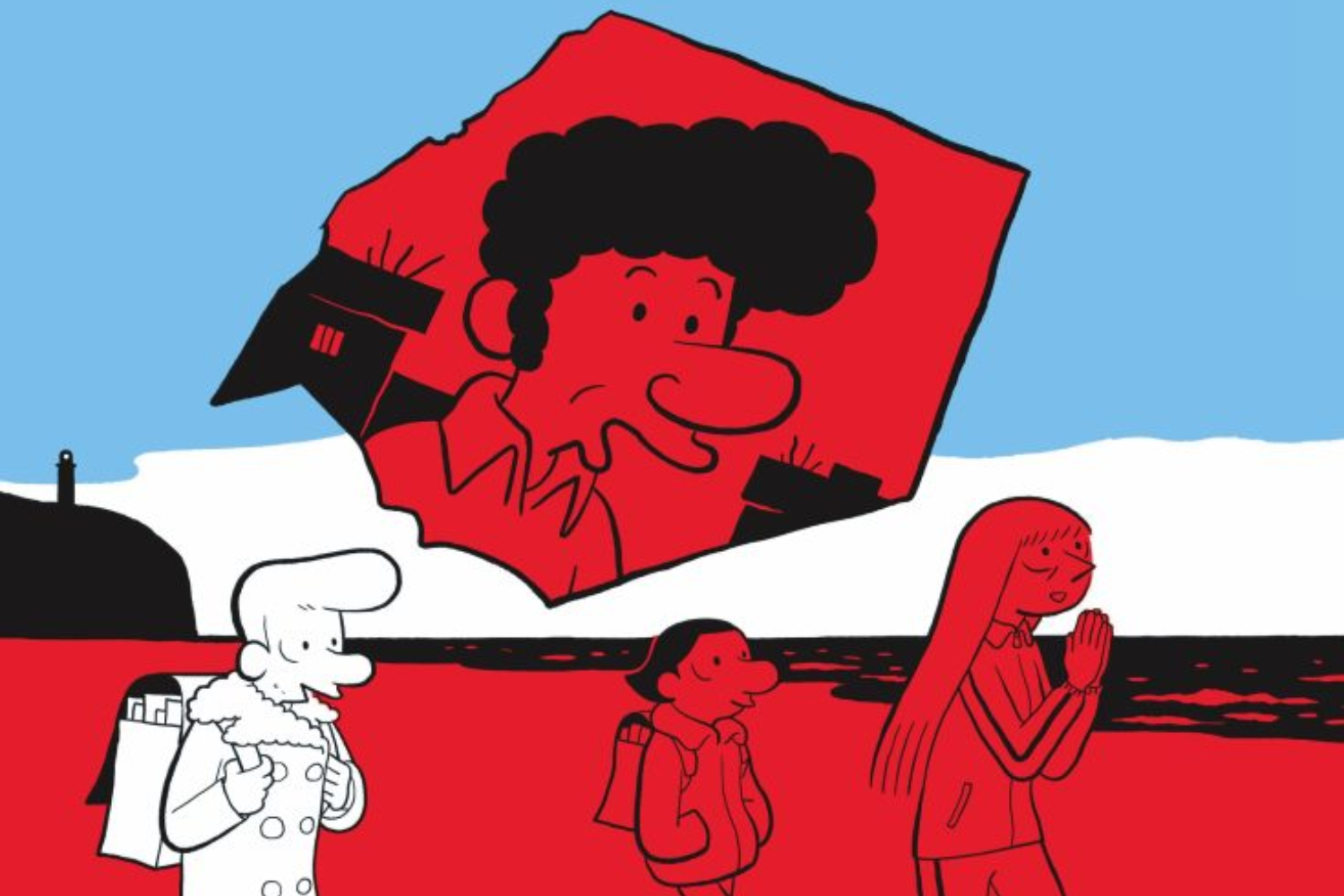

For more than a decade, Riad Sattouf has invited readers into one of the most acclaimed autobiographical comics projects of the 21st century. Through The End of The Arab of the Future, he has chronicled a childhood spent between France, Libya, and Syria, navigating the often-conflicting worlds created by his French mother and his charismatic yet authoritarian Syrian father.
Now, with The End of the Arab of the Future: A Youth in the Middle East (volume one is out now via Fantagraphics), American readers finally have the next chapter in that journey.
The graphic novel marks the beginning of the two-volume conclusion to Sattouf’s internationally award-winning memoir. Set during his teenage years in Brittany, France, the book follows a 14-year-old Riad as he grapples with adolescence, isolation, family trauma, and the lingering absence of his younger brother Fadi, who was abducted years earlier by their father and taken to Syria.
Yet despite the heavy subject matter, the book is often hilarious. Awkward crushes, embarrassing misunderstandings, heavy metal obsessions, and the everyday humiliations of being a teenager sit alongside grief, displacement, and questions of identity. The result is a story that feels intensely personal while remaining universally recognizable.

Courtesy of Fantagraphics.
Speaking with me via email, Sattouf explained that recreating those years wasn’t a matter of historical research so much as recovering the sensations that defined them.
“I didn’t really work like a historian trying to reconstruct a period from archives,” Sattouf said. “What interests me is less the exact chronology than the exact sensation.”
That distinction helps explain why The Arab of the Future has resonated with readers around the world. Sattouf isn’t simply documenting events; he’s recreating what it felt like to live through them. For him, memory exists beyond facts and dates.
“I believe some memories remain in the body,” Sattouf said. “They are memories of smells, of light, of physical embarrassment, of solitude, of fantasies.”

Courtesy of Fantagraphics.
Those sensations become the building blocks of The End of the Arab of the Future, particularly as the series shifts from childhood into adolescence. Sattouf captures teenage life with a specificity that can feel almost uncomfortable, from humiliating social encounters to overwhelming romantic obsessions.
That overwhelming sense of discomfort is intentional.
“Adolescence is not a noble, clear, coherent period,” Sattouf said. “Quite the opposite.”
One sequence in particular, set on a nude beach, perfectly encapsulates that very philosophy. While trying to focus on a meaningful family moment involving his grandfather, young Riad is simultaneously distracted by everything else happening around him. The scene is funny, awkward, and painfully relatable.
Adults, Sattouf argues, often sanitize their memories when looking back.
“They reorganize their past in order to make it more dignified, more intelligent, cleaner,” Sattouf said. “I want to recover the confusion.”

Courtesy of Fantagraphics.
That confusion extends beyond adolescence itself. Throughout the book, Sattouf searches for refuge wherever he can find it. Drawing becomes one escape; heavy metal becomes another.
“Drawing was truly my main refuge,” Sattouf said. “It was the place where I could regain a little control over the world.”
Comic creators such as Robert Crumb, Mœbius, Richard Corben, and Philippe Vuillemin became creative idols. Meanwhile, bands like Slayer, Sepultura, Nirvana, and Sonic Youth offered an emotional intensity that mirrored what he was experiencing internally.
Added Sattouf, “I needed to tell myself that another world existed.”
Those influences help transform The End of the Arab of the Future into something larger than a memoir. While the book remains deeply personal, it also serves as a portrait of adolescence before the internet reshaped how young people interact with culture. Looking back on the 1990s, Sattouf remembers a time when identity was formed through records, magazines, tapes, album covers, and rumors.
“There were fewer images available,” Sattouf said. “So the images you did encounter had enormous power.”

Courtesy of Fantagraphics.
That period also left him acutely aware of questions surrounding identity, nationality, and belonging. Having spent much of his childhood moving between countries and cultures, Sattouf often found himself viewed as an outsider regardless of where he lived.
Sattouf added, “I experienced xenophobia in several directions.”
Those experiences helped shape his understanding of how fear and suspicion can emerge in any society. Yet even while addressing difficult topics, Sattouf rarely abandons humor. In fact, some of the book’s most heartbreaking moments are also its funniest.
One sequence involving teenage jealousy feels devastating filtered through Riad’s eyes while simultaneously carrying an almost absurd quality from an adult perspective.
“I don’t really try to balance the two,” Sattouf said when asked about mixing heartbreak and comedy. “For me, they are already together in reality.”

Courtesy of Fantagraphics.
Humor, he believes, isn’t a way of diminishing pain. It’s often what makes pain feel more authentic.
“Life is never only tragic,” Sattouf said. “Even in the darkest moments, there are grotesque details, absurd words, ridiculous gestures.”
That philosophy has defined The Arab of the Future from the very beginning. Throughout the series, family trauma exists alongside ridiculous conversations. Political upheaval shares space with childish obsessions. Terrible events are often framed through details that are strangely funny.
According to Sattouf, those contradictions are simply part of being human.
“I do not want villains, victims, and heroes,” Sattouf said. “I want to show contradictory human beings.”

Courtesy of Fantagraphics.
As The Arab of the Future grew into an international phenomenon, that essential commitment to honesty became increasingly difficult. Added Sattouf, “The more numerous the readers became, the stranger the intimacy of the story felt,” he admitted.
Even so, he never once considered pulling back, adding, “I absolutely did not want to protect myself at the end.”
Now, after years spent chronicling his childhood, adolescence, family relationships, and personal history, Sattouf finds himself approaching the end of a journey that has defined much of his creative life.
“It’s very strange,” Sattouf said. “Finishing The Arab of the Future was like closing a door, but a door that opened onto a very deep part of myself.”

Courtesy of Fantagraphics.
There is relief in finishing the project; there is also melancholy.
“The dead, the absent, the vanished places, the former versions of yourself become almost work companions,” Sattouf said.
Yet perhaps the most fitting conclusion is the one he arrived at himself. Making The Arab of the Future never erased the pain that inspired it. Instead, it transformed those experiences into something that could be shared.
Added Satouff, “When storytelling works, it does not erase the pain, but it gives it a form.”
After more than a decade of memories, mistakes, laughter, and heartbreak, that story now belongs to readers as much as it belongs to him.
The End of the Arab of the Future: A Youth in the Middle East is available wherever comics and books are sold.


You must be logged in to post a comment.