

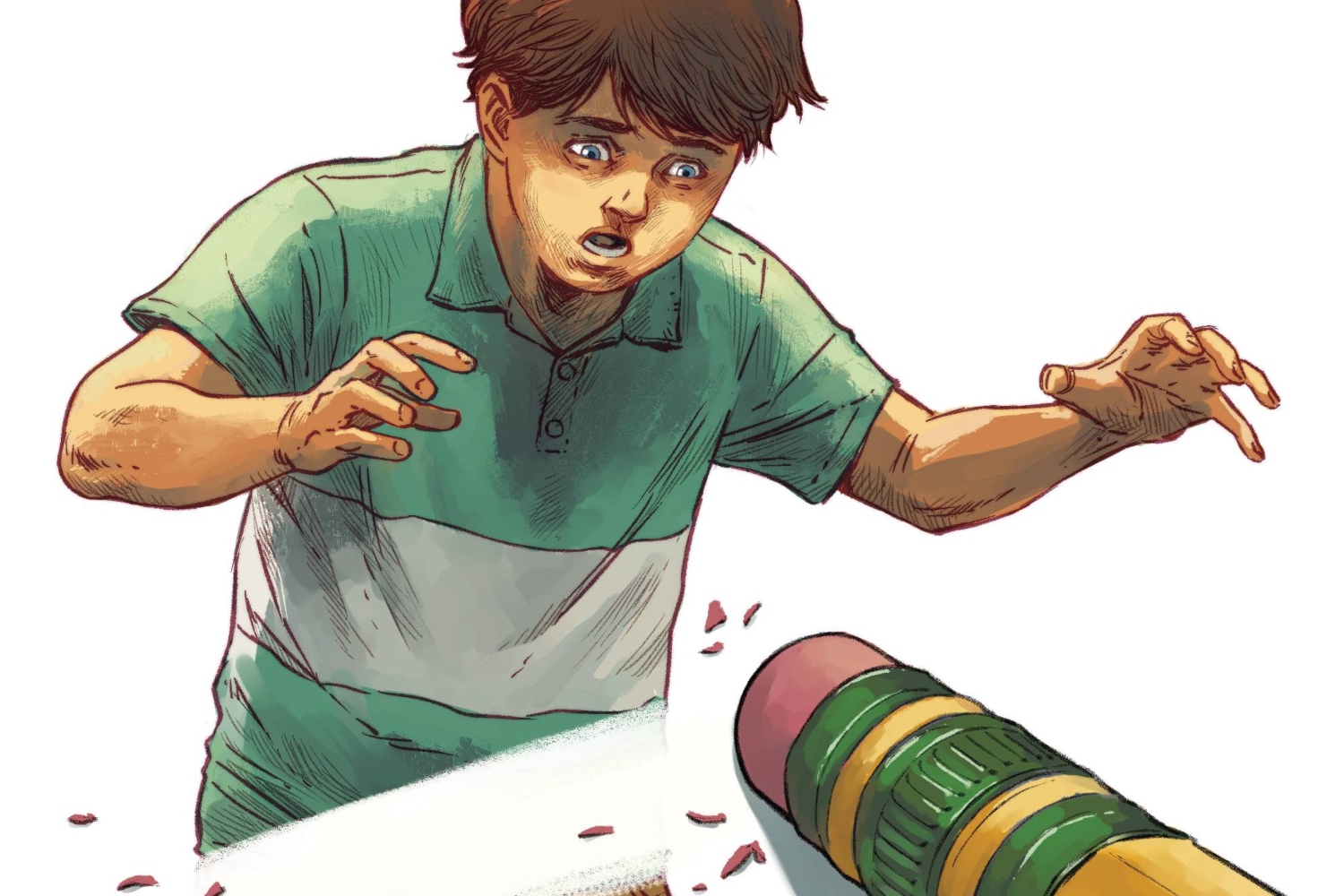

For a comic featuring a kung-fu version of Turbo Teen, Uncanny Valley has been decidedly poignant. The creative team (writer Tony Fleecs, artist Dave Wachter, and letterer Pat Brosseau) have managed to use young Oliver’s immersion into his cartoon heritage as this potent exploration of family, identity, and even the magic of our own ugly reality. But as we land at the penultimate issue, Uncanny Valley may have reached its most emotional and deliberate issue thus far. And there’s still a dang cartoon dingo just hanging around.
At the end of issue #4, the battle for Oliver (between his grandpa, Pecos Peet, and the nefarious The First) reached a fever pitch when Peet got the ol’ yeet over a cliff. But before The First got to sacrifice Oliver in this issue, his mother, Peggy/Margaret, stepped up even more for a pretty gnarly confrontation. I’ll let you decide if Peet’s actually gone, or if he reappears midway into this battle, but Margaret’s continued presence is vital here. Namely, Uncanny Valley has tried to maintain this balance between the cartoon and reality — it’s been a way to explore these heady ideas through a weird framework to get us thinking about the power of these properties and the sheer overlap between the worlds of reality and art/comics/cartoons.

Courtesy of BOOM! Studios.
But in issue #5, it feels like that balance, that kind of back-and-forth between these aesthetics and ideas, has reached peak cohesiveness. What we get, then, is this very real conflict that touches on those thematic tentpoles — identity and family but also notions of social change and generational responsibility — that happen in these increasingly cartoonish settings. The whole world isn’t just dotted with cartoons, but it’s as if they’ve completely taken over this universe’s “real world.”
But even as we get magic pixies and henchmen skeletons, they’ve reached a level of detail and intensity that makes it feel as if this “reality” has had just as much impact on the toons themselves. The First, especially, still has those Saturday morning cartoon vibes to the very top of his pointed helm, and yet he’s got this force and intensity that transcends that. He’s this very real presence poking us in the brain, and it’s through that process that all of it becomes deeply, deeply lodged in our consciousness.
What we ultimately get is this perfect symbiosis of ideas, aesthetics, and sentiments — a world where the cartoonish is real, the real is cartoonish, and we’re forced to (quite joyously, I might add), struggle within this little niche zone. It’s about bringing us into this narrative in a way that our perspectives, sensibilities, and understandings are transformed — there is no space between concepts, people, planes of existence, etc.

Courtesy of BOOM! Studios.
It’s all just this place where you can pull a giant weapon from your pocket as long as it’s for good reason, or you can ride a tornado if you’re doing it for love. It’s all magic and something else entirely because that’s how it really is — if you believe in something hard enough, it transcends its limitations and is very much this thing of spiritual and emotional power. It’s this perfect blending that really makes the themes of Uncanny Valley pop like never before; all stories and ideas are united, and it’s those of us with the heart to believe that can move cartoon mountains.
At the same time, issue #5 has a really inventive ending, and while I can’t spoil it, I can say that it works in two important ways. One, it’s a really good surprise, and the kind that sucker-punches you in the stomach. But it also comes in a way that maybe you know it’s not the end, even if you’re not entirely sure. And through that approach, Uncanny Valley is achieving its loftiest goals and potential, and we are asked, in a really compelling way, to struggle with this hope in the face of the odds. That believing in the magic of the world is one thing, but that doesn’t make it any less of a struggle. It’s a lesson that empowers the ideas of family and identity because that’s maybe what it’s all about: having these things that lock us into the world and lift us up at the same time.

Courtesy of BOOM! Studios.
You can’t have one without the other, and Uncanny Valley encourages us to fight for big things even when we can’t always see them. To lean into whatever’s inside of us to find the courage and commitment to make this magic real in the world. It’s not always an easy journey, but as this issue made clear, convenience isn’t always the name of the game.
I find myself after Uncanny Valley #5 truly buying into this story like I haven’t before. Sure, I always quite liked it, and thought that there were some really great concepts and ideas operating across the storyline. But issue #5 is where, and I hope that’s been made clear by my semi-motivational yapping, that Uncanny Valley had something larger to say. A message that’s hugely personal and uplifting, yeah, but also comments on meta storytelling (the book has layers narratively and visually that feed back into one another) as well as the nature of comics at-large.

Courtesy of BOOM! Studios.
In that way, it’s a greater realization of the creative team’s work as storytellers as much as it adds a new sheen to Uncanny Valley. That they were balancing all these ideas, energies, inspirations, etc. to achieve a master stroke where all of that stuff aligned, and what we were left with is this powerful experience that has the force and intent of, say, Neverending Story or Labyrinth. Properties that become pillars not just due to storytelling and art, but by showing us the existential wonders of embracing a bizarre world and how not knowing real from fake, up versus down is what makes us better, more accepting and engaging people.
Issue #5 is a huge step forward in all the right ways, and it’s where we see the courage and power of Uncanny Valley realized in such a profound yet still understated manner. It’s a chapter of this book that’s equally funny, heartbreaking, and endearing, sustaining every part perfectly as to remind us that the best stories become so much more than their origins as they seek to transform readers into seeing the true curvature of the universe.
I have very high hopes for issue #6, and I’m fairly certain that Uncanny Valley can conclude with even more robust feats of poignant whimsy.




You must be logged in to post a comment Login