

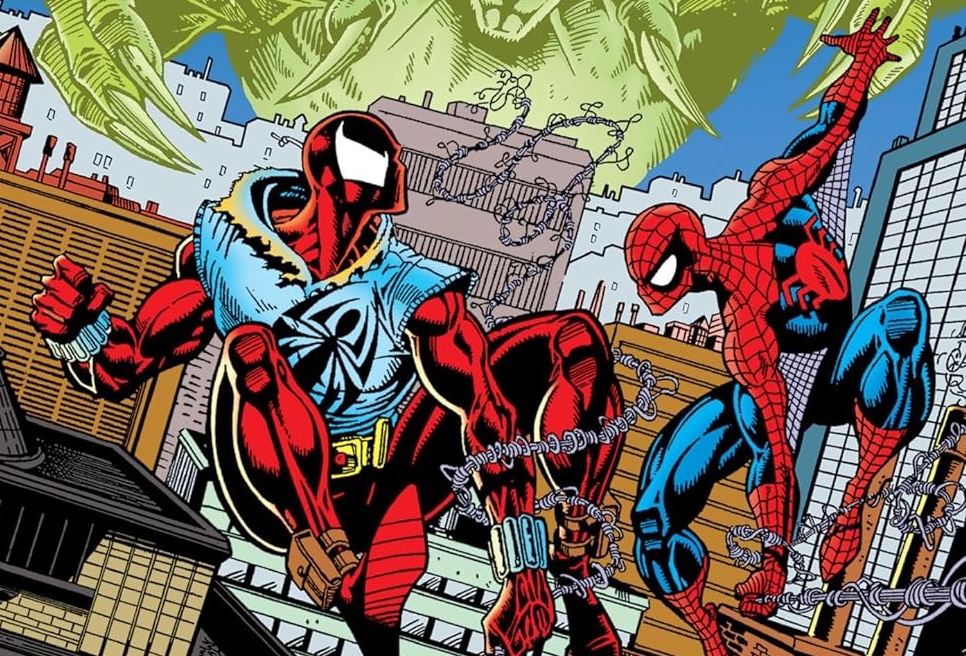

As someone who remembers the backlash of the time, sitting down with Amazing Spider-Man Epic Collection: Web of Life, Web of Death is somewhat eye-opening.
To say that the critical and fan reception of The Clone Saga was negative would be to undersell just how massive, long-lasting, and vitriolic that backlash was. For years, The Clone Saga was the butt of a lot of frustrated jokes about the hubris of the 1990s. Fans muttered about it not just as a ‘bad’ story, but as an affront to fans. Fans weren’t just angry at the event, they seemed hurt by it. Even fans who never fully read the story bore this burden until 2005’s The Other storyline replaced it as the most damaging story arc in their minds.

Marvel Comics
The story, which sees Peter Parker’s clone Ben Reilly return to New York to visit Aunt May in the hospital (a stroke, this time) and get pulled into super-heroing as the Scarlet Spider, isn’t initially troubling. Its opening arc, collected in Amazing Spider-Man Epic Collection: The Clone Saga, doesn’t do much to upset the Spider-Man narrative. In Web of Life, Web of Death, we begin to see where the hurt comes from.

Marvel Comics
In this volume, Reilly and Parker finally start to interact with one another, drawn together by the machinations of the clone’s original creator, the Jackal. The damning aspect was that Peter Parker’s legitimacy as ‘the real Spider-Man’ gets called into question — not once, but twice. If Reilly (or Kaine, or a third clone, or any of the half-dozen others Jackal has running around in his lab) was the real Spidey, wouldn’t that mean that the preceding 20 years – from the original clone story of the mid 19970s to The Clone Saga of 1995 – be invalidated? Every big story, from Peter’s and Mary Jane’s wedding and Kraven’s Last Hunt to Maximum Carnage, could be seen as a lie.
To believe that such a massive rewrite of Spider-Man could happen, in a medium that thrives on a status quo, was a bit naive on the part of fans and critics at the time; this was the character whose creator insisted, after all, on an ‘illusion of change’. But this was the era when people believed that Superman could die (or, a few years later, that he could turn into two electric guys). It’s important to understand that superhero comics were still a relatively new thing; the medium was only sixty years old, and Spider-Man himself was just over thirty; fans of the books were younger, still.
But the story wasn’t the only problem: perhaps a lot of the hatred for the event lies in its expensive nature. Emboldened by the popularity of the heavily interwoven Maximum Carnage, the company insisted on making readers chase stories from title to title. This means a few things, most obvious among them that readers were forced to buy not just one of the Spidey comics every month, they were forced to buy all of the Spidey comics every month. Web of Spider-Man led to the adjective-less Spider-Man, which led in turn to Amazing Spider-Man. With five possible titles in a given month (Spider-Man: Unlimited came only every few months), a reader had to spend upwards of thirteen dollars to follow their favorite (and second-favorite) web-slinger. That might not seem like much – thirteen bucks barely covers three comics today – but it nonetheless felt inexcusable.

Marvel Comics
Inexcusable because the story was inescapable – with every book tapped, there was no space for a reader to experience Spider-Man without the heavy, clunky machinery of the all-pervasive event. A reader couldn’t opt for a low-commitment title out of five on offer. Further, creative teams were never quite on the same page, no matter how well-planned a story might have been. Peter Parker and Ben Reilly’s motivations change from one issue to the next, as do minor illustration details.

I love Mark Bagley…
Marvel Comics
What was eye-opening, looking back on the book with nearly thirty years of hindsight, was that these books aren’t actually bad, however many inconsistencies. Hell, a quarter of the issues were written by longtime Amazing Spider-Man architect JM DeMatteis, whose tenure had seen landmark after landmark. Those issues were also illustrated by the incredible Mark Bagley, whose contribution to the character’s aesthetic rivaled that of Steve Ditko’s, Sal Buscema’s, and Todd McFarlane’s. The other books had heavy hitters like Tom DeFalco, Howard Mackie, Bill Sienkiewicz, and Buscema himself on board; removed from the legacy of The Clone Saga, these were master-class creators with sterling craftsmanship skills.

…but I hate this panel.
Marvel Comics
The books could be bouncy, bombastic, and fun – though they tended toward moody and self-loathing (Ben Reilly: for people who felt that Peter Parker wasn’t morose and whiny enough). There’s a lot to be had here, even for those who remember the stories with that trademark nerd vitriol.
Safely removed from the active plot lines and frustrating publishing schedule, the Clone Saga – particularly the portion collected in Amazing Spider-Man Epic Collection – Web of Life, Web of Death – doesn’t deserve its hyperbolic, angry reputation. Fans no longer have to suffer through its slog in real-time, and perhaps the readership has developed a healthy amount of cynicism when it comes to believing unreasonable narrative turns.
In the end, all will be returned to the status quo so that the next set of creators can mess it all up again; those upsets – yes, even The Clone Saga – are what make comics interesting.



You must be logged in to post a comment.