

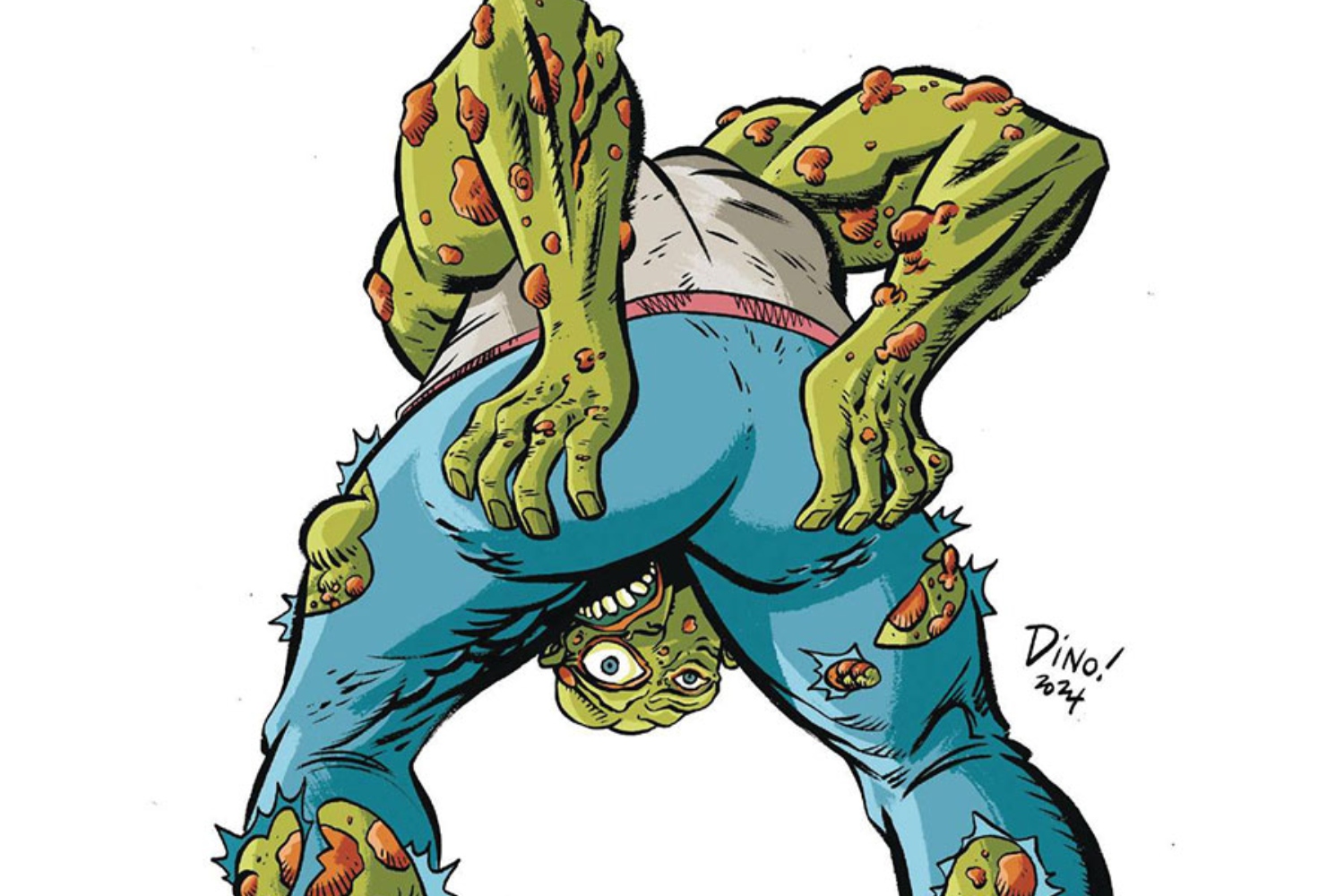

Admittedly, I was extra stoked on The Toxic Avenger #1. If the film wasn’t my favorite of all time, it certainly was the thing that most shaped and informed my worldview (for better and worse). And for the start of this latest comics adaptation, writer Matt Bors and artist Fred Harper did a damn good job in updating the important parts, taking out the overt racism and misogyny, injecting more hefty themes, and giving us more humanity over hijinks to truly make this a Toxie for a new era.
But issue #2 is where this toxic waste dump may be less of a home and more of a possible hazard.

Courtesy of AHOY Comics.
Perhaps some of that is because there’s less “razzle dazzle” in The Toxic Avenger #2 — as in that genius use of reverse chronology is pushed to the side for a more direct timeline and approach. And it’s a small decision, but it really gave that debut a more savvy approach to its development and let the creators frame this whole thing in a way that played up our uncertainty and our immersion into this version of Tromaville.
But that’s mostly excusable as the real problems with this issue are more about the content at-large. Namely, the emphasis on Gen Z humor and cultural dissection. The Toxic Avenger film worked because it took down ‘80s Reaganism and general cultural vapidness with brutal efficiency — poking holes in the yuppies’ whole worldview and showing them to be vacant, antisocial bullies who consume goodness and crap out waste and greed. In this latest series, you only have to update that hit list a little, as Trumpism feels like a direct descendent of the same awful worldviews.
Only, that doesn’t ring nearly as true in this second issue. What we got was a lot of one-off jokes that reference modern pop culture, like Liver King and alphas-betas. References, I might add, that either come off as hollow gags or emphasize one target when there’s so many more deserving targets out in the world today. It’s an issue represented where Melvin spends time fighting another mutated teen, Pluto, in a battle that looks and feels cool but ultimately emphasizes this book’s increasing issue with choosing a discerning enemy.

Courtesy of AHOY Comics.
It’s an even larger issue furthered by another key aspect of this issue: where Melvin nearly becomes the corporate liaison to the company that turned the town into a toxic hellhole. It’s funny enough — Melvin really shows his humanity in wanting the money and influence that such a role would offer. But it ultimately either doesn’t land as heavily and intently as it should, or it becomes just another joke or gimmick as opposed to an actual challenge or obstacle to overcome and offer some keen insight. Either way, it’s extra indicative of how this book seems to struggle in gaining real momentum in making worthwhile satire. That it knows it needs to make fun of something, but it either can’t decide or actually decides in a way that feels iffy and/or non-committal.
It’s satire that may feel safer and more approachable than the 1984 movie, but while that film is wholly offensive by today’s standards, at least it had the gumption to punch up to the elite (even if it still kinda struck those below). This Toxic Avenger doesn’t yet have that sheer force or poisoned tongue to nail anything in a way that’s either perfectly clear or feels like it goes beyond more gimmicky swings at Gen Z culture. If I wanted half-hearted takedowns of our feckless culture, I’d just watch even more TikTok.
That’s not to say that The Toxic Avenger #2 is somehow a complete failure (even as these aforementioned issues feel significant enough). One of the biggest aspects of the debut was, as mentioned, the humanity. We got less pastiche and more real people — the punk rock spin on Melvin, for instance, made him someone with edges and texture to really grapple with amid his transformation. And in issue #2, we see him more as a lonely daydreamer (without impacting his whole rebellious streak), and that whole dynamic made Melvin more robust and engaging than ever before. It’s that core of humanity that connects us to him and even makes some of the downfalls of this issue feel organic and nuanced, which does help.

Courtesy of AHOY Comics.
The confrontation with Pluto, for instance, ends in this really evocative and poignant way — it cuts through the concerns and half-cocked satire to show the humanity of our self-destruction and what we’re doing to youth culture everywhere (snuffing it out, basically). It’s that humanity that makes all that satire truly land, and while it can’t save this issue entirely, it’s that personality and sense of spirit that we’re looking for all along. That if you’re going to take apart modern political and cultural artifacts, you need to have something that resonates in hearts as much as minds.
And, if nothing else, the art team (Harper alongside colorist Lee Loughridge and letterer Rob Steen) continue to shine in crafting this unique take on Tromaville. There’s so many visuals standouts from this second issue: the Toxie-Pluto fight is super gross while still being deeply human and packed with emotion; the daydreams by Melvin nail a mix of silly and serious (with a side of nostalgia) that facilitates actual pointed, thoughtful satire in a way this book can’t always muster; and the world in general balances the jokiness, community, and grit that you need as a baseline for a story with specific themes and end goals.
I felt throughout the issue, be it the aforementioned fight or just a weird pose from Toxie, how much the art splits the difference between the movie as well as other properties in this vein. And how in doing that, it offered a kind of gravity and presence that could have made every joke, satirical comment, or heartfelt moment ring extra true. The fact that not all of it worked had less to do with the world of this book but rather what happens when you don’t better utilize your surroundings and the power of great art to extend your messages and make your barbs land extra sharp.

Courtesy of AHOY Comics.
It occurred to me, midway into reading, that I came to this issue mere days after the 2024 election, and that I was more acutely aware of these overarching ideas/issues. That we live in world so ripe for a complete evisceration by popular media, and that lackluster examples will often hang in the air like a bad fart. That’s not to say my love for this Toxic Avenger is somehow over already. Or, that the book can’t make good on its ample potential. Rather, that #2 is hopefully a speed bump, and that the wit and commitment of the creative team can carry on in giving the rest of the story the integrity and insanity needed to truly accomplish its mission of giving us a modern-day satirical superhero.
Otherwise, even I may have to move out of Tromaville with my head hung low.




You must be logged in to post a comment.