

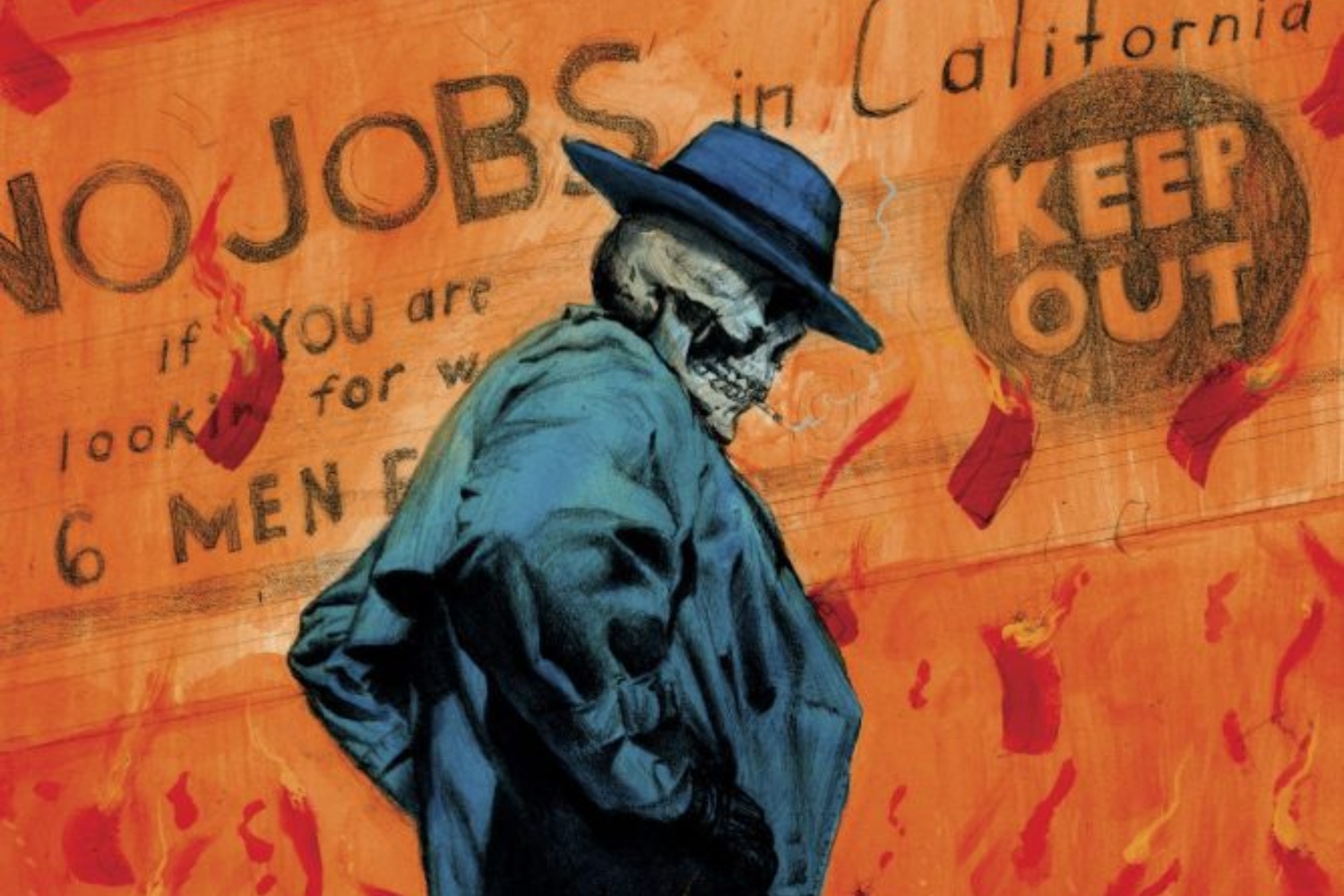

With its debut, Calavera P.I. promised what was basically “extra pulp-y The Crow but with Chicanos.” And despite that core magic of said premise, it was the humanity that really resonated. The sense of justice and decency of our lead, Juan Calavera; the love and power of his partner, Maria Valdez; and just the way artist-writer Marco Finnegan treated this story about a bold and live people/tradition.
With issue #2, Calavera P.I. is decidedly more supernatural creature than mere man, and this chapter is both better and worse for that development.

Courtesy of Oni Press.
Now that Calavera is officially back from the dead, we get to some of the more horror-leaning aspects of this story. As he and Maria start to track down her lost son, forcing them to confront the legends of La Fantasma, the scenery and general vibes are appropriately scary. Finnegan really knows how to set the mood with coloring and shadows, creating a kind of “haunted L.A.” vibe that works really well to creep into horror while still respecting the folksy story. The atmosphere feels heavy but playful like a real great but cheesy horror flick, and you feel pulled into this time and place.
And speaking of the story, even amid the horror vibes and overarching mood, the socio-political undertones work exceptionally well. If anything, opening up threads about the Mexican Repatriation is perfectly suited for this story — Calavera is the literal monster that so many white Americans feared/needed as a scapegoat back then. (An idea Mr. Calavera is very much aware of and expertly plays up in the early part of the issue.)
The setting and the alignment of the narrative feel like this book is clearly playing with genre storytelling (something mentioned in my own interview with Finnegan) and stepping up in a really big way. Calavera, especially, nails that balance between edgy P.I. and spooky ghoul, displaying the appropriate levels of kitschy terror and actual heft and edge to feel deeply effective. He’s very much both reflective of his circumstances and settings (again, the city feels fully scary without feeling overly hokey) and yet stands out as an actual walking skeleton. (I love the way he’s basically bones in a trenchcoat.)

Courtesy of Oni Press.
And from that we get this palpable tension that feels almost physically effective and is still very much about the issues of discrimination and other-ing that are central to this story. In this way, genre feels almost like a character in this story, and it empowers so much of the story without taking away from this very relatable, very human drama.
At the same time, though, this increase in horror energies/vibes does have some side effects (intended or otherwise). Namely, after such a massively important introduction in Calavera P.I. #1, Maria feels a little flat here. Yes, she does keep Calavera’s “legacy” going by starting up Calavera Productions to recreate his stories (with “gringo actors”) in a move that’s wonderfully meta and furthers this title’s genre “experiments.”
But she mostly spends issue #2 crying about her son, and she doesn’t exude the same mix of personal strength and general savvy than seemed so apparent in the debut. She’s also got a husband (or maybe just her son’s dad?) named Mike, and I think even the mere utterance of a possible love triangle impacts the Calavera-Maria dynamic in a way that feels annoying.

Courtesy of Oni Press.
Still, that’s only a mere possibility at this moment, and even some of the issues with Maria in issue #2 are acceptable enough. No, when it comes to actual problems with this issue, it’s all about the clown. Namely, an actual clown who may be abducting kids (like Maria’s son). In a book with an actual private dick skeleton, the clown bad guy/henchman may be a bridge too far. That red color and general energy does more to undercut this story and it’s more serious implications than any walking bag of bones.
The clown is, for all intents and purposes, the opposite of Calavera himself — what happens when you let tropes, gimmicks, genre, etc. go a little too far. When these “devices” don’t come in service of the story but rather take away from the perilously-balanced grounded elements and the supernatural components. It’s small enough, but it could be indicative of larger problems as this story further develops and brings us deeper into its lore. It’s almost a denial of organic humanity, in some ways, and the way that the supernatural could take away from, and not add to, a story about a disenfranchised people fighting for their last strands of dignity.

Courtesy of Oni Press.
Generally speaking, though, Calavera P.I. #2 maintained enough humanity and reality amid the rising horror tides to still feel truly promising. Maybe it wasn’t an entirely perfect and/or streamlined approach to this kind of storytelling, but there was lots of heart and creativity employed. And perhaps more than anything else, that’s what speaks to me about this series so far.
It’s a little creepy, totally plucky, and deeply interested in fostering a story that’s equal parts relevant, silly, and totally relatable. We’ll see how the rest of this case unfolds, but let’s just say we’ve generally got the right man for the job.




You must be logged in to post a comment.