

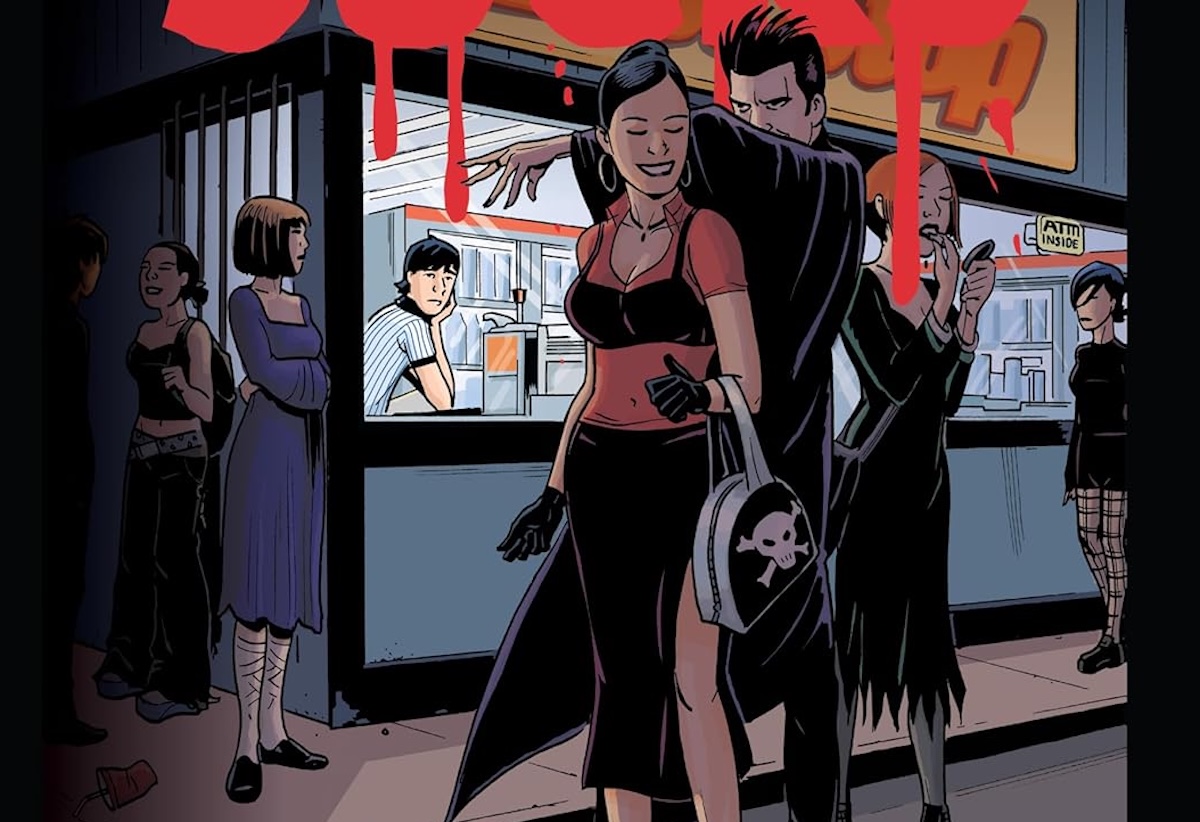

One of the most striking things about Life Sucks is how much it feels like a ’90s indie flick. Not just because so much of the action revolves around a convenience store, Clerks-style, and not just because of its very ’90s goth aesthetic, but because there’s a sort of young, iconoclast yearning that felt very prevalent in that decade. Morose boys crushing on hot, counter-culture girls, missed connections, and unduly confident sidekicks, Life Sucks is the indie-kid version of the teen comedies now 30 years gone.
Originally published in 2008, the book isn’t that far away from the films that it resembles; it also released the same year as Twilight, which means its vampire courtship more closely resembles Anne Rice than The Vampire Diaries. This is late stage, pre-Hot Topic goth: knee-high platform boots, mesh shirts, ankhs and crosses. Indeed, our central crush-object, Rosa, participates in a gothic fashion show, and her piece is something very of its time in goth history.

Fantagraphics
The narrative plays with a comic juxtaposition: the goth obsession with death and vampires and the schlubby white boys who are actually damned to an unlife. It might seem a tad obvious by today’s standards (lame guys are as apt to get bitten by a vampire as 16th-century warlords), but in the framing of this particular teen dramedy, it feels somewhat fresh, if a little without nuance.
Our protagonist – a down-on-his-luck boy named Dave – has been turned into a vampire by an old-world vampire who has made his way to America in a stereotypical send-up of emigrant convenience store ownership. He is doomed to work the night shift, ostensibly for eternity, and it during these night shifts that he begins to creep on Rosa as she stops in after a night of dancing. The book follows that classic thread of boy yearns for girl, boy (inexplicably) attains girl, boy loses girl.
He just happens to be a vampire throughout.

Fantagraphics
The lack of nuance comes from a feeling that the narrative – like so many of those movies the book resembles – feels half-baked, its conflict underdeveloped and its climax and resolution rushed and weightless. Like so many stories of this type, there’s an implication of meaning tagged onto the end, whereas no lessons are explicitly learned.
At nearly twenty years past its due date, Life Sucks hasn’t become savvy to the more woke trends that warn creators away from creepy crushes or even the implication late in the book, after Rosa is inevitably turned into a vampire by Dave’s nemesis, that she is “owned” against her will. Even if vampire stories are innately about abduction and cruelty, these are real ‘yikes’ concerns in any story released today – or, at least, they would be addressed and considered in any story containing them now. But this is an era of American Pie sequels; that it is “of its time” doesn’t make the book unpalatable, only a curiosity.
Ultimately, fresh readers of Life Sucks might be charmed (especially by Warren Pleece’s just-refined-enough cartooning), but they might best view it through a lens of nostalgia for a time when stories like these were more novel.




You must be logged in to post a comment.