

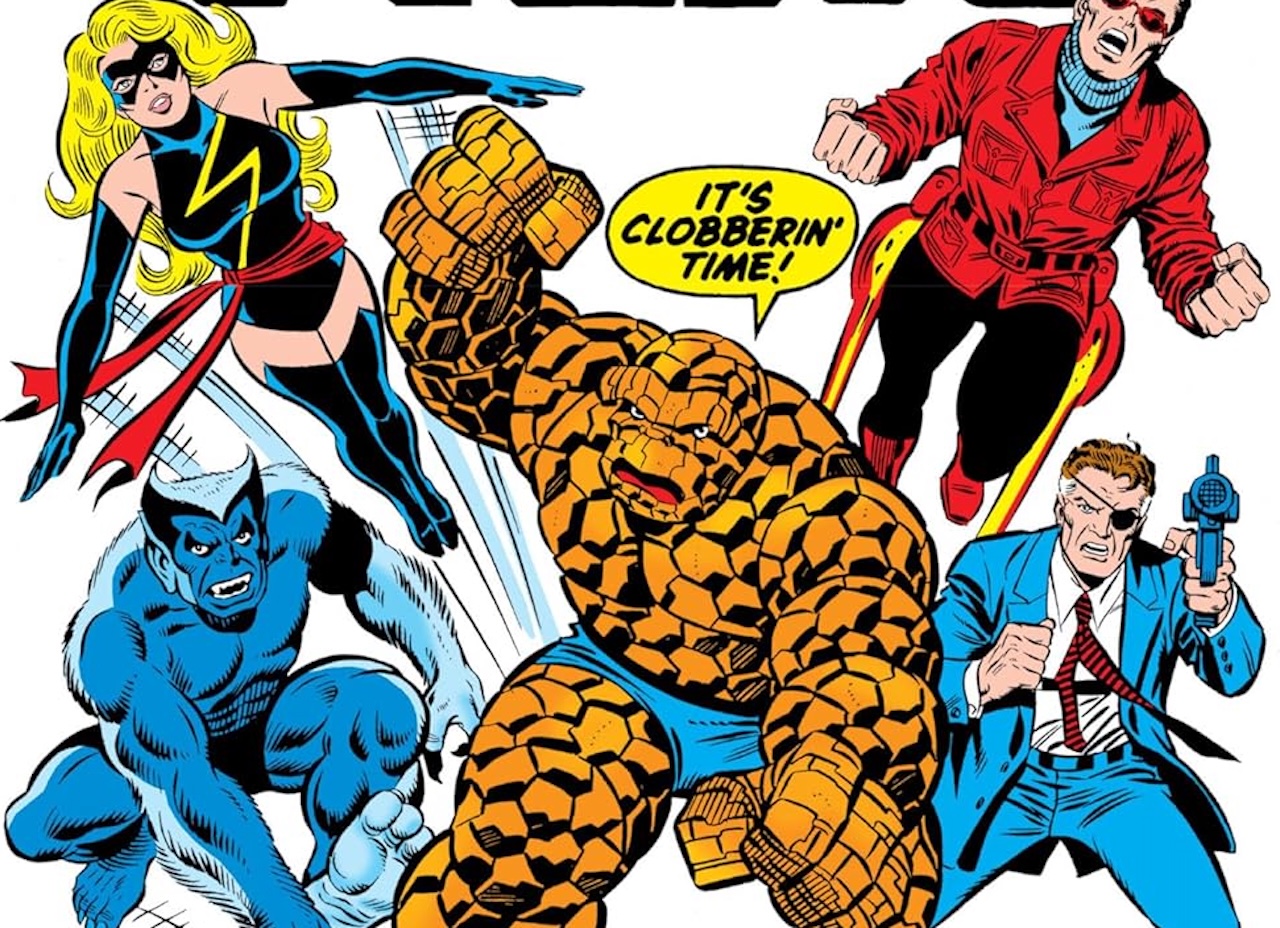

Some Fantastic Four and related comics of the late 1960s and early 1970s tended toward a stodgy, frustrating conservatism that didn’t quite mingle with the fun, bizarre, and creatively free universe that was unfolding around it. Even under Marvel’s younger, second wave of creators – creators like Roy Thomas – the Thing was often portrayed as an uptight curmudgeon who complained about feminism. Meanwhile, over in Marvel Two-in-One, he tended to be antagonistic toward his co-stars, unable to develop a real chemistry with them, as if the warmhearted grump we’ve come to know him as hadn’t yet broken through that rocky exterior.
Marvel Two-in-One Epic Collection: Remembrance of Things Past sees a lightening of that tone, a softening of the stiff and grumbling Thing. Sure, the character is often perplexed and complaining about his situations, but that’s part of the charm of the character: he makes a show of how he’d really rather not with all this superhero hooey. By the late 1970s, however, he’s downright playful in his adventures.

Marvel
It should be remembered that he was one of Marvel’s most beloved characters since his debut in Fantastic Four #1 in 1963; even stodgy, he was one of the few characters to get spun off into a second book of which he was the flagship character (just behind Spider-Man, whose Marvel Team-Up preceded the eventual onslaught of Spider-Man books). By Two-in-One’s 37th issue, creators like Marv Wolfman and Bill Mantlo were having more fun with the character and allowing Thing to have comfortable, sometimes intimate, relationships with his super-peers.

Marvel
In this volume’s famous, penultimate issue (#51), we see one of Marvel’s more fun conventions: the superhero poker game, a long-running institution often shown to include not just the Thing but Nick Fury, Beast, and (later on) Wolverine. This issue, written by Peter Gillis and drawn by an early-career Frank Miller, sees Thing sneaking into a S.H.I.E.L.D. facility to sit down at the table with Nick, Beast, Ms. Marvel, and Wonder Man (plus civilians Jarvis and a district attorney). The story isn’t about poker: there’s a terrorist attack going on elsewhere that the crew must stop by the conclusion of the issue. But the poker game highlights something that seemed fresh and new by this point on Marvel’s then-short world-building: these characters are friends, their high-flying antics leading to relationships outside of crisis.
This is the Marvel Universe at its most earnest and realistic: characters who are familiar with one another and have ongoing relationship arcs. This issue highlights a growing community of work buddies blowing off steam, trying to have a normal life despite their extraordinary day-to-day.

Marvel
That’s the Thing that develops throughout the pages of this era of Marvel Two-in-One: a Thing who makes idle chatter with his peers, whose lived-in relationship with Spider-Man or Black Panther allows for dad jokes and begrudging affections. This is Ben Grimm as he remains to this day: one masking his good cheer with a play-acted sardonicism. This is how the character would behave throughout the coming decade, particularly under the hand of John Byrne (who executes one of the best issues here, #50, which features Thing going up against a younger, more Jack Kirby-esque version of himself).

Marvel
The adventures in Marvel Two-in-One Epic Collection: Remembrance of Things Past are goofy, clear-cut, single-issue escapades. The guest stars are mostly heavy hitters (Captain America, Black Panther, Doctor Strange), but the more experimental aspects of Marvel Comics in the ’70s creep in around the corners (Man-Thing, Brother Voodoo, Nova). It’s as if the then-revolutionary finally begins to rub off on Marvel’s most curmudgeonly character.




You must be logged in to post a comment.