

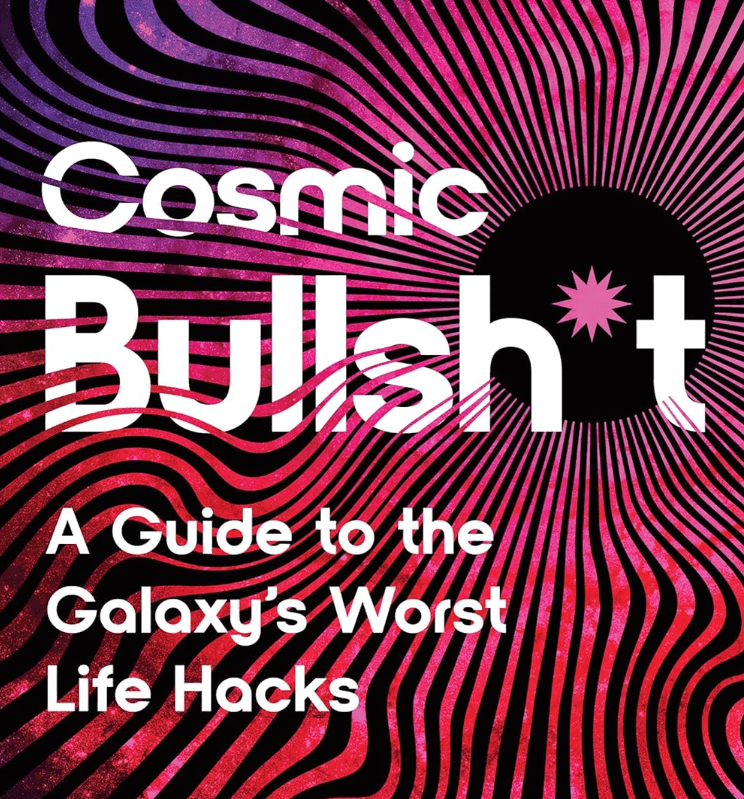

Sometimes, you just have to call a thing what it is. After writing several science books for kids, physicist and mathematician Chris Ferrie released Quantum Bullsh*t into the world in 2023, to help educate adults on the use and misuse of that word.
On March 18, Ferrie’s follow-up,
AIPT: How would you describe what your new book, Cosmic Bullsh*t: A Guide to the Galaxy’s Worst Life Hacks, will be about?
Chris Ferrie: Cosmic Bullsh*t is my attempt to dissect, lampoon, and ultimately understand the many myths, misconceptions, and pseudoscientific stories humanity has come to embrace — particularly around “cosmic,” big-picture ideas. If Quantum Bullsh*t was about the science-sounding nonsense people use to claim everything can be solved with “quantum” stuff, Cosmic Bullsh*t broadens that scope to the cosmos at large — creation myths, horoscopes, aliens, time travel, and more.
I go into the actual science behind the universe’s origins, the reality of stars, the plausibility of aliens and time travel, and what is likely to happen in the future, near and far. The aim is to show that reality is more interesting when we see it through a scientific lens, and also to have a bit of fun pointing out the absurdities along the way!
AIPT: In a previous interview you told me Quantum Bullsh*t was motivated by academic pseudoscience and a desire to teach quantum physics. More recently you wrote a book called What You Shouldn’t Know About Quantum Computers. Now with Cosmic Bullsh*t, I see a trend, like some kind of broadening of your original concept to things outside of academia. Do you see it that way?
CF: Initially, I was motivated by the desire to clarify what quantum physics actually is, because it’s so often misused in marketing hype, pop culture, and even by some academics who should know better. In general, I just love explaining complicated ideas in a way that’s hopefully both accessible and entertaining. There was no intentional plan to broaden the scope of my writing beyond quantum — other than the fact that I feel like I’ve said everything that can be said about quantum physics and computers at this point!

AIPT: The copy for your new book refers to creation myths as bullsh*t. How do you approach this topic, considering creation myths are important in some religions, which can make them touchy subjects?
CF: My approach was to acknowledge the cultural and historical value of these stories — how they shaped entire civilizations — and then contrast that with what we know from the best available scientific evidence about the universe’s origins. I’m not trying to ridicule people’s deeply held beliefs so much as I am poking fun at the idea that these myths should override or replace science in explaining natural phenomena.
In the text, I do use humor (yes, sometimes irreverent) to show how creation myths have real human worth — morally, artistically, culturally — while also pointing out the absurdity of taking them literally. If people read carefully, I’m not saying, “You’re a fool if you believe a myth.” I’m saying, “Look how these stories developed over thousands of years — and here’s the far more amazing story that modern astrophysics, cosmology, biology, and maybe even a bit of quantum (can’t escape it!) can tell us about how we got here.” It’s meant to be eye-opening rather than just confrontational.
AIPT: What would you say to someone, let’s say a true believer of a pseudoscience, if they said to you, “You’re not an expert in astrology (or pick whatever other pseudoscience). You should stick to quantum theory and quantum computers”?
CF: Saying “you’re not an expert in astrology, so you have no right to dismiss it” is akin to saying, “you’re not an expert in Tolkien lore, so you can’t claim Middle Earth is fictional.” Of course you can! You don’t need to memorize The Lord of the Rings to know that Gondor isn’t a real place, and a wizard isn’t going to show up asking you to destroy a ring.
In the same way, being an “expert” in astrology usually means you’re deeply versed in its internal logic — understanding houses, signs, planetary alignments, and so on. It’s like being intimately familiar with a complex fictional universe. Sure, you can be a consummate scholar of it, but that doesn’t make its claims any more factual in the real world.
So if someone says, “You can’t criticize astrology unless you’re an expert,” I’d just respond with, “I’m capable of evaluating any claim — fictional or otherwise — without having to master its entire fictional framework. I can identify why it’s fictional. And if the only retort is, “You haven’t read the sacred lore from cover to cover,” it doesn’t really prove anything other than you know your lore better than me — not that the lore is true.
AIPT: You had a Kickstarter campaign for a quantum computer simulation device called a Quokka. I believe the mission behind that was to democratize quantum computing. Is that still a mission you pursue? How do you see your approach to pseudoscience fitting in with that mission?
CF: The Quokka project is about making quantum computing concepts more tangible — in a sense, demystifying them. I still hold that same mission. I think the public deserves access to real science in forms that spark curiosity and understanding. When people don’t have that access, it’s easy for hype or pseudoscience to rush in to fill the knowledge gap.
My approach to pseudoscience is, in a sense, an extension of that mission. I want to lower barriers to understanding so that actual science becomes accessible to non-experts. Whether that’s quantum computing or cosmology, I try to provide enough background that you can spot hype for what it is and see the real, exciting science underneath. So yes, I still see myself as fighting for the democratization of knowledge, whatever it may be.
AIPT: NVIDIA’s CEO recently caused some quantum computing companies to lose value on the stock exchange over fears of hype and a speculative bubble. Ironically, not long after that, news of DeepSeek’s new AI models caused a similar reckoning for AI stocks like NVIDIA. Do you see your writing to be a corrective voice to help the general public, venture capitalists, or governments who might be supporting these ventures?
CF: No—at least, not in the sense that I’m going to personally debunk every new hype claim out there. I don’t have the bandwidth or the desire to be a one-person corrective for all the misinformation that surfaces, whether in quantum or AI or anything else. At some point, people have to take ownership of what they choose to believe and invest in. If my writing nudges them to pause and think, “Wait, is there real science here, or am I being sold a fantasy?” then I’ve done my job. But I’m not aiming to be the world’s misinformation cop — just someone who encourages a bit of skepticism and responsibility in how we consume and act on “breakthrough” claims.
AIPT: Scott Aaronson, a theoretical computer scientist, is also an outspoken critic of quantum computing pseudoscience. Do you get a chance to discuss these issues with others in your field, either academically or in business?
CF: Scott is a fantastic example of someone who can talk quantum complexity theory at the highest academic level and also do public outreach debunking myths. I’ve crossed paths with him and folks like him at conferences and on panels. There’s a pretty lively, informal network of scientists who enjoy calling out pseudoscience — especially in hot fields like quantum computing or AI.
Academically, you see these conversations happening on blogs, social media, and especially at the Q&A sessions after talks, where the more skeptical-minded folks raise pointed questions. In business circles, it’s less direct, because many people are worried about stepping on toes or deflating hype they might benefit from. But behind closed doors, there’s definitely a lot of, “Can you believe what that press release claimed?” going around. So yes, these discussions absolutely happen, both in the hallways and on Slack channels.
is available for pre-order now.
Every February, to help celebrate Darwin Day, the Science section of AIPT cranks up the critical thinking for SKEPTICISM MONTH! Skepticism is an approach to evaluating claims that emphasizes evidence and applies the tools of science. All month we’ll be highlighting skepticism in pop culture, and skepticism *OF* pop culture. AIPT Science is co-presented by AIPT and the New York City Skeptics.



You must be logged in to post a comment.