

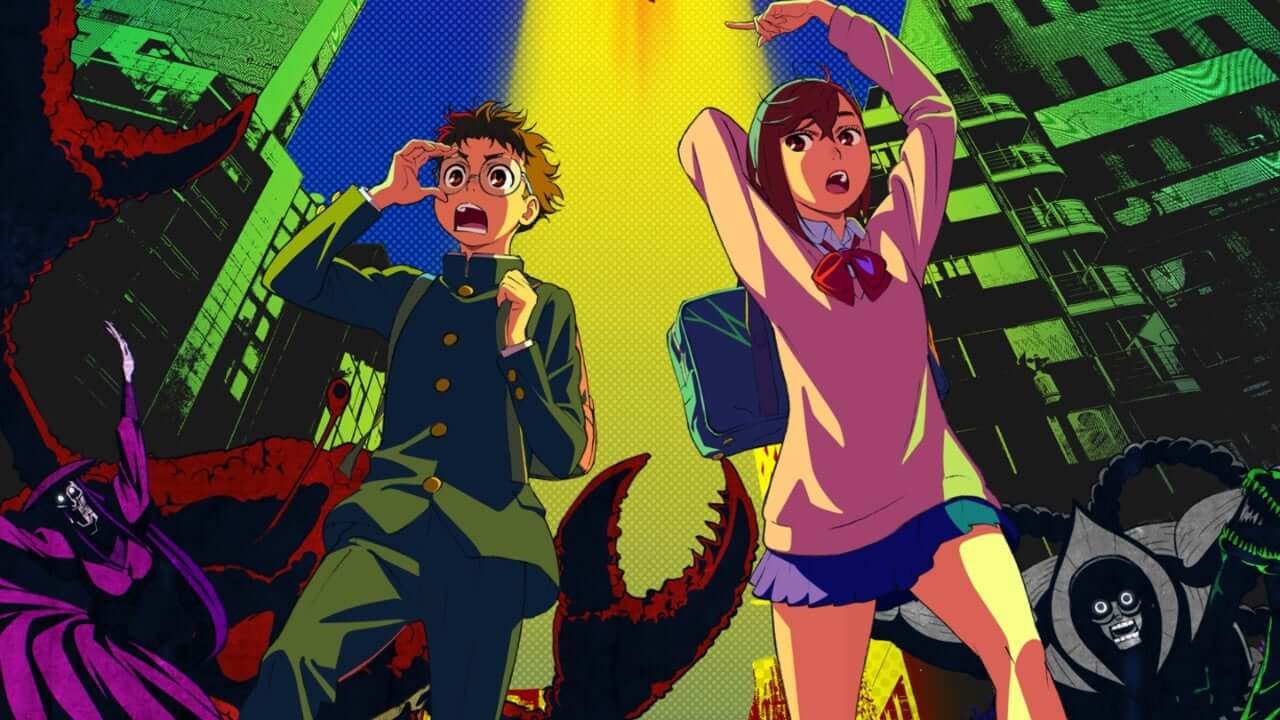

You know the story. Boy meets girl. Boy woos girl with his encyclopedic knowledge of the paranormal. Girl falls head over heels for boy but, just when things are getting serious, boy has his balls stolen by a witch, whose supernatural powers he subsequently steals from her. Then boy and girl go off to fight aliens together. Familiar, right?
If not, this is a good indication that you somehow managed to miss Dandadan (ダンダダン), the international hit anime from 2024, based on the manga of the same name by Yukinobu Tatsu. With over 3 million views, it was the most streamed anime and second-most popular “non-English language” program on Netflix, though the series can be watched dubbed or subtitled.
Why was Dandadan so popular? Partly due to its stellar animation and genre-defying storytelling (is romantic-comedy-horror a genre?), but also that Dandadan is a massive love letter to all things weird and spooky.
Dandadan revolves around high schoolers Momo Ayase and Ken Takakura, whom Momo nicknames “Okarun” (Occult + the Japanese prefix “kun,” a term of endearment), due to his obsession with the paranormal. The two bond over their mutual interest in the subject, as Momo’s grandmother is a famous spirit medium. Together they begin investigating paranormal occurrences around their hometown, and quickly discover that not only are aliens, ghosts, and cryptids all real, but also very dangerous and … surprisingly horny.

Okarun eventually becomes a victim of koro, a well-documented phenomenon among scholars of social panics in which a man claims to have his genitalia stolen, typically by a witch. In Okarun’s case, his junk is initially taken by Turbo Granny (ターボばあちゃん), a hag-like yokai from Mt. Roku in Hyogo prefecture with the ability to move at super-fast speeds.
Watching Dandadan, it’s clear that much of Tatsu’s knowledge of the paranormal is derived from one extremely influential Japanese publication in particular. When Momo first meets Okarun, he’s reading an article about “Project Pegasus” – a conspiracy theory that alleges that U.S. President Barack Obama was part of a secret CIA project to explore Mars in the early 1980s – in a magazine called “PO.”
However, anyone familiar with Japanese Forteana will instantly recognize that “PO” is an obvious stand-in for Japan’s premier paranormal periodical MU (ムー), founded in 1979 in response to the Japanese “Occult Boom” of the ’70s. In a 2021 interview with Japan Today, Takeharu Mikami, the current editor of MU, stated that the magazine’s goal is not to encourage belief in the supernatural and conspiracy theories, but rather to increase readers’ “conspiracy theory literacy.” In March 2023, MU did a special issue to promote the release of the ninth volume of the Dandadan manga.
MU shares several similarities with its UK counterpart Fortean Times (founded in 1973), including a monthly publication schedule, eye-catching presentation, sensational-sounding headlines and, despite all that, a surprisingly critical attitude towards its chosen subject matter. Currently MU boasts a monthly print circulation of around 57,033. In 2018, Fortean Times had a monthly print circulation of just over 14,800, while the American Skeptical Inquirer has a monthly circulation of more than 18,000.
But while MU was clearly a major influence on Dandadan, it’s not Tatsu’s only source of inspiration, the other major one being Japanese kaiju media. There’s an excellent example of the complex interplay of kaiju and the paranormal in episodes 8-10, in which our protagonists run up against two cryptids, or UMA (Unidentified Mystery Animals) as they’re known in Japan. One of these is a “Nessie,” whose physical appearance is clearly modeled after that most iconic of Japanese monsters, Godzilla — specifically, the version which appeared in the critically acclaimed 2017 film Shin Godzilla.

The Dover Demon of ‘Dandadan’
The other cryptid is the more obscure Dover Demon, a mysterious creature that was originally reported on April 21–22, 1977, in Dover, Massachusetts. The version in Dandadan looks nothing like the creature allegedly seen by eyewitnesses, though, but is based on the kaiju Kanegon, from episode 15 of Ultra Q (1966), a landmark series in the history of Japanese sci-fi television similar to The Twilight Zone in terms of overall cultural impact.
Moreover, Momo’s grandmother observes that the Dover Demon reminds her of a kappa from Japanese folklore, which leads Okarun to note there are theories that kappa are aliens. This was the subject of one of MU‘s most fondly remembered articles: “The true identity of the alien gray was a kappa!!” (異星人グレイの正体は河童だった!!) from April 1996, issue no. 185, co-authored by Asuka Akio and Mikami Takeru. Of course, the Dover Demon has also sometimes been identified as an alien, as well.
In my essay “From Cryptids to Kaiju,” I discuss how Japanese kaiju media has been influenced by cryptozoology and has, in turn, served as an influence on cryptozoology, creating a mutually reinforcing feedback loop. It remains to be seen if the success and popularity of Dandadan will increase the public’s awareness (be it skeptical or uncritical) of paranormal subjects like Project Pegasus, koro, and extraterrestrial kappa, but given the two genres’ history, it seems likely.
Season 2 of Dandadan is slated to premier in July 2025.
For more on the paranormal references in Dandadan check out Justin’s appearance on the MonsterTalk podcast!
Every February, to help celebrate Darwin Day, the Science section of AIPT cranks up the critical thinking for SKEPTICISM MONTH! Skepticism is an approach to evaluating claims that emphasizes evidence and applies the tools of science. All month we’ll be highlighting skepticism in pop culture, and skepticism *OF* pop culture.



You must be logged in to post a comment.