

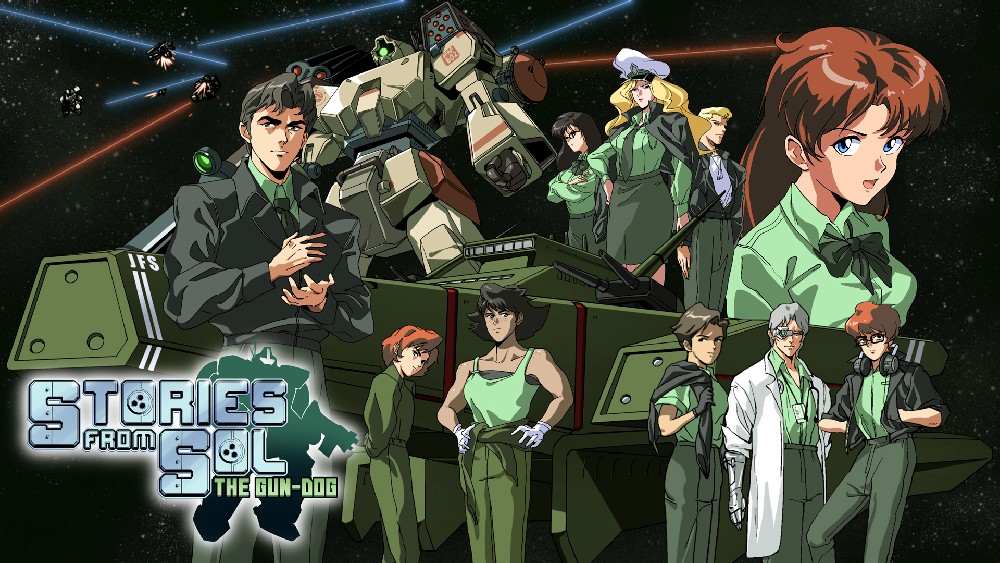

It’s been four years since the Solar War, four years since a mechanical failure in the launch system of your Armored Frame saved you from a battle that wiped out all but one other member of your squadron. You’re still in the Jovian Navy, and you’ve made lieutenant. Not as a pilot, but as a security officer, and you’re newly assigned to the patrol ship Gun-Dog. While one of your nine crewmates, Hansen Crwys, is the only other survivor of your squadron and still reviles you as a coward, another is the bright-hearted, bubbly Lieutenant Commander Cassandra “Cassie” Quinn — your girlfriend of two years. The Gun-Dog’s mission is to rendezvous with fellow patrol ship O’Brien and investigate a mysterious spatial anomaly. On paper, that’s simple. As you’ll repeatedly say in practice, “Nothing’s ever easy.”
Stories from Sol: The Gun-Dog is going to stick with me. We’re early into 2025, but if it doesn’t end up one of my favorite games of the year, then 2025 will be a hell of a year for video games. It’s a loving homage to classic adventure games and visual novels — particularly the kind that Japan’s PC-98 personal computer is famous for. It’s a first-person adventure where the player interacts with its setting and cast through dialogue choices, a selection of acquirable tools, and puzzle solving. Clearing a playthrough takes about six to ten hours, and there’s significant replay value. Player choice impacts how a run through The Gun-Dog will play out, sometimes dramatically. I completed it three times, and my choices led to each run being substantially different from the others.

For example, early in The Gun-Dog, Hansen — who blames you for destroying your Armored Frame wing — corners you and Cassie and tries to pick a fight. You can try to play strong and silent, give Hansen the brawl he wants, or be the bigger person. Each choice affects your relationship with Hansen and Cassie. Act like a trigger-happy knucklehead, and Cassie will pull rank on both of you and put you in your place, deeply disappointed. Stand up to Hansen without being a schmuck, and he’ll have to start thinking of you as a person rather than a cardboard cutout he can rage against. Throughout the game, your choices add up. They affect your relationships with your crewmates, affecting the options available to you as this story from Sol twists and turns.
An ensemble member who isn’t prominent in one run may become the MVP of the next. The protagonist’s choices shape how their crewmates see them, meaning they need dimensionality for those shifts to feel genuine. Lead writer Jonathan Durham gives each of the Gun-Dog’s crew space to be. Cassie, for instance, is a sweetheart who cherishes the protagonist both because they’re a good person and because she’s been lonely for a long time. If the protagonist makes an ass of themselves confronting Hansen, Cassie will be furious for their dereliction of duty and disappointed that they’d be so callow. Likewise, the protagonist, while their name and gender are player-determined, is a character rather than a simple avatar. They’re haunted by their time in the Solar War, learn to go with the flow of their eccentric crewmates, and move planets and stars for Cassie.

Mechanically, The Gun-Dog’s integration of player choice into gameplay is impressively thorough and thoughtful. While big dramatic moments like your encounter with Hansen have big dramatic consequences, the team at Space Colony Studios pays equal attention to smaller moments, which contributes to building player agency and the game’s compelling character work. Early on, players learn that Cassie has a massive sweet tooth. The Gun-Dog’s vending machine carries her favorite chocolate bar, and players can gift it to her throughout the story. This is entirely optional and easy to miss, and it makes Cassie and the protagonist’s relationship feel real. It’s the sort of sweet (sorry) little thing someone would do for their partner, and keeping up with it throughout the game leads to a lovely character moment later.
A simple chocolate bar is a great example of the care visible in every facet of The Gun-Dog’s production. Space Colony Studios aren’t paying shallow tribute to the PC-98’s library and ’80s and ’90s science fiction by going, “LOOK, IT’S THE THING YOU REMEMBER!” They’re paying homage by drilling into why those games, anime, TV series, and novels are beloved and executing their take on the form with precision and skill.
The Gun-Dog’s visuals are a prime example of this. The game offers three visual modes — full vivid color, a modern cousin to the PC-98’s impressive-to-this-day pixel art; greenscale, a la the original Game Boy; and what the team calls “Doujin” mode, greenscale with a distinct set of character sprites. While pixel artist and animator Kevin Butler’s character designs echo the work of 80s sci-fi anime artists Kenichi Sonoda and Haruhiko Mikimoto, their priority is being expressive and conveying character in expression, posture, and carefully deployed bursts of motion. When the Gun-Dog’s Captain Bartermews gets furious, her eyes widen, and her irises shrink to enraged points, as though the only thing she’s seeing is what’s made her angry. The Gun-Dog’s fully illustrated moments are similarly striking, capturing the game’s Big Deal moments with skill and style. Cassie tackle-hugging the protagonist when they reunite for the first time isn’t just a fun moment, it reveals a good deal about her and her partner.

I want to know more about Stories from Sol: The Gun-Dog’s cast. I want to see them grow and change, see them struggle. I want more gorgeous pixel art and consequences for my choices. This is a special game. I adore it, I am glad it exists, and I want folks to play it. This is and will be one of 2025’s best.



You must be logged in to post a comment.