

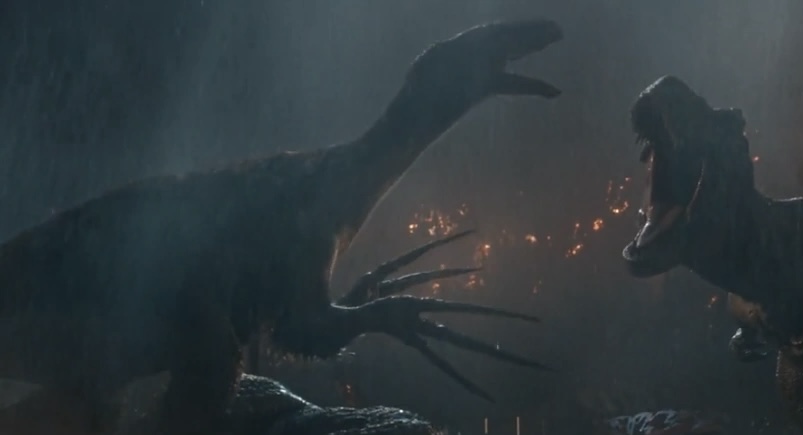

For many, 2022’s Jurassic World: Dominion was their first experience with the strange group of dinosaurs known as therizinosaurs. In the film, a partially blind Therizinosaurus gives a surprise assist, distracting the Giganotosaurus both from the human protagonists, and series dinosaur regular Rexy. Hailing from what’s now Asia and North America, and characterized by their unusual proportions (upright position, short yet thick legs, wide hips, and three giant claws), therizinosaurs have long been some of the more bizarre dinosaurs. And their family just got a bit weirder.
The most recently described member of the family, Duonychus tsogtbaatari, eschewed three fingers in favor of two.
Discovered in Mongolia, Duonychus is named for its two claws and after Khishigjav Tsogtbaatar, a Mongolian paleontologist. Duonychus‘ two-fingered hands call to mind the tyrannosaurs, which evolved from three-fingered forms like Guanlong into more massive, two-fingered animals like Tyrannosaurus rex. Within the clade Coelurosauria (the group that includes T. rex, Therizinosaurus, Velociraptor, and birds), this digit reduction has occurred multiple times. It’s been seen among oviraptorosaurs like Oksoko avarsan, and the alvarezsaurs, like one-fingered Mononykus, which appeared in the Apple TV+ series Prehistoric Planet.

Digit reduction isn’t entirely uncommon in the animal kingdom, and though you might not notice it at first glance, many hooved animals like cows and camels are also working with two digits (a condition called didactyly). A study into the molecular development of animals with reduced digits found the mechanisms for the digit reduction were different, suggesting that these instances may have evolved independently, even among closely related animals.
The reasons for digit reduction in different groups isn’t always clear. Tyrannosaurs appear to have lost digits as their arms became more vestigial, due to their feeding strategy shifting to their massive heads, but horses went through stages of reduction to their current one-toed form because of changes in locomotion. Exactly what led to Duonychus’ digit reduction is unclear; its arm size doesn’t appear to be reduced compared to its therizinosaur relatives, nor was it using them to walk.
While the specimen recovered was only a partial skeleton, the remains of Duonychus allowed authors Yoshitsugu Kobayashi, Darla Zelenitsky, et al to ascertain some important information about the creature. Based on the results of a different study into the family, and the preservation of the ulna and metacarpals, the authors were able to estimate the mass of Duonychus at ~260 kg. While no giant like its Hollywood cousin, this was still a hefty animal.

Additionally, the claws on its two-fingered hand were well-preserved, including preservation of the keratinous sheath of the claw. Keratin doesn’t normally fossilize, leaving scientists to usually estimate the in-life length of claws and horns on extinct animals based on fossilized bone cores.
Though its claws were sharp and curved, Duonychus was almost certainly an herbivore, like its close relatives. Indeed, the authors discuss in the paper that the curvature of the claws and the flexibility of the digits would have made it an effective grasper, allowing it to forage selectively for the plants of its choosing. The claws may have also served as a defense against predators and rivals, akin to today’s giant anteaters.
Whatever its hands were doing, Duonychus is yet another example of the wondrous creatures that make up Earth’s distant past. Future studies into the digit reduction in dinosaurs may lead to a better understanding of the animals we share the planet with today.
AIPT Science is co-presented by AIPT and the New York City Skeptics.



You must be logged in to post a comment.