

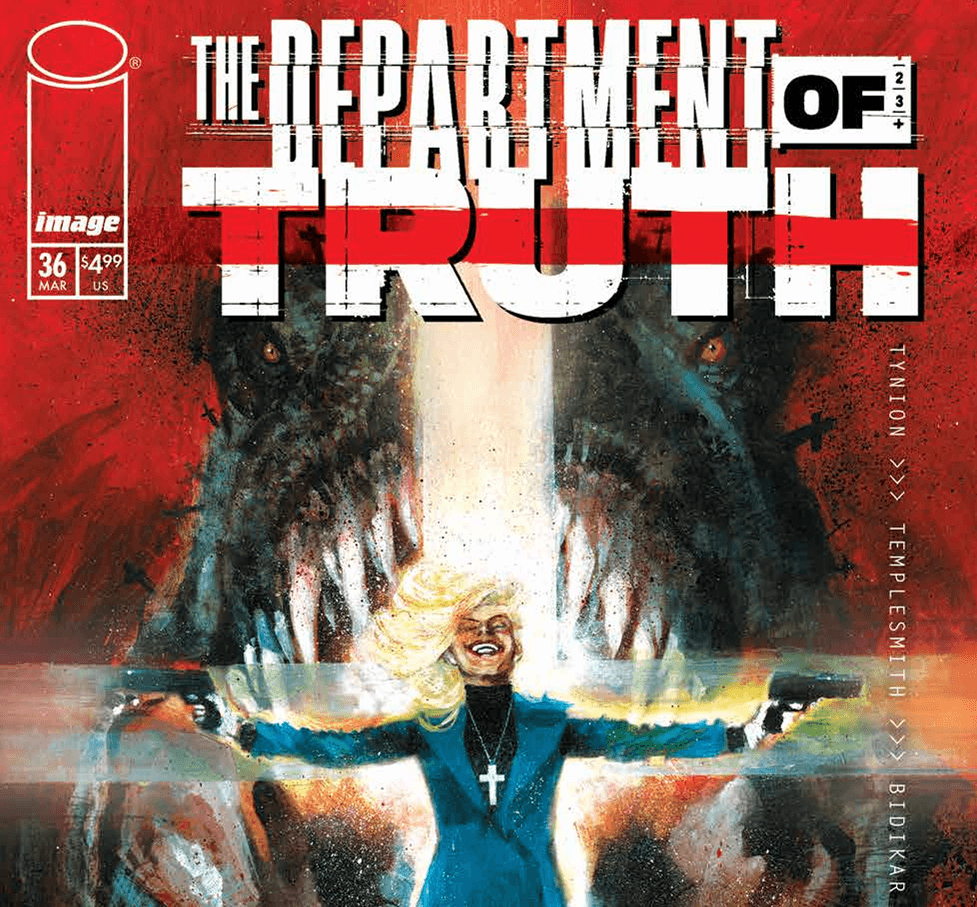

In James Tynion IV’s The Department of Truth, collective belief in conspiracy theories and the paranormal is portrayed as the most powerful force in the universe. Longtime readers have seen the collective power of belief create “Wild Fictions” like Bigfoot, Mothman, and even a still-living Elvis Presley. They’ve seen it manifest entire “phantom” epochs of recorded history. They’ve even seen it literally flatten our planet. So why couldn’t collective belief also resurrect the dinosaurs? This is the question at the heart of The Department of Truth’s current three-issue story arc, set in the 1990s, written by Tynion and drawn by special guest artist Ben Templesmith. In issue #36, Hunky, Huck’s son, is starting his new job of professional couch potato at the DoT, monitoring the country’s descent into conspiracy belief through the 24-hour news cycle.
That’s how he learns about The Birth of Jesus Holy Adventure Park, a young Earth creationist theme park being built in Florida by a popular televangelist, Pastor Jim James. Given the story’s setting and the pastor’s particular theology, it’s clear that he’s intended to be a caricature of both Walt Disney and Australian creationist Ken Ham, who built an actual young Earth creationism theme park in Williamstown, Kentucky, the highlight of which is a “life-sized” recreation of Noah’s Ark. Ham’s Ark is filled with plenty of model dinosaurs, but Holy Adventure Park also has live ones, conjured back from extinction by Pastor James’ follower’s fervent belief.

Department of Truth #36, Image Comics
To understand why young Earth creationists are so obsessed with dinosaurs, we have to look at the Bible, but maybe not the parts you’d think. Rather than looking in Genesis, it’s the more than 30 instances of the Hebrew word tannin (pronounced “tu-un-na-nu”), found mostly in Psalms and the prophetic books of Isaiah, Jeremiah, and Ezekiel which are key. In the ancient Israelite imagination, the tannin was a specific class of monsters, the most famous of which is the scaly, fire-breathing sea-beast Leviathan, described in exciting detail in the 41st chapter of the Book of Job. If that sounds like a dragon to you, you’re not wrong. When the Hebrew Bible was translated into Greek in the 2nd century BC, the Jewish scribes rendered the word tannin as drakon, the term from which the Latin draco is derived, and subsequently our modern word “dragon.”
The importance of dragons being in the Bible can’t be overstated, because it’s with the context of the newly emerging Christian religion that dragon legends flourished, as demonstrated by historian Daniel Ogden in his book The Dragon in the West (2021). Early Christian texts composed between the 3rd and 6th centuries AD are absolutely stuffed with stories of saints confronting and overcoming dragons. Early natural historians, like physician Conrad Gessner accepted dragons’ existence on faith, which isn’t so shocking when you remember Gessner was also taking on faith the existence of animals like Asian tigers and African elephants, which he’d also never seen, and only read about. But the scientific revolution of the 17th century would soon challenge this mindset, calling for empirical confirmation of the existence of such beasts, and as a result, by the 18th century, the naturalist Carl Linnaeus had declared the dragon mythical.
The discovery of the first dinosaur fossils, and those of other related Mesozoic reptiles in the early 19th century, actually caused a reversal of this opinion. The conflating of dinosaurs and relate taxa with dragons happened quickly. In 1821, occultist Collin de Plancy, reflecting on the discovery of the pterosaur, wrote that “ancient writers spoke of dragons as winged serpents, truly existent. But our moderns, who think themselves far more educated, had accustomed us to regard the dragon as a fake animal.” In 1835, William Kirby, English rector of Barnham in Suffolk and a renowned entomologist, posited that the prehistoric saurians could be the dragons mentioned in scriptures, and suggested that some might still survive in the deep seas and in remote, unexplored regions of the globe.

Department of Truth #37, Image Comics
Concurrent with Kirby’s speculations were those of Thomas Thompson, an English lawyer and vice-president of the Hull Literary and Philosophical Society, who put forth an even bolder hypothesis in The Magazine of Natural History (January 1835), in which he argued that the biblical leviathan should be identified as the recently unearthed predatory dinosaur Megalosaurus. But it was the notably eccentric English fossil-collector Thomas Hawkins’ book The Book of the Great Sea-Dragons (1840) in which the explicit linking of Mesozoic reptiles with the biblical tannin found its fullest early manifestation.
Other later examples of this kind of thinking abound throughout the 19th century, but the end result was that by 1896, this notion was so widely accepted that mythographer Edwin Sidney Hartland felt it necessary to include a disclaimer in his dissertation on The Legend of Perseus stating that “the suggestion” that stories of dragons represent mankind’s encounters with “the saurian which abounded in geological times” is one for which “not a particle of evidence has been adduced,” making it so “wildly improbable as barely to deserve notice.” Hartland’s dissenting opinion notwithstanding, the idea that dinosaurs were the dragons of the Bible wouldn’t disappear, and Biblical fundamentalists carried it into the 20th century.
AIPT Science is co-presented by AIPT and the New York City Skeptics.



You must be logged in to post a comment.