

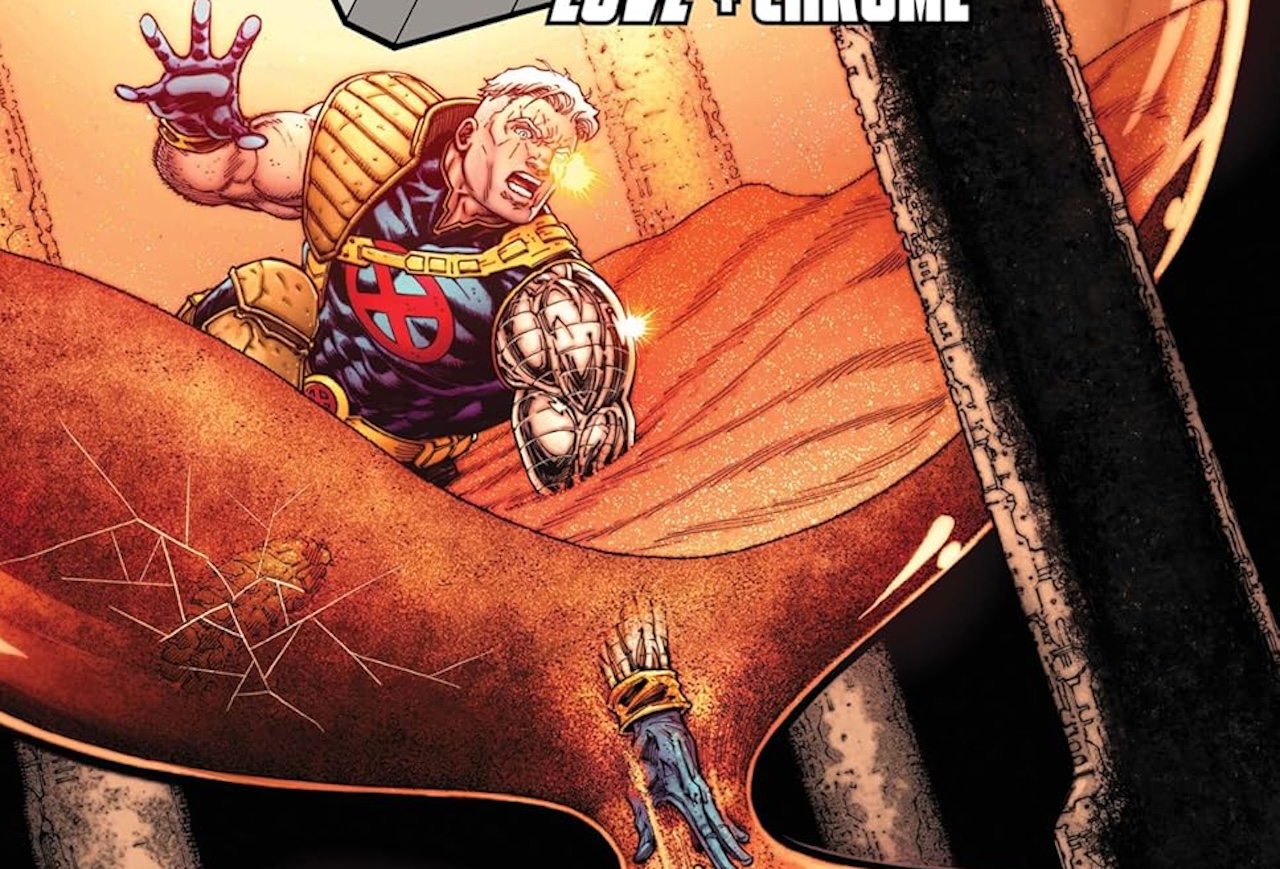

When Cable: Love and Chrome #4 begins, Nathan Summers is in a bind. He’s managed to liberate Salvation Bay from the Prime Conclave, but in the process lost Avery Ryder, the woman he fell in love with. Cable is determined to utilize time travel to try and save her…even if he has to fight against time itself to save Avery’s life. Needless to say, it’s a task that’s easier in theory than execution…namely because some things are meant to happen.
The idea of “fixed points in time” is an old time travel rhetoric, often used to explain why you couldn’t go back in time and kill certain people or stop certain events from happening. Here, David Pepose and Mike Henderson utilize it to tragic effect: every time Cable manages to save Avery, a different fate befalls her or her family, including her sister Lucy. It’s jarring to watch every time, and it will rend even the most hardened heart in two as Cable makes attempt after attempt.
Pepose also returns to another mystery: the warrior known as Cicada, who has been hunting Cable through time. Without spoilers, I can safely say that he pulls off a reveal that no one will see coming – but it makes perfect sense and adds to the tragedy of the overall issue. Pepose has a knack for this; his previous Marvel series, Savage Avengers, and an issue of his Space Ghost series both utilized a similar story for devastating effect. Basically, I’m saying that David Pepose may be one of the few writers who can turn out a time travel story that feels fresh.

Marvel
Henderson also leans into the tragic edge of Cable: Love and Chrome #4. His very first page of art is a nine panel grid intercutting between Cable preparing to make his time jump, and Avery slowly fading away from the world of the living. Nine panel grids have more or less been the gold standard for comic art since Watchmen, but Henderson actually manages to bring a fresh edge to it by displaying just how intertwined Cable and Avery’s lives have become. Another grid highlights the increasing tragedy of Cable’s repeated trips through time, until the reader will probably feel as beat down as he is.
Emotion gives way to action, as the next few pages feature Cable tumbling through time. Henderson draws a series of images that will burn themselves in the reader’s brain: a tumble through the timestream that recalls the events of Love and Chrome up to this point; Cable unleashing a volley of bright blue laser fire; or his telekinetic abilities slamming someone through a wall with the force of an 18-wheeler.
All of it is rendered in hues of muted blue, green, and black by Arif Prianto, which only underlines the bleakness of the future that awaits Cable. The one exception is his Timeslide, and even that’s pretty dour; a violent pink background lanced with bolts of lightning. Prianto lives up to the “Chrome” part of the title too, displaying Joe Sabino’s captions in a steely gray font.
Cable: Love and Chrome #4 takes a turn for the tragic, as the series delivers earth-shaking revelations while hurtling toward its end. Nathan Summers may have fought against the future all his life, but it looks like that fight is coming to an end.




You must be logged in to post a comment.