


At the start of Warfare, we are introduced to the ensemble cast of soldiers who are watching the music video for the Eric Prydz song “Call on Me”, which features an aerobics class of women wearing 1980s styled aerobics outfits performing sexually suggestive gym routines. What may seem like a jarring opening for a film that is set during the Iraq War, this is the only moment of levity we get with these characters before we hard cut to their mission that covers throughout the whole film.
Following last year’s Civil War, in which was Alex Garland was the writer-director and Ray Mendoza was the military supervisor, their next collaboration would be a re-enactment of an encounter Mendoza and his platoon experienced on November 19, 2006, in the wake of the Battle of Ramadi. With Garland and Mendoza both in the position of writer and director, the film’s material is exclusively taken from the testimonies of the platoon members to maintain historical accuracy.
Considering that Civil War was a sprawling action thriller that leaned toward speculative fiction, Warfare is a bare-bone narrative set in one location that is built upon real-life soldiers’ own accounts of the incident. Audiences may differ over the lack of politics as the film is closer to Ridley Scott’s Black Hawk Down in how both are about the horrors of modern warfare, even if there isn’t a great deal of substance.
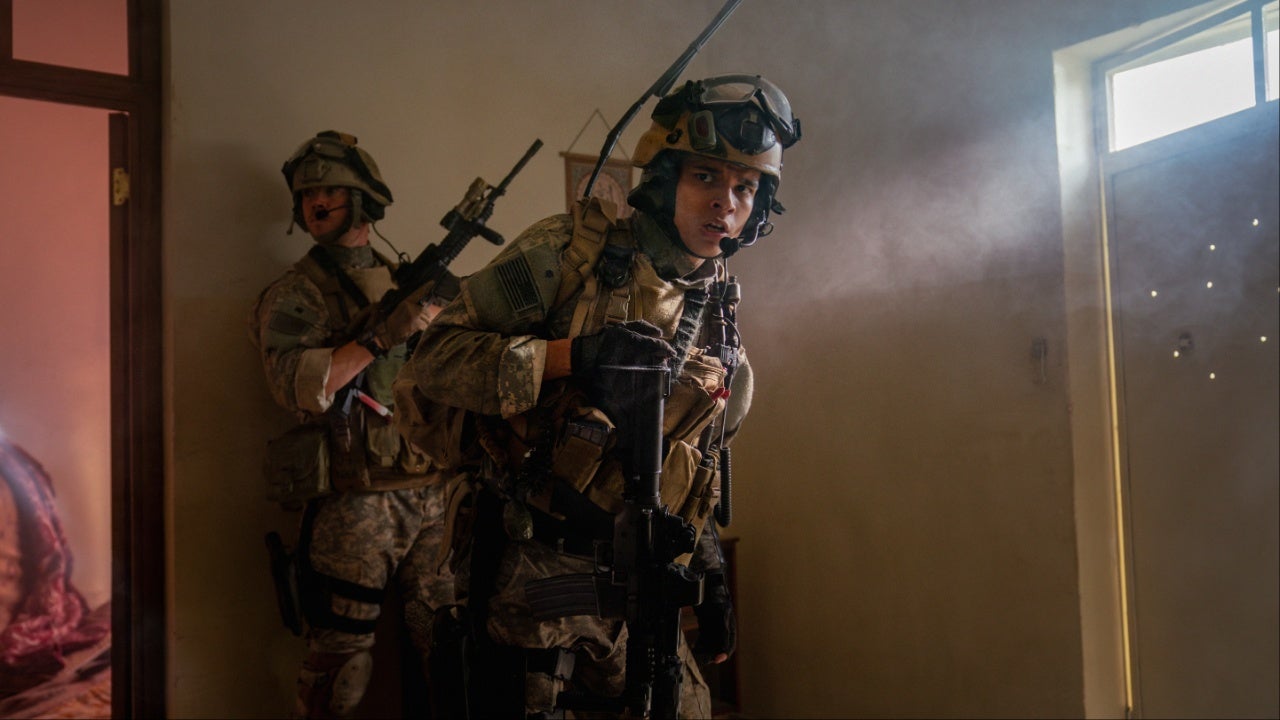
As Navy SEAL platoon Alpha One takes control of a multi-story house, where the different families who live there are told to remain silent and in place. We see the soldiers hanging out with communications officer Ray Mendoza (D’Pharaoh Woon-A-Tai), who uses air support to monitor their positions while sniper Elliott Miller (Cosmo Jarvis) monitors a neighborhood market across the street. Even during that initial half-hour where the soldiers are quietly bantering, there are no scenes of deep conversations where a character’s backstory is explored or their thoughts on the war they are currently going through. The closest to dramatic tension outside of the bullets blazing and explosions, is the families who feel trapped and question the presence of these soldiers.
When a grenade is thrown into one of the rooms, that’s when the chaos ensues as the platoon’s position has been compromised and need to evacuate, only for the incident to escalate to an even horrific degree. There is nothing flashy about the action, which is both immersive and terrifying with the soldiers improvising with their tactical skills and knowledge to get out a situation where they are on the edge of death. While there isn’t a film that is built on dramatic performances, seeing actors like Joseph Quinn and Will Poulter being put through the ringer is truly engaging.
No matter how authentic films like Saving Private Ryan are when it comes to presenting visceral battle sequences, no dramatization can entirely recreate that feel of war. What could have easily been a technical exercise that uses a lot of documentary techniques, Warfare uses somewhat subjective techniques, particularly Glenn Freemantle’s sound design that really adds to the immersion of the situation, ranging from heart-pounding gunshots to deafening static sounds from the communication equipment. Another horrific piece in the sound design is the screams coming out of some of the soldiers who are going through horrific pain.




