

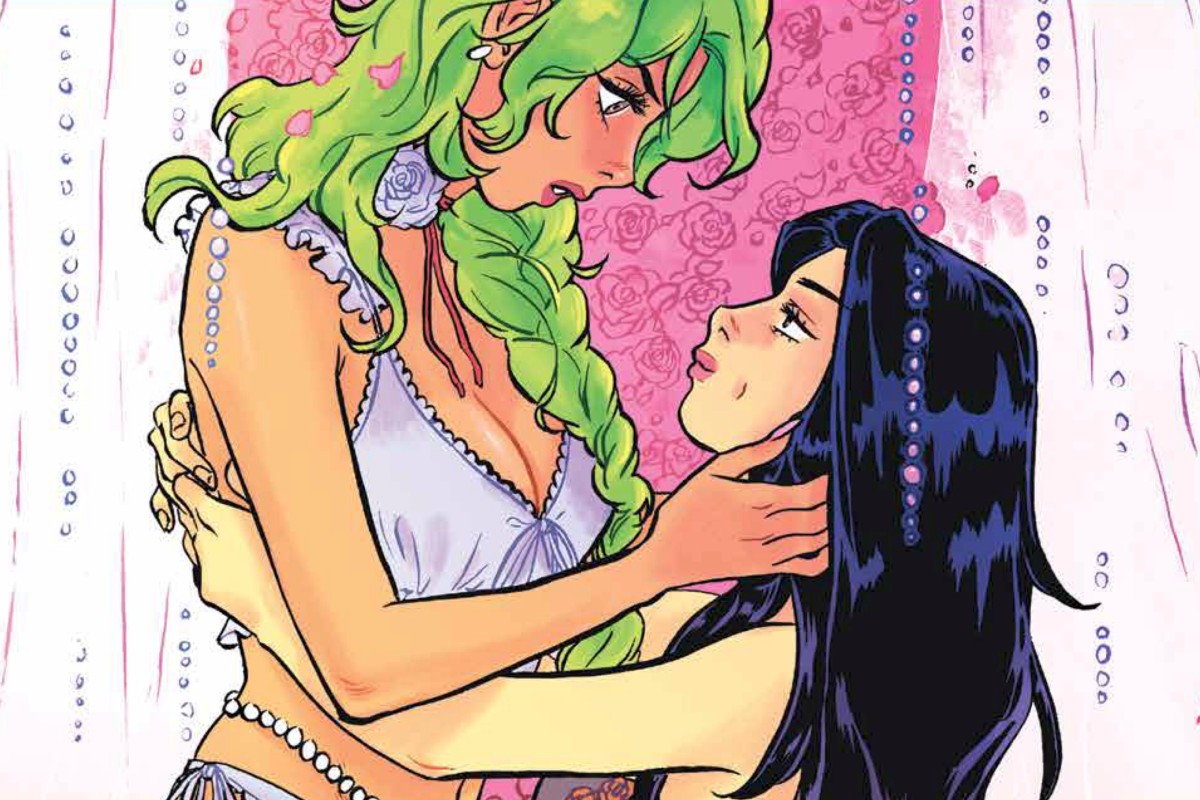

Since Leslie Hung and Bryan Lee O’Malley’s Snotgirl returned late last year, the surreal sunshine comic noir has paired every answer to one of its mysteries with a new question. Readers know, for instance, that Charlotte “Lottie” Person, allergy-prone fashion influencer sometimes-extraordinaire, really does seem to have befriended a ghost. Her name is Yolanda, and she’s probably not a dodgy-allergy-meds-induced hallucination. Conversely, while the audience has a fix on how Lottie’s mercurial beloved, her fellow fashionista Caroline, behaves, her history remains a black box. Hung and O’Malley have revealed enough to shift the question from “who is she?” into “what is she?” She—or someone who looks exactly like her—was somehow active in the modeling scene at the end of the 20th century. Her younger brother, Virgil, might have been working as her fixer, but he has no direct memories of having done so. There’s a cult (they say they aren’t a cult, but they wear robes. They’re probably a cult). Given the way Snotgirl #20, “Kiss and Make Up”—and by extension, this story arc “Weekend II”– ends, the answers are coming, and with them a hell of a crash.
But first, the deep breath before the sneeze.

Image Comics
Prior to the big, paradigm-shifting drop that closes “Kiss and Make Up”‘s denouement, Hung and O’Malley build to two climaxes—one action-based, the other emotion-based. On the action side, Virgil, Lottie’s ex Sunny, and their frenemy Misty get a look at the probably-a-cult Sisterhood’s inner workings. On the emotional side, Lottie learns truths about her mother Kimiko and her Aunt Aya’s past as idol singers—truths that reshape her relationship with her aunt and push her to figure out how to break through to Caroline.
While Lottie’s side of the issue is lower-key than Virgil’s, they feed into each other. Virgil and company are dealing with what Lottie and company will soon have to deal with, which means they’ll need to find a moment to catch their breath and process. Lottie is gaining a perspective that Virgil hasn’t had a chance to—she’s still got a lot of growing up to do, but she won’t be facing what comes next as the bumbling wreck she was earlier in Snotgirl. Simultaneously, the tonal dissonance between the Sisterhood’s out-there conference and the isolation and comparative stillness of Auntie Aya’s inn highlights each side of the comic’s strengths—larger-than-life, absurdist comedy and insightful character study.

Image
Hung and colorist Rachael Cohen do marvelous work throughout “Kiss and Make Up,” particularly during Kimiko and Aya’s flashbacks to their past. Cohen fades her colors, separating the past from the present and simultaneously lending a dreamy quality to the past. For Kimiko, the past was what might have been. For Aya, the past is what never could have lasted, thanks to the social mores and notions of propriety that shaped Japan in the 1980s.
Cohen’s color unites the two in memory, while Hung’s illustrations emphasize their vast difference in perspective. For Kimiko, Haruna, the third member of their idol group, was there, and that’s about it. Aya, meanwhile, was deeply in love with Haruna, and she reciprocated. In Kimiko’s memories, Hung draws Haruna in group shots—and even has her pointing to Kimiko, who’s the central character of her memories. In Aya’s memories, Haruna is a constant, even overwhelming presence. She’s a collage of photos that bleed into memories that she dominates, to the point that Aya has a clearer memory of her beloved than she does of herself.

O’Malley’s good at writing swoon-worthy, feelings-forward romance.
Image
Hung’s impeccable art is backed by O’Malley’s ability to capture the intensity of love. No one’s had to fight a league of evil exes yet, but it’s not out of the question, as Snotgirl‘s very much a continuation of O’Malley’s work in Scott Pilgrim and Seconds. Romances can be as thorny as they can be transcendent, and they take work and honesty from everyone involved. Caroline’s a riddle wrapped in an enigma clad in spectacular fits. Lottie loves her, but it’s an open, compelling question whether Caroline is willing or able to match that love, especially with the issue’s last pages upending what has been a comfortable status quo for her throughout “Weekend II.”
It’s also a question that will take a minute to answer, since “Kiss and Make Up” will be Snotgirl’s last issue as a monthly comic. Once the trade for “Weekend II” drops later this year, the series will shift to a trade-based publishing model, similar to Sean Phillips and Ed Brubaker’s Reckless series. O’Malley’s most famous work, Scott Pilgrim, was written in long-form installments, but it will be interesting to see how the next story adapts to the new mode. Part of what’s made “Weekend II” so much fun to read is its cliffhangers and abrupt tonal changes, both of which use the monthly publishing format to their advantage. For now, though, this is a strong conclusion to a strong story in a strong comic. It’s well worth a read for mystery lovers, romantics, people who dig the strange, and anyone who’s ever had their world rocked by allergies.




You must be logged in to post a comment.