


Few creators ever get to see their most personal work re-imagined in a blockbuster film. For Paul Jenkins (co-creator of the Sentry with artist Jae Lee), the release of Thunderbolts was more than just a career milestone. It was a moment of affirmation.
“I suspected the film would be pretty special,” Jenkins told me recently over Zoom. “I was able to work on it as a consultant, and I met Jake Schreier [the director] early on to talk about what the Sentry really meant.”
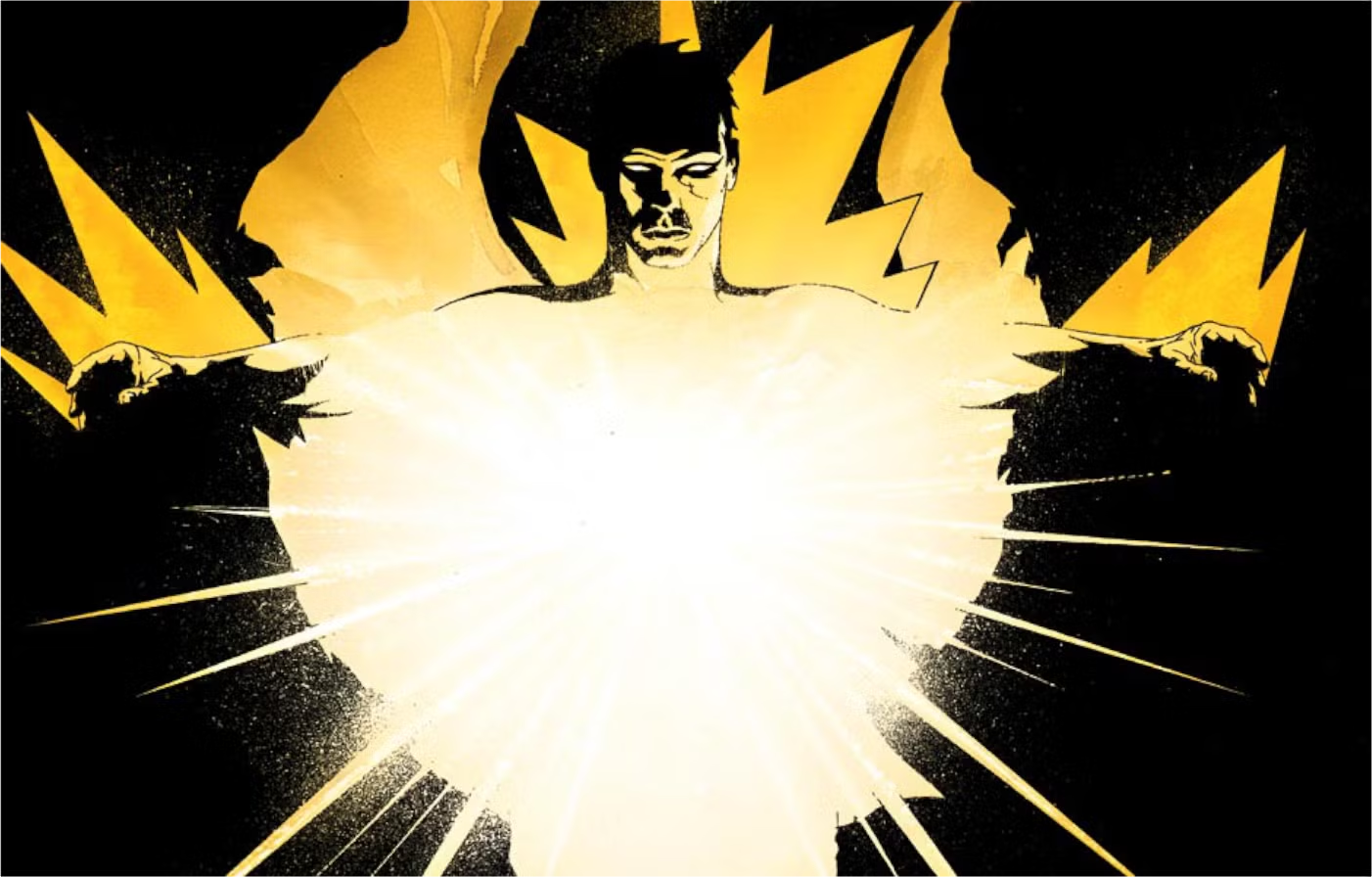
That meaning runs deep. Since the character’s debut in 2000, fans have resonated with the Sentry’s inner turmoil — a superhero whose immense power is rivaled only by his psychological fragility. Jenkins said the emotional weight of the character struck a chord with readers struggling with mental illness.
“I get contacted all the time by people who thank me for creating the Sentry because they’re dealing with mental health issues,” Jenkins said. “And I told Jake, maybe Sentry could be for people struggling with mental health what Black Panther was for people of color — they’ll see themselves. They’ll know it.”
Sentry and the Power of Vulnerability
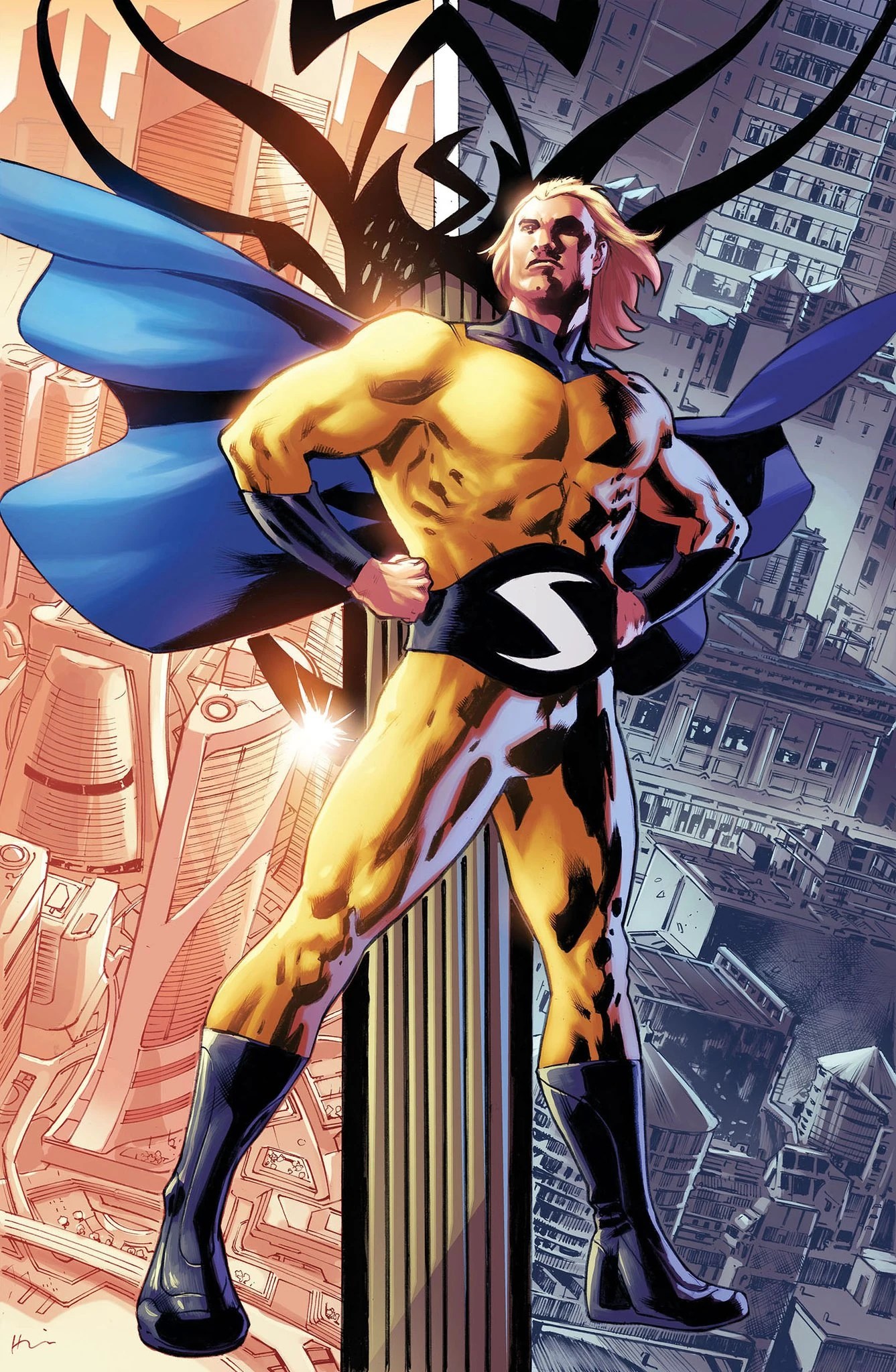
In Thunderbolts, Lewis Pullman portrays the Sentry with the raw intensity that Jenkins hoped for.
“Lewis’ performance is something people are really going to dig,” Jenkins said. “He captures the pain, the light and dark, the full duality of the Sentry.”
Jenkins noted that while the film remains a Marvel product, it isn’t typical Marvel.
“It’s not about who punches who or who the villain is,” Jenkins said. “It’s about how we deal with our own struggles and how we find each other.”
That emotional focus was always at the heart of the character.
“The Sentry is about the two sides of ourselves,” Jenkins said. “The bit that’s easy, the bit that’s hard, the bit that’s light, the bit that’s dark.”

Courtesy of Marvel Comics.
Metafiction and Mental Health
One of the most memorable aspects of Jenkins and Lee’s original Sentry comic was its audacious premise: that the Sentry had always existed in the Marvel Universe but was somehow forgotten. And that wasn’t just a narrative trick.
“It’s even more meta than that,” Jenkins said. “I mirrored the evolution of the comics industry itself. In the ’30s and ’40s, it was like taking a drug for the first time. Anything goes. Then in the ’90s, it got nasty, cynical, gratuitous. By the 2000s, it was about recovery.”
That metaphor extended to the Sentry’s serum, a source of addiction and agony.
“The evolution of comics became the evolution of a drug experience,” Jenkins said. “And so the Sentry, with his struggle, mirrored that perfectly.”
A Marvel Hero, Not a DC God
Though the Sentry could’ve ended up elsewhere — Jenkins originally pitched the idea to DC — he now sees it as a fundamentally Marvel story.
“Marvel characters are grounded. Their power is their problem,” Jenkins said. “Spider-Man has to keep a secret identity. Daredevil can’t see. Professor X can’t walk. And the Sentry is dealing with schizophrenia and agoraphobia.”
While DC might have been able to publish the story through its DC Black Label line today, Jenkins feels the character found his natural home.
“In hindsight, I think it probably is better to have been a Marvel character than a DC character,” Jenkins said.
The Third Chapter: Godhood
As the character is introduced to new audiences via the big screen, Jenkins said that he still has more Sentry stories in him. He had originally envisioned the saga as an entire trilogy.
“The first was coming to terms with his struggle,” Jenkins said. “The second was about identity: who am I as a human being? The third would be: If I transcend humanity, what does that mean? If I become a god, why me? Why not someone else?”
Though he couldn’t reveal specifics, Jenkins hinted at ideas for a solo film that would reflect those themes.
“If you highlight what his powers mean—how destructive and self-destructive we can be—that’s a film everyone can relate to,” Jenkins said.
Jae Lee, the Co-Creator Who Said Yes
While Jenkins faced multiple rejections when pitching the Sentry, his partnership with Jae Lee ultimately brought the idea to life.
“I’d pitched the Sentry and been rejected a few times,” Jenkins said. “But Jae said, ‘I like this. I want this to be our next story.’ And that made all the difference.”
Jenkins credits Lee’s moody, evocative art as essential to the Sentry’s tone.
“It’s light and shadow, reflection and pain,” Jenkins said. “The pensive Sentry — all of it plays out without loads of punching and kicking. It’s a real drama.”
Letting Go of the Baby
When asked how it felt to see others interpret his creation over the years, Jenkins was philosophical.
“I’m not precious about anything I create,” Jenkins said. “I did a run on The Hulk that people liked, and the next writer did something else. That’s how it should be.”
He compared it to a generational baton pass.
“People asked Jamie Delano what he thought of Garth Ennis on Hellblazer,” Jenkins said. “Then they asked Garth what he thought of me. That’s how it goes. You don’t control it. You just hope they stay true to the character.”
Courtesy of Marvel Comics.
If the Sentry Had a Support Animal…
Jenkins is quick to add levity to even the heaviest subjects. When asked what kind of support animal the Sentry might have, his answer was rather unexpected:
“It’d be the Hulk.”
Thankfully, he quickly elaborated.
“People never asked the Hulk what was wrong,” Jenkins said. “His skin hurt, and he couldn’t articulate the pain. But when he was around the Sentry, the pain eased. He’d be like a little sidekick: ‘Did I do good? Hulk is bravest there is.’ It would break your heart.”
The Void, naturally, would have… “a piece of lava,” Jenkins laughed. “He’d think that was his pet.”
Beyond Comics: Gaming, Tech, and NFTs (But Not the Bad Kind)
Jenkins’ ongoing work sees him pushing the same kind of boundaries he did with Sentry. These days, he works in game design and emerging technology through his company Meta Studios (short for Media, Education, Technology, and Advancement).
“We’re building games that embed new technologies to prove them out creatively,” Jenkins said. That includes blockchain storytelling experiments like Bitcoin Origins, a treasure hunt that made use of NFTs not as collectible gimmicks, but as functional narrative keys. Jenkins is clear-eyed about the controversy surrounding NFTs, but he’s quick to draw a distinction.
“You shouldn’t be upset at NFTs,” Jenkins saud. “You should be upset at crypto bros,” he said. “NFTs aren’t the problem — it’s the misuse that was.”
To address environmental concerns, Jenkins and his team deliberately chose the WAX blockchain for their work, an energy-efficient network with a much smaller carbon footprint than Ethereum-based platforms.
“Our NFTs had a positive footprint. That’s why we used WAX,” Jenkins said. “And one of the technologies we’re developing right now could have a significant impact on the world’s carbon footprint.”
For Jenkins, the goal isn’t hype — it’s storytelling.
“Think of an NFT as a key that opens a door,” Jenkins said.” We’re building experiences where story and technology work hand in hand.”
The More I Practice, The Luckier I Get
For Jenkins, his wide-ranging career— from Hellblazer and Inhumans to game development and cinematic consulting — comes down to one thing: effort.
“When people ask, ‘Why you?’ I always quote golfer Gary Player: ‘The more I practice, the luckier I get.’”



You must be logged in to post a comment.