

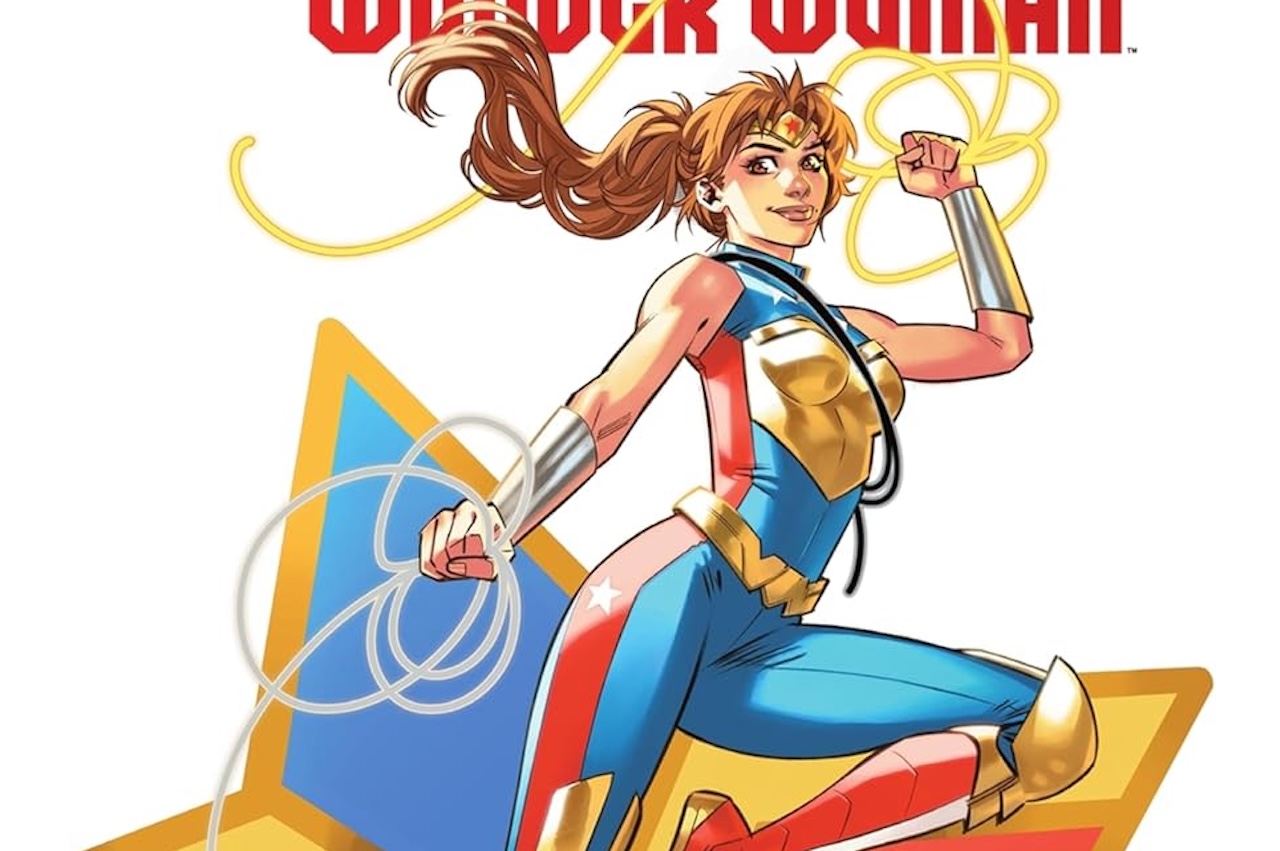

I’m not trying to be hyperbolic when I say that I find Trinity: Daughter of Wonder Woman #1 to be borderline offensive as a Wonder Woman fan. The central conceit of the series is that Trinity is trying to find her father, Steve Trevor, who died in last year’s Wonder Woman #14. Without even getting into the underlying politics of Wonder Woman’s made-from-clay origin, the focus of Diana’s daughter’s first solo series being finding her father is regressive.
Further, this series can’t be considered in its context without discussing the creation of the Trinity character herself. Plenty of think pieces have already been put to print to say things more in depth and more eloquently than we have time for here, however, it must be noted that Trinity’s existence has been characterized by a distinct disconnection from the Wonder Woman mythos and the feminist politics which inform the Wonder Woman character.
I’m not even sure if this issue passes the Bechdel test, depending on how you consider the three Trinitys who serve as the book’s protagonist.

DC
Writer Tom King really struggles throughout the issue to characterize the three versions of Trinity in ways that don’t simply feel generic. Some of this may be a product of the specific brand of humor he employs here, which does at times earn a smile or chuckle. Lines like, “I don’t think you’re listening to me, which is a bit of a shock, as I am known to be a great listener.” could be attributed to dozens or more teenager or young adult characters.
This is extra noticeable because it’s not incredibly different from the characterization of Yara Flor in King’s Wonder Woman run. Both characters are arrogant, aggressive and lean heavily on youthful humor.
What does work about this book is the structure of it. King is clearly writing this as an homage to the Golden and Silver Ages when Wonder Woman, Wonder Girl and Wonder Tot were all Diana of Themyscira somehow. That’s a silly corner of Wonder Woman’s history and it’s for this very reason that King is pulling on it. It informs the fun, kid-friendly tone of this story and allows him room to build as zany of a plot as his heart desires.
The A-plot of Trinity’s time-travel shenanigans turning the other heroes into super corgis that get lost in time is fun. The visuals are fun. Li’l Lizzie chasing them is fun. It has all of the charm of a zany Golden Age story at times, but then it also chooses to time travel to the death of the universe.
What likely would’ve seen Trinity chasing corgis around King Arthur’s court, or something similar, in that other Age, is instead invested with a decidedly modern spin. Instead of a conversation with Sir Gawain, Li’l Lizzie is having a conversation with Pariah. This is clearly because King desires to use the situation of Pariah to discuss depression, but on the page itself it doesn’t necessarily feel as if King is giving the issue the reverence that one might give that conversation.
To be fair, this is a first issue and he may be building up to a heavier conversation. It’s simply that some of the humor feels misplaced.
What absolutely is worth everyone’s time is Belen Ortega’s art. Their style is perfectly matched to the style and tone of this story, which needs to be cute and silly and exciting constantly. On top of that, there’s a crazy level of expressiveness present on almost every page of the book. It definitely works for the humor, but it might make readers wish Ortega could’ve gone full-send on some more serious moments.
Each Trinity feels distinct throughout the issue, which feels as if it will be essential to this narrative working. It isn’t just the designs which are successfully different, but it’s the sizes and movements of each Trinity which is wholly her own. As the series goes on, the work to develop this visual language will surely pay off over and over again.
There are parts of this issue which could be told almost entirely without words. The pacing and the panel design lead the reader so intuitively through the story that virtually anyone could pick this up as potentially their first comic.
It’s really a shame that such a fun plot and such fun art feel somewhat wasted on a story which doesn’t feel appropriate for the character and her world. After having read the issue I’m simply left wondering why this is what King chose to do with this series. In a mythos which is all about mothers and their relationships with their daughters and having not previously explored Diana & Trinity’s relationship extensively, this feels like a really avoidable misfire.




You must be logged in to post a comment.