

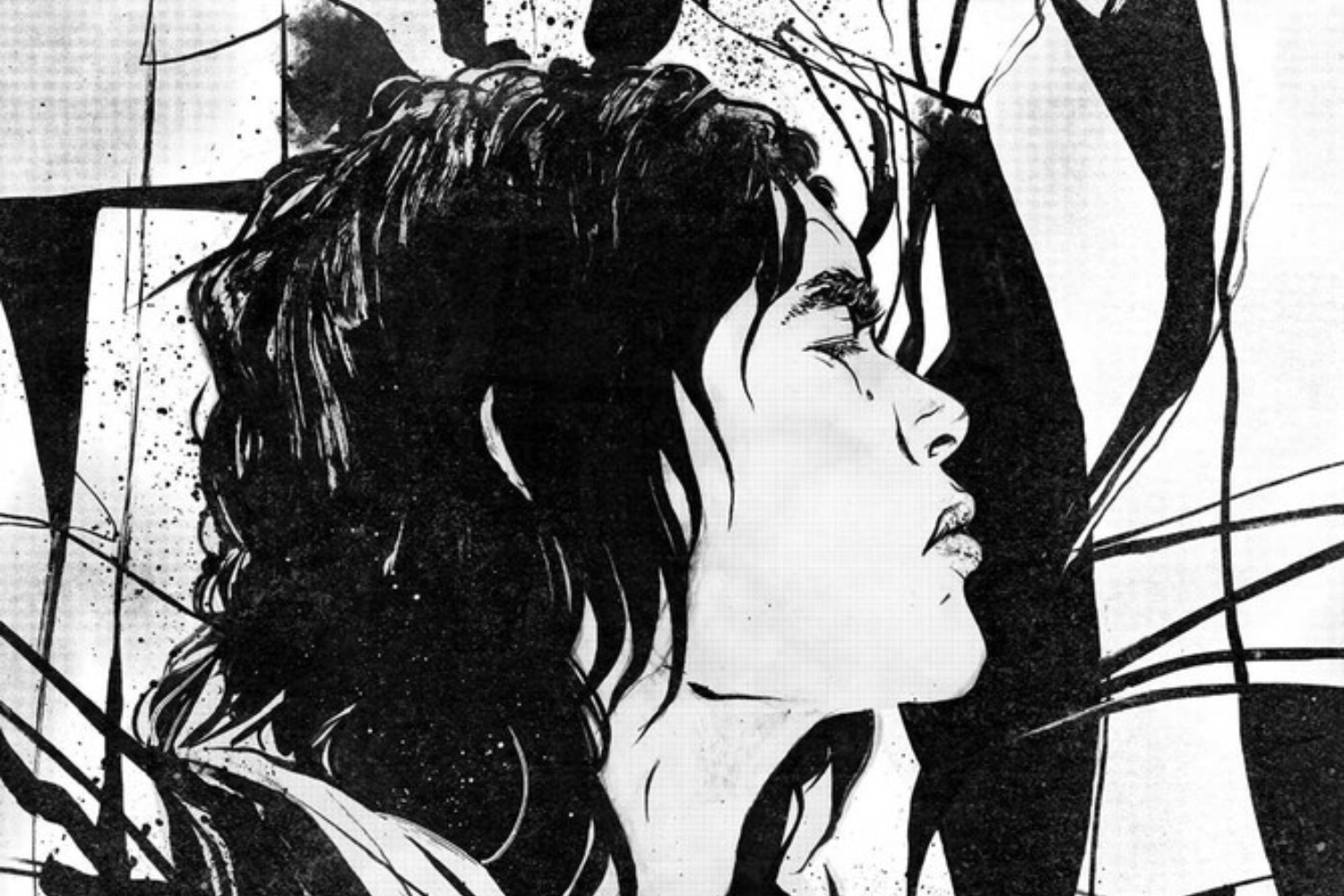

When he once gave Batman “vampire teeth,” I knew Paul Pope was somebody utterly special.
Admittedly, 2006’s Batman: Year 100 is just a small part of Pope’s rather sizable bibliography/contributions to comics. That list includes THB, Heavy Liquid, Battling Boy, and dozens of covers for most major publishers. With his sharp lines, inventive eye, endless style, and robust charm, Pope’s comics creations exist in a brighter, bolder world outside of our very own. They are, in short, that intense, slightly pulpy set of vampire teeth snapping at us from the edge.
If you’d like to delve deeper into all things Pope (and beyond his more well-known offerings), then you’re in luck. Starting this week, New York’s Philippe Labaune Gallery is hosting a career-spanning exhibit of all things Pope. There’s art from the aforementioned books as well as “homages to European artists such as Hugo Pratt and Moebius,” several personal works, and even non-comics work, including pieces for bands like Jon Spencer Blues Explosion and The Grateful Dead.
“When I do something, I want it to be timeless,” Pope said in a statement. “I don’t want to chase the zeitgeist — I want to create something that will feel relevant in 10 or 20 years.”
And the Pope-a-palooza continues with the recent release of PulpHope2: The Art of Paul Pope. Published by BOOM! Studios, the 300-page art book features sketches and unpublished work alongside “commentary that illuminate his creative process and influences.” (It’s basically a reprint of a long-out-of-print book, FYI.) It’s not just a “testament to [Pope’s] enduring legacy on comics,” but a chance for the artist to define his perspective/worldview in a way that you can’t always get from reading his stories.
The “Paul Pope Exhibit” runs from now through July 26 at the Philippe Labaune Gallery (534 W. 24th St., New York, New York). Meanwhile, PulpHope2 hit shelves back in March. (For even more on that book, Pope spoke with The Comics Journal earlier this spring.) In the lead up to both happenings, Pope and Labaune were kind enough to answer a few questions via email about the exhibit specifically. That includes Pope’s significance as an artist and his larger cultural impact, the true scope of his many works, and some of the exhibit’s standout pieces.

Courtesy of BOOM! Studios.
AIPT: What is Paul Pope’s overarching significance in the realm of comics and art? What makes him so unique in terms of vision and output?
Paul Pope: I have tried to always remain faithful to the “purity” of the essence of comics and cartooning, to gestural drawing, and to applying classical art techniques to my work. I gravitated early on to a brush, having long admired manga and European cartoonists. My formal training is in studio arts and art history, and I worked at a stint in commercial printing in my college years. I still make screenprints to this day. Between these various influences and creative prompts, I slowly developed a style which blends the best of manga, classic European BD, and American comics of the Golden and Silver Ages.
Philippe Labaune: Paul Pope occupies a singular place in the world of comics and visual art. What sets him apart is his ability to merge influences from across the globe—Japanese manga, European graphic novels, American underground comics—and merge them together into something wholly his own. His work has the kinetic intensity of manga, the elegance and nuance of bande dessinée, and the raw emotional immediacy of punk aesthetics, all filtered through a deeply personal lens.

Courtesy of Paul Pope.
But beyond the stylistic fusion, what truly defines Paul is the intention behind his work. He doesn’t just tell stories — he builds worlds. Whether it’s THB, Heavy Liquid, or Battling Boy, each world he creates is layered with political, emotional, and psychological depth. His brushwork is loose yet precise, expressive yet grounded in form. It’s this tension that makes his work so powerful.
AIPT: Philippe, what are the challenges and opportunities uniquely carried by organizing an art exhibit for Paul’s work? He’s done so much across purposes/mediums, and I’m curious how you curate someone whose work is so robust and boundary-pushing?
PL: What made the timing of this show perfect was the release of PulpHope 2. That book became a natural foundation for us. It’s not just a monograph; it’s a reflection of Paul’s interior world and creative evolution. Using the book as a guide, we were able to shape the exhibit as a kind of compact survey—one that touches on his major works like THB, Heavy Liquid, Batman: Year 100, and Battling Boy, while also giving space to more personal, experimental pieces.
The opportunity, then, lies in the range. Paul’s work is not bound by one style or tradition.
The challenge is editing. It’s also worth noting that presenting Paul’s work in a gallery setting lets viewers engage with the pages on a different level. You can see the ink, the corrections, the tension in the line. I think that experience — the ability to be close to the process — creates a deeper appreciation for just how much Paul has contributed to the language of comics and visual art.

Courtesy of Paul Pope.
AIPT: Paul, what does this kind of “forced” retrospection do for you while still working as an artist? Is it good to look back as you continue doing something fresh/new?
PP: I’m not sure what you mean by “forced” in this context. The exhibit came out of a generous offer from Philippe to showcase art from the new monograph and to represent some of my best or most recognizable works in a well curated gallery setting. I’m also at a sort of midway journey in my own travels as an artist, so the book is designed to be a “guide” for younger artists who are finding their own paths in the creative world. I tried to expose some of the thoughts and fears and aspirations which other artists may relate to as they forge their own creative identities. It’s a sort of artist’s confessional.
AIPT: What is the single most important/interesting piece from the exhibit and why? (I’ll allow you up to two pieces if that makes it easier somehow.)
PP: I couldn’t say, really. It’s like publicly preferring one child over another. Each piece stands as a marker in time, and I have many emotional threads linking me back to each work. I might say the two Native American tributes to Hugo Pratt are favorites, as is the portrait of my girlfriend Neha, which was done in the height of COVID when we couldn’t see each other for months at a time.
PL: It’s tough to choose just one, but if I had to, I’d say the Lone Wolf piece. It’s beautifully composed — the wolf centered the way that it is. The line work is masterful, full of tension and grace. It’s quintessential Paul Pope: expressive, moody, and unmistakably his, yet you can also feel that European influence woven in. I love that piece so much — I could lick it!

Courtesy of Paul Pope/Vertigo.
AIPT: How much of this is about further cementing comics as this massively valid artform, or does that not factor into your thought process or planning at all?
PP: It’s amazing comics and comic book art are being taken so seriously now. It’s taken a long time for Americans to catch up to Europeans and the Japanese/Chinese on this front. Philippe’s gallery is becoming a crucial piece of the New York art scene, so this is a perfect nexus of ambitions and opportunity. We want as many people to come and see the art and to appreciate the work in its own right. Not just for my work, but for the art of narrative visual storytelling as a medium special unto itself. It’s a universal visual language at this point, and the original artwork has value.
PL: It’s absolutely a part of our thought process — and honestly, it’s at the heart of what we do at the gallery. One of our core goals has always been to elevate the medium of comics and to create space for these works to be appreciated as fine art. Comics are one of the most powerful and democratic forms of visual storytelling we have, and artists like Paul Pope prove just how expansive and expressive the medium can be. So, with every exhibition, we’re thinking about how to further legitimize comics in the broader art world. It’s not about making comics something they’re not — it’s about giving them the critical and cultural platform they’ve always deserved.
AIPT: Paul, do you have an idea about how this exhibit might inform or encapsulate your legacy? What kind of message do you hope it sends to you as an artist?
PP: At a certain point, I think an artist needs to become their own curator. You have a body of work, it has merit, people appreciate it, and you want to share it. Being able to share the original art in a gallery setting in the heart of Chelsea’s art scene is a perfect blending of intention and showcase. It isn’t that often people can look at the original drawings and comic book pages up close, eraser markings and mistakes, penciled liner notes on the sides of the pages and all. It’s intimate and rewarding.

Courtesy of Paul Pope.
AIPT: Is there anything else we should know about this exhibit, comics, Paul Pope (human and/or artist), art, etc.?
PP: There are some clues toward my future works in this exhibit. I have a number of new and current projects in play now, most of which I can’t discuss yet. So we’ve seeded some hints in the body of work on show. I’m actually sort of a shy person, so if it wasn’t for the prompting of Neha and Philippe making this offer, the show would not have likely happened! Also, we’ll have autographed copies of PulpHope2 at the gallery for those interested.
PL: I think what’s most important to share is that beyond being an extraordinary artist, Paul is a truly generous and thoughtful person. He cares deeply — not just about the craft, but about the emotional weight his work can carry and how it connects with people. He’s someone who pours himself into every page, every brushstroke, and that sincerity comes through in the art.
Paul’s significance also lies in how he’s pushed the boundaries of the medium itself. His work challenges what comics can be, both in structure and in spirit. He’s opened doors for new generations of artists to think beyond the frame, to embrace hybridity, and to approach comics as a legitimate form of fine art. That’s why presenting his work in a gallery context feels essential.



You must be logged in to post a comment.