

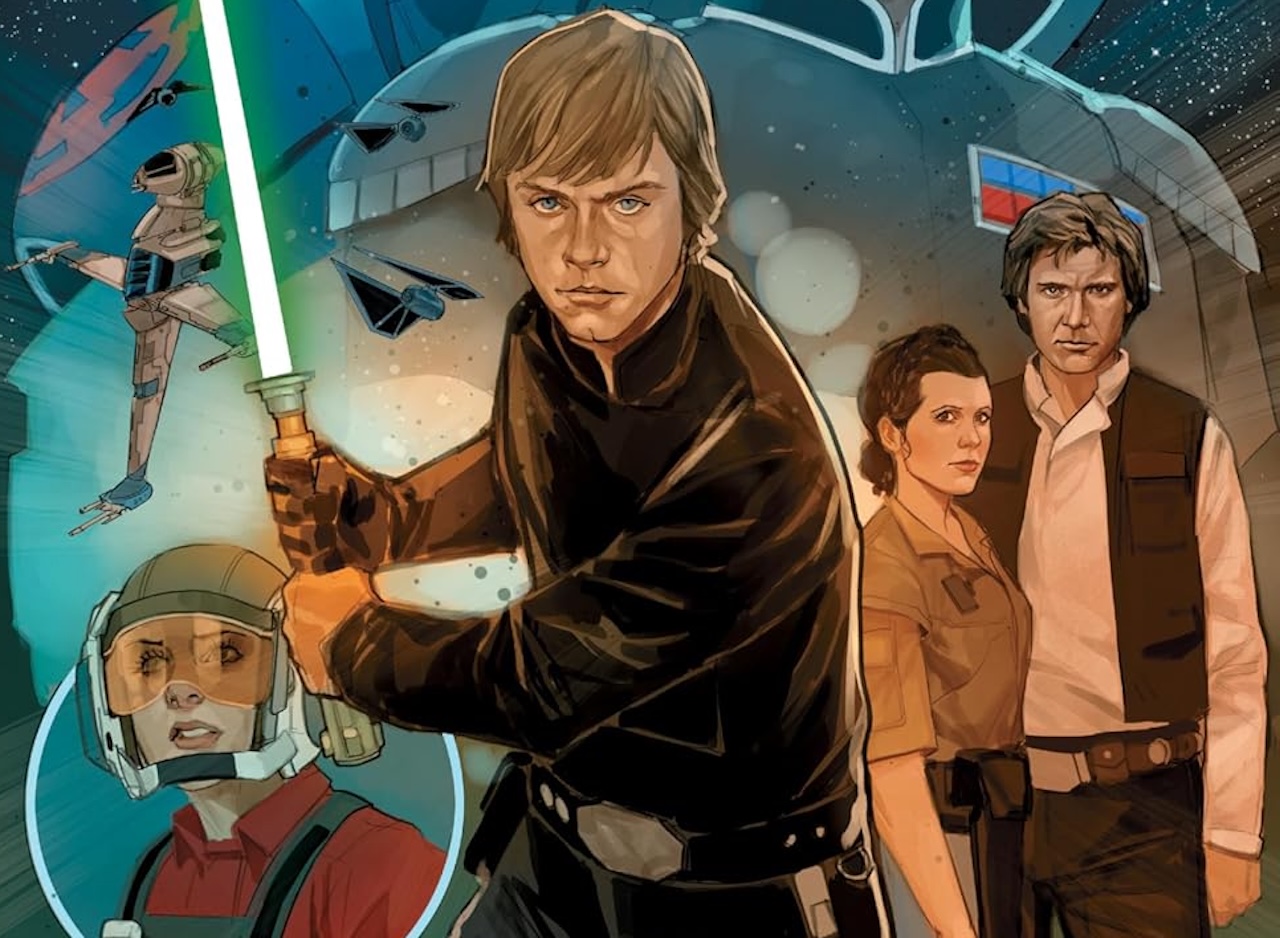

Marvel recently restarted their entire Star Wars line, promising to show the events following the end of Return of the Jedi in current continuity. To prepare for this anticipated new era, fans were treated to the final battle against the Empire with a 12-issue arc, bringing finality to the Galactic Civil War. Told across three miniseries and packed into one trade paperback, the story aims to fill in canonical gaps and expand on a pivotal moment often referenced in other Star Wars media. Despite its ambition and deep ties to the broader Star Wars mythos, the book feels oddly small in scope, content to sketch broad events rather than plunge into their emotional or strategic depth. While competent in its execution, it feels forgettable considering the scope of the battle, even while the art and writing is perfectly enjoyable.
The trade collects three miniseries: Insurgency Rising (#1–4), Republic Under Siege (#1–4), and Last Stand (#1–4), forming a continuous arc that spans the weeks following Endor. As Leia and Mon Mothma try to unite fractured systems under the New Republic banner, a vengeful Imperial warlord launches a surprise offensive centered around Jakku. Luke is drawn into a separate hunt for a missing Jedi relic, uncovering hints of darker forces at play. The story weaves in underworld dealings, fleet-scale conflict, and some character-driven detours, including a quiet subplot involving the birth of Ben Solo. Structurally, it’s clean and readable, though the individual arcs don’t always build momentum as effectively as they might. I would have preferred this was done as a single 12-issue series, as having three dueling miniseries for a story of this nature feels clunky in its design.

Marvel
Alex Segura’s writing is serviceable and at times strong, especially when he taps into Leia’s internal conflicts or Mon Mothma’s political tightrope-walking (having just finished Andor, I was happy to get more Mothma characterization). Dialogue is generally solid, if a little stiff at times, with some effective emotional beats scattered throughout the final issues. There’s clear respect for the material and its broader place in Star Wars continuity, but the pacing struggles under the weight of trying to serve both epic galactic shifts and intimate character stories. The result is a script that often plays it safe. It’s efficient and readable, but rarely memorable.
The artwork, while capable, is split across multiple artists. This is rarely a good sign, but it is stylistically consistent. It looks like current Marvel house style associated with Star Wars comics, with clean line work and cinematic-worthy panels. The art’s at its best during wide-angle space battles or tense political standoffs. Action is easy to follow, and the characters are recognizable without being too photo-referential. The visual storytelling does a lot of the heavy lifting in moments where the script sags. That said, there’s little visual experimentation or stylistic flair here; it’s workmanlike art that hits the Marvel house style mark and rarely steps outside it.

Marvel
In the end, Battle of Jakku is a respectable if unremarkable entry in the expanding post-Endor timeline. For lore completists like myself, it’s well worth reading to see the final moments of the Empire as their plans come crashing down. If you liked the Aftermath book trilogy or the Battlefront II game, there’s a lot to appreciate, especially in how it ties together long-dangling threads and teases new narrative threads. But for a story meant to dramatize the final nail in the Empire’s coffin, it lacks the weight and distinctiveness that such a tale demands. It’s a decent bridge in the canon but might not be essential for those not well-versed in the Star Wars expanded universe.




You must be logged in to post a comment.