

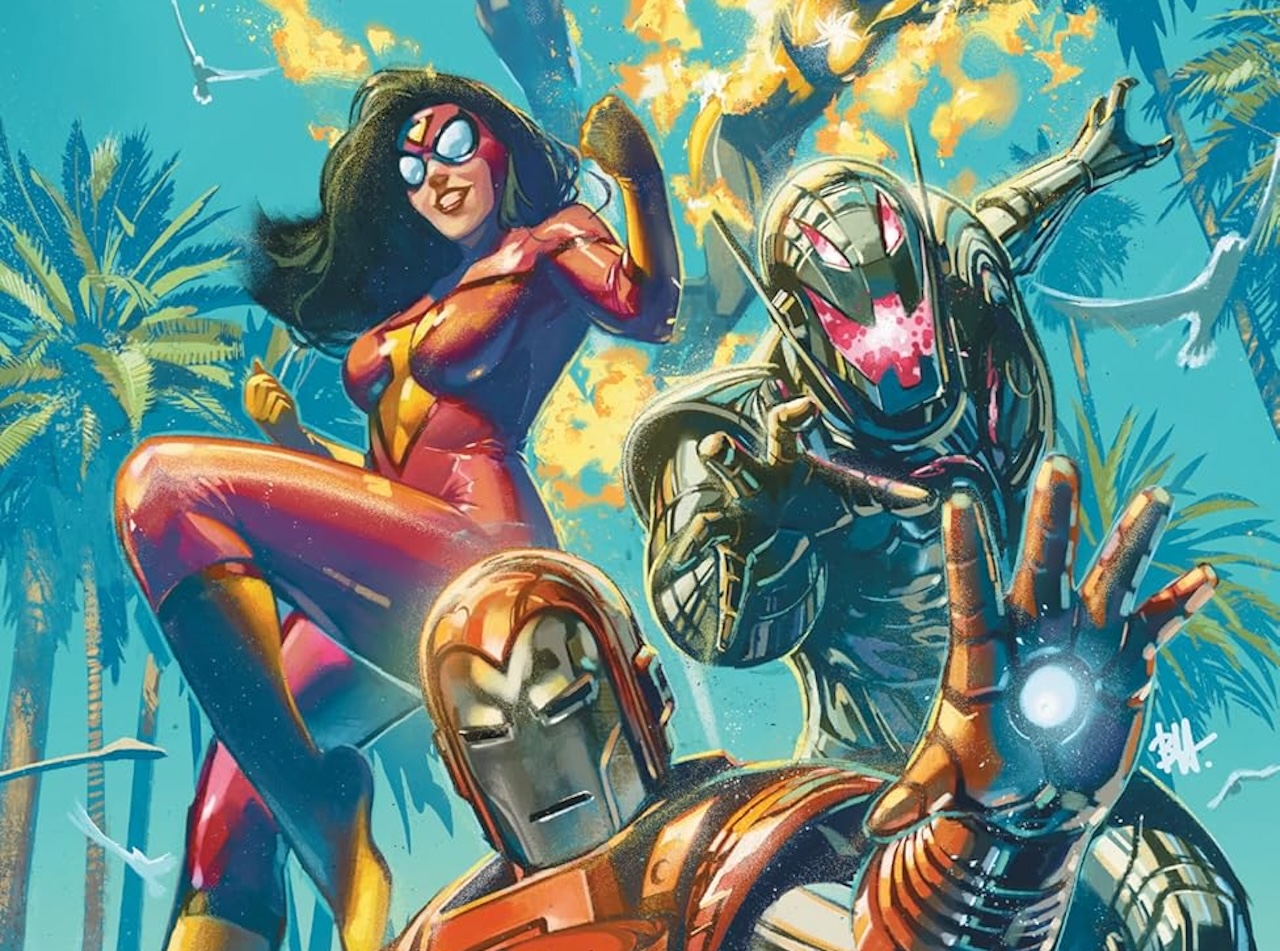

West Coast Avengers is trying to be a big book – it anticipates its own longevity.
Which is to say that the first few issues, collected in The Gospel of Ultron, set up a number of plot threads that expect long-term germination for any eventual satisfying conclusions. From the book’s central conceit – Tony Stark and James Rhodes putting together a team of heroes whose goal, ultimately, is to rehabilitate supervillains, including a version of the once-genocidal Ultron – to a personal growth arc laid out for the PTSD-laden Firestar, the book needs room to stew on its plans.

Marvel
That’s a lofty endeavor for an industry that isn’t exactly letting books come to fruition on their own terms. Books with similar ambitions – like last year’s X-Factor by Mark Russel and Bob Quinn, which launched around the same time as West Coast Avengers– are consistently finding themselves cut short before much can be made of their simmering plot points. We’re no longer in a market that rewards lengthy goals.
That might be fine for an exceptional book, one with tight writing and a superstar artist, but West Coast isn’t exactly that: while artist Danny Kim is talented and consistent, he isn’t providing work here that feels in any way revolutionary or trend-setting. Writer Gerry Duggan – much more a ‘name’ in the business – hasn’t quite tailored the book for the industry’s now-compulsive trade paperback standard; we can argue back and forth for days about whether or not designing narrative around easily-collected five-issue arcs is good, but the fact is that’s the model we’ve been working with for years. The Gospel of Ultron does little to resolve itself, long-term ambitions or not.

Marvel
None of this makes West Coast a bad book – there’s a lot going on here to like. The team’s got an interesting roster, for one (though not all of them get a lot to do in the first arc), and the current state of Ultron is deeply compelling: split into various bodies, each with their own goals and philosophies. The set-up deserves the potential for a narrative long-haul; whether The Gospel of Ultron supports that long-haul is another question.
The book’s most interesting hook doesn’t get much play, however: the second Ultron has created a religion, sprouting angel wings and grafting the heads of disenfranchised humans to duplicates of his body. These sequences are interrupted by a less-compelling plot featuring Hydra Cap; neither story manages to fit within this format. This is not a failing of the book, but of the larger industry standard.
What The Gospel of Ultron leaves the reader with is an uneasy hope for the future of its completion. The comic has at least another five issues to wrap up these ambitious threads – issue #10 hits stands next month – but with heavy-handed concerns like Firestar’s alcoholism might not be able to be handled delicately or satisfyingly within that space. Fingers crossed.




You must be logged in to post a comment.