

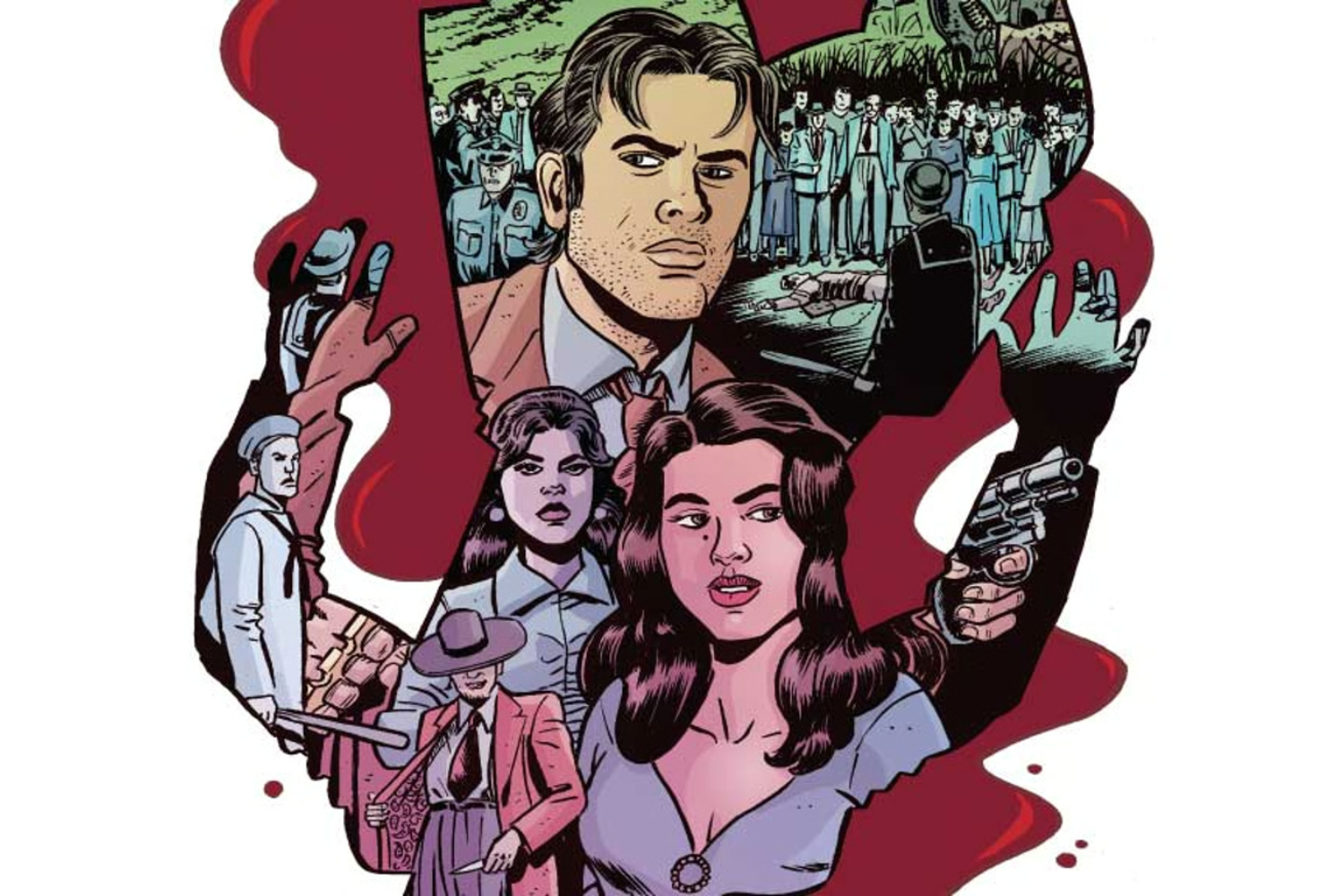

Henry Barajas is my kind of writer.
When we spoke about Death to Pachuco, he had all kinds of insights to share. Like how this book connects with real people and histories, and how he wanted to be sensitive to that in scripting the story. Or, that the Los Angeles of the 1940s was a true cultural melting pot, and this book is as much about Chicano culture as it represents black influence and histories.
But there’s one idea, expressed toward the end of our little chat, that really stood out:
“…I want people to know this is coming from a place of love as much as it is a place of frustration that things haven’t changed much in the last 80 years.”
It’s that very energy and approach that really makes Death to Pachuco so profoundly compelling and utterly vital.

Courtesy of Image Comics/Top Cow.
Because, yes, this is very much a robust celebration of Chicano heritage. And it’s not even Barajas technically leading the charge — artist Rachel Merrill and colorist Lee Loughridge find the right design choices for the Zoot suits, alongside the quaint-but-imperfect architecture of the city, to bring us into history firsthand. And through that process, we can feel the excitement and uncertainty, passion and intrigue that was pushing L.A. of 1943 ever-forward. It’s good to see that this isn’t just Barajas’ book-baby, and his creators have built this vivid, organic world for him to then fill and extend.
And, in many ways, so much of my adoration simply comes from the visual feel and tone of this world. As someone who grew up primarily with Mexican-Americans (albeit in Phoenix), I can look out even on this “version” of L.A. and see the warmth, down-home vibes, and communal might of these people and connect that to my own experiences. It a dynamic that makes this book very real, and I feel my own emotions and connections travel back in time to explore their roots and delve into a vital moment in history.

Courtesy of Image Comics/Top Cow.
At the same time, we never once forget that this is a story not just of the light and love within Chicano culture, but in a moment where things were on the verge of a violent social explosion. I won’t get too deep into the Sleepy Lagoon murders, and the corresponding fallout from that event. (Barajas’ narrative does a damn fine job getting everyone up to speed but while making this a folk story and not just another bland history lesson.) There’s real stakes and actual pain at the heart of this story, and Death to Pachuco brings us in with honesty and integrity.
Barajas has a few tools to do just that, and chief among them is the use of Spanglish. In some ways, it’s generally charming to read, and fits nicely with the well-tailored Zoot suits to immerse us quickly and effortlessly into this unique world. Still, Spanglish can be jarring if you didn’t grow up with it, and that’s likely the point. It’s how Death to Pacheco can best show us 1) how Chicanos were trying to integrate but also maintain their own cultural practices and 2) how that encapsulates a certain tension that put them needlessly at odds with local whites (mostly the sailors and servicemen who saw their presence as some affront to American values).
It’s a kind of “cultural melding” that’s also used elsewhere in the book — during a march by the Klan in the sundown town of Pasadena, we see the kinds of people who are really enforcing these “rules,” and that focus on cultural interactions and social dynamics is used to heighten the tension and show just how dire it was for Chicanos back then. (There’s also this stylish sheen to that march, and the “appeal” really heightens how awful this scene is and just how it was regarded at the time.)

Courtesy of Image Comics/Top Cow.
Yet perhaps the best tool of Death to Pachuco is our lead, private eye Ricardo “Ricky” Tellez. Barajas had said he was born to be a detective, and that he’s equal parts appealing and dangerous. That’s Ricky to a tee, and he rides the line brilliantly between these cultures and this vibe of celebration but also maintaining an unflinching crime story. (Once again, the art team nails Ricky’s whole look, and the fact that he feels balanced between his role as gritty P.I. and Everyman Chicano is at least 12% of his success and effectiveness as a lead.) Ricky speaks and moves like he should be in a Dashiell Hammett novel, and yet you never forget who is and want he wants to do. (Which is help his people even as he knows that being non-white means he’s inherently in danger.)
He’s troubled but charming, detached but dedicated — in many ways, he’s the best encapsulation of this book’s ability to balance ideas and cultures and also explore ideas of cultural integration, meaningful diversity, and even questioning certain cultural norms to continually push upon what we actually consider Americans. (That’d be all of us trying to make a go of it in a nation that wants to chew us up and spit us out.)

Courtesy of Image Comics/Top Cow.
And, sure, Ricky does feel like he stands out a bit too much — he certainly dominates most scenes even as some other characters also feel a little under-developed at this point. Similarly, I don’t think this debut did enough to set up some key elements, like a possible, story-defining big bad (a must-have in a proper noir) as well as giving us more of a thrilling end for this first chapter. (Still, that may have been a deliberate choice as it speaks to a certain tonal comfort zone and pacing for this book, but the issue nonetheless ends a little abruptly.)
But I won’t hold any of that against Death to Pachuco so far as it really is a breath of fresh air in an increasingly crowded shelf of crime comics. That’s because it knows where it came from, what it’s about, where it wants to go, and the things it’ll do and say along the way. It’s my kind of comic, and if you give it a chance, this stylish, substantive piece of noir just might win your heart outright.




You must be logged in to post a comment.