


You may see zoot suits and only think about that ridiculous ska revival of the ’90s. But students of history will likely turn back to the Zoot Suit Riots, which in the early days of June 1943 very nearly ripped apart Los Angeles.
At the heart of the riots were clashes between Mexican-American (or Chicano) teens and young people and the predominantly white U.S. servicemen stationed in the City of Angeles. These confrontations came about for a number of reasons, with tensions high due to wartime shortages and general anti-Mexican sentiments gaining in prevalence. But a massive driving force was the Sleepy Lagoon murder trial, with the 1942 death of José Gallardo Díaz serving as an especially visceral focal point for the growing injustices experienced by the local Mexican population.
But history never truly stays in the past, and we’re living in a day and age right now where this same kind of rhetoric and societal violence is used to diminish and harm Latin communities across the country. But as we’ve done now and even way back then, we turn to stories for help and guidance, and that includes the forthcoming Death to Pachuco.
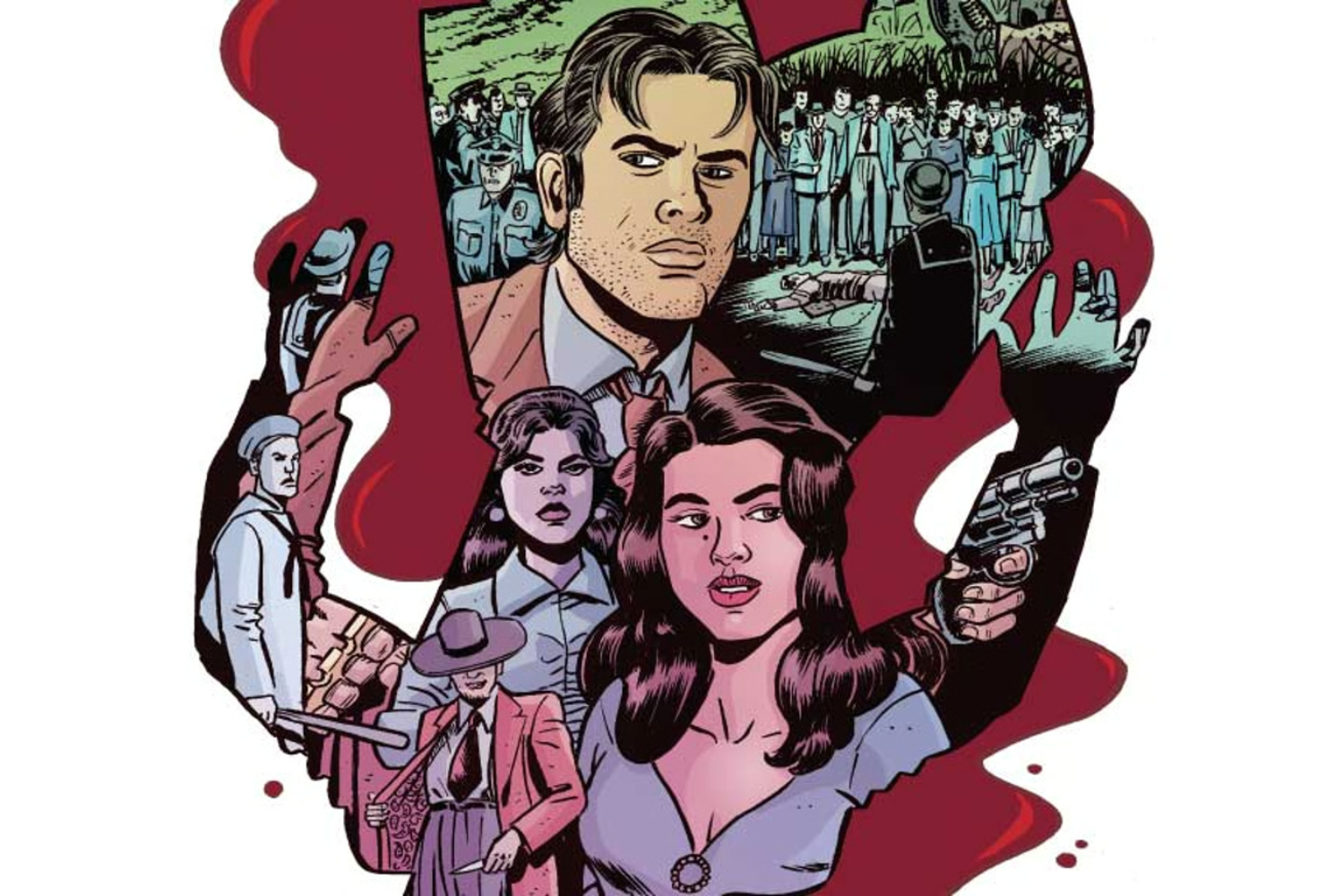
Written by Henry Barajas, and with art by Rachel Merrill and Lee Loughridge, Death to Pachuco holds no punches in exploring our country’s history of anti-Chicano sentiments. (The book’s “tagline” or “mantra” is “It’s a bad time to be a Mexican.”) As clashes rock L.A. proper, we follow P.I. Ricardo “Ricky” Tellez as he tries to “find the Sleepy Lagoon Killer before the racist mob kills him in the Zoot Suit Riots.” As thrilling as it is unrelenting, Death to Pachuco is a solid piece of noir but also so much more still.
By lightly playing around with history (but never in a way that changes or mitigates this vital moment), Death to Pachuco lets readers understand a moment in time and its reverberations to this very day. It’s a story that may feel flashy and exciting like all great crime stories do, but at its core is this unwavering dissection of what happens when we deny a people their right to grow and flourish and to ultimately add their part to our “nation as a living experiment.” Without lecturing, but rather enthusiastically exploring history, Death to Pachuco brings this historical moment home in ways that might forever alter your very perceptions.
Death to Pachuco #1 is out October 8. (If you can’t wait, you can read a black and white version right now over at Image Comics.) Ahead of the release, we connected with Barajas via email to answer a few burning questions. That includes Chicano representation in comics/art, personalizing the book’s historical interests, the development of our P.I. Tellez, and some big story beats/moments.

Variant cover by Katie Skelly. Courtesy of Image Comics/Top Cow.
AIPT: I’d love to, however briefly, talk about the Chicano presence in comics. How do you think most publishers have fared regarding proper representation, and has that improved at all in the last 10-15 years?
Henry Barajas: I always air on the side of there’s more work to be done and published. I hope we come to a point where Chicano, Latino, Latina, Latine, Latinx, or whatever the preferred nōmenclātūra is given the same respect as any other storyteller. Death to Pachuco at its core is a noir just like how Guillermo del Toro’s latest Frankenstein remake is a horror not “Latino Frankenstein.” But I would be a liar if I didn’t say the publishing space has made great strides while regressed drastically. We are seeing more and more BIPOC and LGBTQIA+ creators tell get work, but the status quo is still predominantly cis white people because they’re proven to what “sells.” If publishers and editors don’t look outside of the proverbial box, they’ll keep getting the same results.
AIPT: There’s also a solid tradition of Chicano noir. What defines some of these stories and heroes versus more familiar writers like, say, Raymond Chandler?
HB: The compass will always point north towards the godfather of Pachuco comics: Marco Finnegan. He came out with his latest series, Calavera P.I., last year, and I cursed under my breath because I wanted Death to Pachuco to be the new shiny Chicano noir on the spinner racks. But it helps that there are more comics like Calavera in the market to show that there is, in fact, a market for this flavor of genre. Don’t be surprised when more of it hits the shelves in the near future. I know Lalo Alcaraz has been teasing his Pachuco comic, and I’m excited to read that.
I think we’re still defining these stories in the comics space. There’s not enough stuff out there like Death to Pachuco, so I hope this gives publishers the permission to play in this sandbox.

Courtesy of Image Comics/Top Cow.
AIPT: There’s a couple key references mentioned in the press for the book: Luis Valdez’s Zoot Suit and James M. Cain’s Double Indemnity. Can you talk about how those filter in, and are there other cultural touch-points?
HB: The reason you can’t make Dracula comic without filtering through Bram Stoker’s original vision…there is no Death to Pachuco without Zoot Suit. It’s the closest thing to live footage from the event. Thankfully, I’m used to making regular visits to the Library of Congress and the various branches in Los Angeles, so I could glean from the various text and newspaper articles. But Luis Alvarez’s incredible play and film adaptation is a beautiful artistic response to an important American tragedy that doesn’t get its fair shake.
AIPT: What’s so compelling about this period in time and this case for you personally? It feels like it was so transformative in how this group of people was assimilating (or not) into the larger culture.
HB: What fascinates me is that these zoot suit riots were happening all around the country. But there was no social media for everyone to get inspired. Black jazz musicians were going from town to town inspiring young minds. The fact that the “pachuco” is said to be originated in south Texas, and it make it across to East L.A. will never have me stop wandering. But there’s something to be said about how Black culture has defined fashion and music in the states. Everyone’s wearing Air Jordans now. I love exploring these themes, and I’m glad I get to talk about it in my comics for the first time.

Courtesy of Image Comics/Top Cow.
AIPT: What are some of the challenges and opportunities about writing about a specific segment of history? Is it OK to rework something like Sleepy Lagoon in the name of art/storytelling, or is that process complicated?
HB: The challenge is that real people were harmed and one person died. I wanted to respect that while trying to tell an engaging story. I wanted the same runway storytellers get when they rework the Holocaust, storming Normandy, slavery, or any historical event. I don’t want to be boxed into writing exclusively about border trauma or drug cartels. Not only that, but I want to talk about American history, too.
AIPT: There’s obvious parallels between what happened with Chicano/Mexican communities in the 1940s and right now. Is it hard to tap into this moment in that way, and how do you balance fiction with real life struggles and loss?
HB: I’m from an hour away from the Mexican border. The first pages of La Voz De M.A.Y.O. addressed deportations and families being torn apart. This isn’t new to me and people like me, it’s just now happening in rich white neighborhoods. Now you can’t unsee it. People are forced to turn a blind eye to something that was exasperated by the Clinton administration. Obama was known as the “Deporter-in-Chief.” Migrants and undocumented people have been bargaining chips for so long to placate GOP lawmakers to make sure kids are given free lunches and Medicare. But the chickens have come to roost, and now it’s everyone’s problem.

Courtesy of Image Comics/Top Cow.
AIPT: What was it like working with Rachel and Lee? What did their skill and perspective do in helping to shape this story?
HB: Rachel has something to prove. We want to show what we’re made of, and we make a great team. She can read my mind sometimes, and that makes for a good collaboration. She’s also good at taking direction and looking at the page with my lenses, but I know when to step back and let her cook. Lee is a legend. He is the quickest colorist in the business. Lee is a freakin’ pro. But he is a vibe want to be associated with. When you see Lee and Will Dennis’ name on the cover, you know it’s going to be a comic worth picking up.
AIPT: Ricardo seems so perfectly formed in the debut issue. How would you describe him, and what makes him such a compelling lead in the tradition of great PIs?
HB: Ricky Téllez was born to be a detective. We’ll get more painfully sad details about his life, but where he thrives is when he’s trying to solve a crime. He’s in Los Angeles in the 1940s for Christ’s sake. He’s taking the jobs no one wants in the parts of town other Dicks are afraid to go. I think that’s what makes him more appealing and dangerous.

Courtesy of Image Comics/Top Cow.
AIPT: I love the use of Spanglish and straight up Spanish here. Can you talk about why that’s so important— it’s not just historically accurate, but I think it helps readers with immersion and connecting to these characters.
HB: I grew up with Spanglish. My nana would be talking at me in English and Spanish all the time. Everything I write is for her even though she’s not with us. It kills me I can’t show her this comic in particular because I know she would like it. I think the Spanglish really sets us apart for everyone else. I want this to stand on its own and not be a Chinatown rip-off. These are also first-generation American characters mostly. They are growing up in Spanish speaking house holds while operating in WWII era Los Angeles. They had to code switch for survival no matter where they were.
AIPT: Do you have a favorite moment, panel, and/or page from issue #1 — something that speaks to the core of this story?
HB: I love the first page where the police are rounding up the Mexican people because those are based on real reference photos. The guys going in the bus is real. The men and women in the police line ups are based on real photographs. This show the gravity of the situation. There are real stakes, and Ricky’s going to have his work cut out for him in this series.

Courtesy of Image Comics/Top Cow.
AIPT: What twists and turns can you tease regarding the rest of the story?
HB: I’m primarily known for writing all ages educational material. This is my first “rated R” story. There is a lot of violence, racism, sexism, and a sex scene. I tried to warn readers on the credits page. But there also be some celebration of the Mexican and Black people. There’s a cool dance scene I can’t wait for readers to get to. It’s kinda an ode to the Matrix Reloaded scene where everyone’s dancing in Zion.
AIPT: Is there anything else we should know about Death to Pachuco, history, Zoot suits, comics, etc.?
HB: This is a comic for anyone that loves true crime and film noir. And I wanted to write a love letter to Los Angeles since I just celebrated 10 years of living here. There’s a lot of references to the original names for certain burroughs, and I want people to know this is coming from a place of love as much as it is a place of frustration that things haven’t changed much in the last 80 years.


You must be logged in to post a comment.